North Korea plays a Significant Role in Ukraine-Russia War
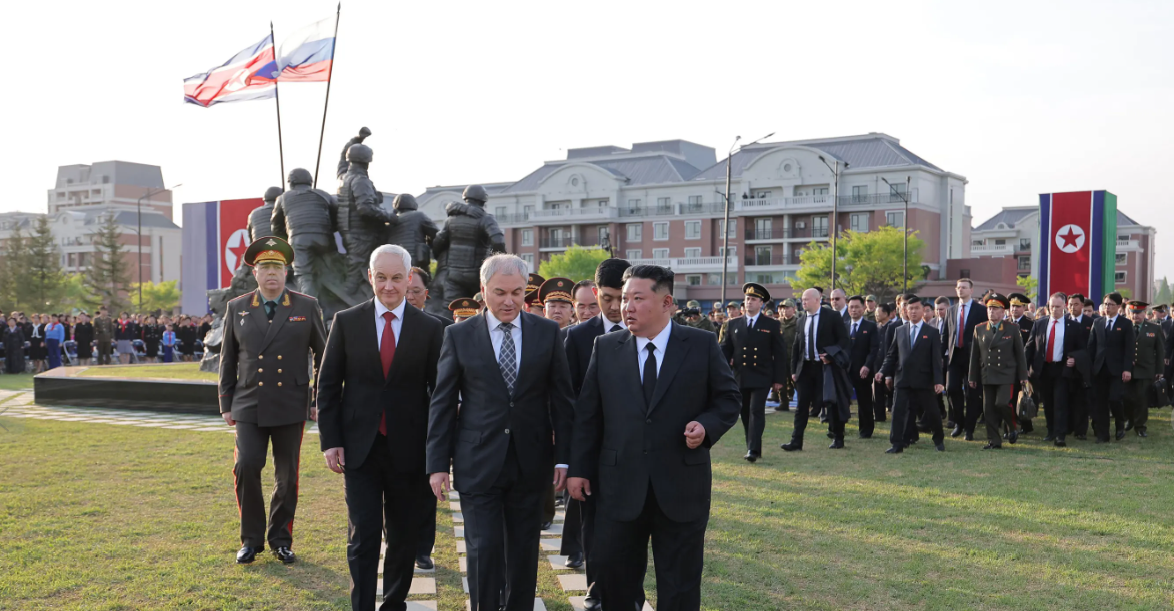
North Korea’s role in the Russia–Ukraine war has evolved from opaque, deniable support into something far more visible: a publicly acknowledged military partnership that includes matériel, personnel, and state‑orchestrated commemoration. Recent reporting describes Pyongyang not only sustaining Russian battlefield consumption with ammunition flows but also turning its involvement into formal symbolism—memorial sites, ceremonies, and official messaging that frame participation as national sacrifice.
1) Material support: ammunition as the backbone
A defining feature of North Korea’s behavior is its apparent willingness to function as a high‑volume supplier of Soviet‑caliber ammunition to Russia. A Reuters‑linked report (carried by The Moscow Times) described Russian unit documents and open‑source research indicating Russian artillery units relied on large shares of North Korean shells, with estimates of millions of rounds shipped by sea from North Korea to Russian ports. A separate analysis from the Royal United Services Institute (RUSI) similarly describes sustained deliveries since 2023, arguing that North Korean ammunition shipments materially helped Russia maintain artillery intensity across phases of the war.
This pattern suggests Pyongyang is behaving less like an occasional arms trader and more like a strategic sustainment partner—a role typically reserved for states willing to accept sanctions risk in exchange for geopolitical leverage and reciprocal benefits. The scale described in these sources is not marginal: it’s framed as war‑shaping logistics.
2) Troops: from allegation to commemorated deployment
Beyond ammunition, reporting in April 2026 centers on a striking public signal: North Korea opened a memorial museum in Pyongyang honoring North Korean soldiers killed while fighting alongside Russian forces. The Associated Press account (republished by News10 ABC) describes the event as attended by senior North Korean and Russian officials and notes KCNA’s description of ceremonial acts at the site. Reuters coverage (republished by NBC News) likewise describes Russian officials attending a completion ceremony for a memorial honoring North Korean soldiers killed in Russia’s Kursk region.
Importantly, reported troop numbers and casualties vary by source and should be treated as estimates. Reuters‑sourced reporting cites estimates of roughly 14,000 troops deployed with more than 6,000 killed (attributed to South Korean, Ukrainian, and Western officials). AP‑sourced reporting cites South Korea’s intelligence estimate of about 15,000 troops deployed and 2,000 killed, while noting Russia and North Korea have not disclosed official figures.
The key behavioral shift here isn’t the exact number—it’s the choice to memorialize, which makes the deployment harder to treat as a temporary or purely deniable arrangement.
3) Institutionalization: planning beyond the war
North Korea’s behavior also appears oriented toward long‑term structure, not just immediate battlefield transactions. Reuters‑sourced reporting states that Russian defense officials discussed putting military cooperation on a “stable, long‑term footing,” including a cooperation plan for 2027–2031. AP‑sourced reporting similarly references Russian state media indicating readiness to sign a military cooperation plan covering 2027–2031.
This matters because it implies behavior designed for a post‑Ukraine‑war horizon—a partnership that expects to persist, evolve, and normalize as a standing channel for military collaboration rather than a wartime exception.
4) What Pyongyang appears to seek in return
The reporting consistently frames the relationship as transactional and strategic. In the AP‑syndicated account, North Korea’s supplies of troops and conventional weapons are presented alongside the belief—attributed to outside governments—that Pyongyang receives economic and other assistance, with concern that transfers could include sensitive technology. Reuters‑sourced reporting likewise notes that, according to South Korean intelligence assessments, North Korea has received economic and military technology assistance in exchange for troops and munitions.
Bottom line
Taken together, North Korea’s behavior in the Russia–Ukraine war can be described as: (1) mass sustainment support through ammunition, (2) participation via personnel deployment (reported/estimated), and (3) deliberate political messaging that elevates involvement into public legitimacy, including memorialization and multi‑year cooperation planning. Whether the war’s frontlines shift or not, the documented trajectory points toward a partnership that is becoming more formal, more public, and more durable than a short‑term supply arrangement.