NATO's Most Dangerous Blind Spot? The Drone Lessons Ukraine Learned in Blood
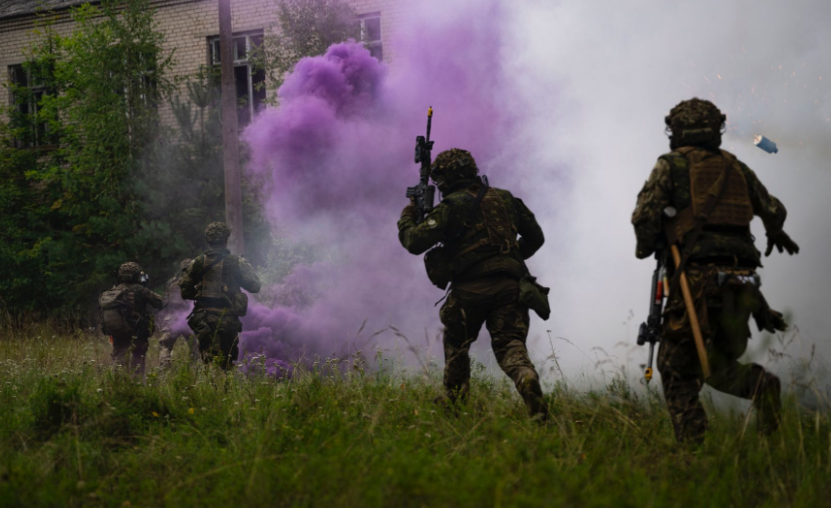
A photograph can sometimes reveal more than a military exercise.
This week, images emerged from NATO's Multinational Brigade training activities in Latvia, near the Belarusian border. The exercise focused on territorial defense, rapid reinforcement, multinational cooperation, and critical infrastructure protection.
On paper, everything looks right.
In reality, one image raises an uncomfortable question:
Has NATO truly absorbed the lessons of Ukraine's drone war?
The reason is simple.
The battlefield has changed faster than military culture.
The Battlefield Is Always Watching
The war in Ukraine has fundamentally transformed how military professionals think about survivability.
For decades, soldiers were taught to think primarily about artillery, tanks, aircraft, and direct fire.
Today, there is another threat present at all times.
The drone.
Not occasionally.
Not during specific phases of combat.
Constantly.
Every concentration of personnel creates a signature.
Every vehicle creates a signature.
Every movement creates a signature.
And every signature can become a target.
The result is a battlefield where being seen is often the first step toward being attacked.
Sometimes within minutes.
Sometimes within seconds.
The New Rule: Dispersion Equals Survival
One of the earliest and most brutal lessons from Ukraine was that spacing matters.
Concentrated formations that once represented combat power increasingly represent vulnerability.
Groups of soldiers clustered together may have been acceptable in previous conflicts.
Today, they can become ideal drone targets.
A single FPV drone carrying a relatively small warhead can inflict casualties across a group.
A loitering munition can punish exposed concentrations.
An observation drone can direct artillery with unprecedented precision.
The lesson is not complicated.
The closer people are together, the more attractive the target becomes.
Ukraine demonstrated this repeatedly.
The armies that adapted survived longer.
The armies that failed to adapt paid heavily.
Vehicles Are No Longer Safe Havens
Another reality of modern war is the changing relationship between soldiers and armored vehicles.
Historically, armor provided protection, mobility, and psychological reassurance.
Today's drones have changed the equation.
Vehicles often attract attention long before dismounted troops do.
Thermal signatures.
Visual recognition.
Movement patterns.
Tracks.
Dust.
Electronic emissions.
Everything can contribute to detection.
In many situations observed during the war in Ukraine, remaining close to a vehicle after dismounting can actually increase risk rather than reduce it.
The vehicle becomes a beacon.
And the soldiers beside it become part of the same target set.
This does not make armor obsolete.
Far from it.
But it does mean that old habits can become dangerous habits.
The Fiber-Optic Challenge
Some military planners still imagine that electronic warfare alone can solve the drone problem.
The reality is becoming more complicated.
Russia and Ukraine are increasingly deploying fiber-optic FPV drones that do not rely on traditional radio-frequency communications.
Unlike conventional FPVs, these systems are not vulnerable to many electronic jamming techniques.
The cable physically connects operator and drone.
No radio signal.
No electronic signature to disrupt in the traditional sense.
The implication is significant.
Counter-drone defense can no longer depend exclusively on jamming systems.
Physical protection, concealment, mobility, detection, camouflage, kinetic interceptors, and layered defense solutions are becoming increasingly important.
The drone threat is evolving.
Rapidly.
Doctrine Is Lagging Behind Technology
History offers a recurring lesson.
Military organizations often adapt more slowly than technology.
The machine gun appeared before armies understood trench warfare.
The tank appeared before armies understood mechanized warfare.
The drone has appeared before many militaries have fully understood persistent aerial surveillance.
That may be today's challenge.
The technology revolution is moving faster than doctrinal evolution.
Exercises may still focus on bringing combat power together.
The battlefield increasingly rewards distributing it.
Commanders may still think about maneuver in terms of vehicles and terrain.
Modern warfare increasingly requires thinking about visibility and signatures.
The side that can see first often shoots first.
The Next War Will Not Be Ukraine
But It May Rhyme With Ukraine
No two wars are identical.
Any future conflict in the Baltics, Poland, or elsewhere would differ significantly from Ukraine.
Different terrain.
Different forces.
Different objectives.
Different technologies.
Yet some lessons appear universal.
Drones are no longer supporting actors.
They are central participants in modern warfare.
Every soldier is now visible.
Every movement is potentially observed.
Every concentration is potentially vulnerable.
The battlefield has become transparent.
The uncomfortable possibility is that some military organizations still train as if it is not.
The Real Question
The issue is not whether NATO can defeat drones.
The issue is whether NATO can adapt quickly enough to the reality they have created.
Ukraine has already paid for these lessons.
In blood.
The question now is whether others will learn from them.
Or repeat them.