Missile Strikes, Startup Deals, and Unbreakable Founders: Why Ukraine May Be Building the World's Toughest Venture Ecosystem
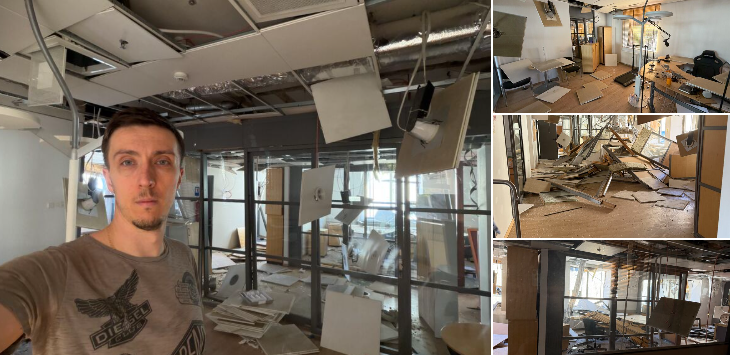
On Monday night, a ballistic missile erased a venture capital office from the map of Kyiv.
The conference room disappeared. The whiteboards vanished. The desks, monitors, and workspaces became rubble.
Yet by morning, the investment firm was operating again.
That simple fact may tell us more about Ukraine's startup ecosystem than any market report, valuation chart, or venture capital conference ever could.
The destruction of the ZAS Ventures office is not primarily a story about war.
It is a story about resilience.
Around the world, venture capital is associated with polished offices, networking events, startup incubators, and carefully managed risk. Investors gather in conference rooms, review pitch decks, debate market opportunities, and discuss innovation in predictable environments.
Ukraine operates under a very different model.
Here, diligence calls pause because of air-raid sirens. Product launches happen during blackouts. Contracts are signed at three in the morning because electricity has finally returned.
And somehow, companies still grow.
That paradox has become one of the most overlooked investment stories in the world.
Since Russia's full-scale invasion began, many observers assumed that Ukrainian entrepreneurship would freeze. The logic seemed obvious. War drives away capital, destroys infrastructure, disrupts supply chains, and creates uncertainty.
The reality proved more complicated.
Instead of disappearing, large parts of Ukraine's startup ecosystem adapted.
Founders relocated teams across multiple locations. Companies moved operations into cloud environments. Employees learned to transition instantly between normal working days and emergency conditions. Entire organizations became specialists in resilience, continuity, and rapid adaptation.
The result is a generation of entrepreneurs unlike almost any other.
Not because war is a good teacher.
It is not.
But because surviving and scaling a company under constant pressure produces a level of operational discipline that few founders elsewhere are forced to develop.
Every startup claims it can operate in uncertainty.
Ukrainian founders actually do.
That distinction matters to investors.
Resilience is often treated as a soft skill in business. In reality, it is a competitive advantage.
Markets change. Technologies evolve. Customers disappear. Supply chains break. Funding environments shift.
The founders who succeed are often not the smartest or the most connected.
They are the ones who continue operating when conditions deteriorate.
Ukraine has become a laboratory for exactly that type of leadership.
The destruction of an office illustrates the point perfectly.
A traditional evaluation of the event focuses on physical losses. Infrastructure damaged. Property destroyed. Workspace eliminated.
But venture capital's most valuable assets have never been desks or conference rooms.
Its real assets are teams, ideas, founder relationships, networks, conviction, and execution.
None of those were destroyed.
The office vanished.
The investment thesis survived.
That distinction represents a profound shift in how modern organizations think about risk.
The most valuable companies in today's economy increasingly own intangible assets rather than physical ones. Intellectual property, software, talent, communities, and expertise generate more value than buildings ever could.
Missiles can destroy concrete.
They struggle to destroy knowledge.
This reality is becoming increasingly important for global investors evaluating Ukraine.
Too many observers still see the country solely through the lens of conflict. They measure damage, risk, uncertainty, and destruction.
What they often miss is the extraordinary culture of execution developing underneath.
Some of Europe's most tested founders are currently building companies from Ukraine.
Not because conditions are favorable.
Because conditions are difficult.
And difficult environments create different kinds of entrepreneurs.
For venture capital, that matters.
Many of the world's most successful companies emerged during economic crises, technological disruptions, or periods of instability. Constraints force innovation. Scarcity creates efficiency. Pressure exposes weaknesses and strengthens survivors.
Ukraine's startup ecosystem is experiencing those forces at national scale.
The missile strike against ZAS Ventures is therefore symbolic of something much larger.
A building was destroyed.
A business continued.
Capital continued flowing.
Founders continued building.
Investors continued investing.
That may be the biggest misunderstanding outsiders still have about Ukraine.
War does not stop the work.
It interrupts the work.
Then people sweep away the glass, reconnect the laptops, and continue.
In the long run, that mindset may become one of Ukraine's most valuable exports.
Not just technology.
Not just startups.
But a culture that has turned resilience into a strategic advantage.
And in a world increasingly defined by uncertainty, that may be one of the most investable assets of all.