The Robot Wingman Revolution: Anduril’s YFQ-44A Is Turning AI Fighters Into Operational Reality
For decades, military aviation has been defined by one assumption: every fighter aircraft needs a pilot.
The U.S. Air Force is now preparing for a future where that may no longer be true.
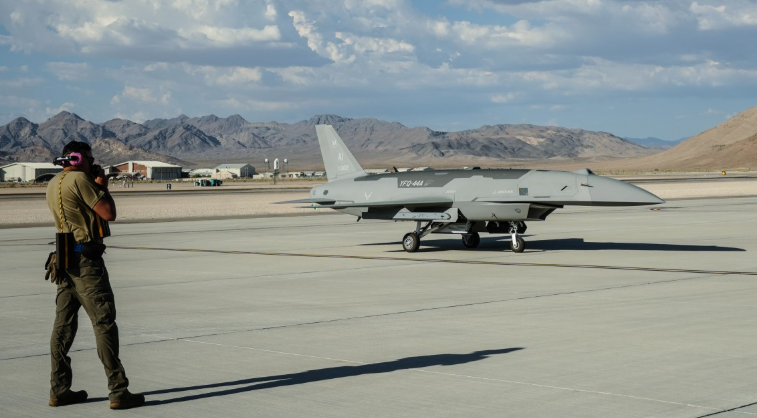
This summer, Anduril Industries' YFQ-44A completed its second major exercise with the U.S. Air Force's Experimental Operations Unit (EOU), a milestone that may ultimately be remembered as far more significant than a routine flight test. It represents another step toward a future in which autonomous combat aircraft fly alongside human pilots, execute missions semi-independently, and fundamentally reshape air warfare.
The aircraft itself is impressive.
The larger story is transformative.
For years, autonomous military aircraft have existed primarily as prototypes, demonstrations, and ambitious PowerPoint presentations. The challenge was never simply building an autonomous aircraft. The challenge was convincing military operators to trust one in combat.
That trust is now being built sortie by sortie.
The YFQ-44A is part of the U.S. Air Force's Collaborative Combat Aircraft (CCA) initiative, one of the most ambitious military aviation programs of the century. The vision is straightforward: pair crewed fighters with lower-cost autonomous aircraft capable of carrying sensors, weapons, electronic warfare payloads, or performing high-risk missions.
In simple terms, every pilot could command a team of robotic wingmen.
Such an approach would radically increase combat mass without proportionally increasing costs or manpower requirements.
The recent exercise at Creech Air Force Base was designed to test exactly that concept.
Unlike traditional demonstrations managed primarily by engineers and contractors, the Experimental Operations Unit places operational Air Force personnel directly in the loop. Pilots, operators, maintainers, and mission planners are actively testing how autonomous systems fit into real military operations.
That distinction matters.
History is filled with defense technologies that looked revolutionary in laboratories but proved difficult to integrate into military organizations. The CCA program is attempting to avoid that mistake by involving end users from the beginning.
During the latest exercise, Air Force operators took on expanded responsibilities across multiple stages of mission execution. They tasked the aircraft from different locations, managed operations in distributed environments, and directly supervised autonomous missions using operationally relevant tactics.
The objective was not simply proving the aircraft could fly.
It was proving that military personnel could efficiently operate and trust the system.
The results appear increasingly encouraging.
A week of high-tempo flight operations featuring multiple sorties per day demonstrated both the aircraft's maturity and the growing confidence of Air Force personnel. Reliability and sustainment are often overlooked in discussions of military innovation, but they frequently determine whether a program succeeds or fails.
A brilliant aircraft that cannot be maintained efficiently remains little more than an expensive experiment.
The YFQ-44A appears to be moving beyond that stage.
More importantly, the exercise showcased one of the most revolutionary aspects of the CCA concept: distributed control.
Future conflicts may unfold across enormous geographic areas while adversaries actively target command centers, communication networks, and logistics hubs. Autonomous aircraft capable of being tasked by operators from multiple locations offer greater flexibility and resilience than traditional force structures.
This shift reflects a broader transformation occurring across modern warfare.
Military power is increasingly becoming a blend of human judgment and machine execution.
Artificial intelligence can process data faster than people. Autonomous systems can absorb risk that would endanger human pilots. Distributed networks can respond faster than centralized organizations.
The nations that successfully combine these capabilities will define the next era of military competition.
That explains why the CCA program has attracted enormous attention from defense planners worldwide.
The Air Force's vision extends far beyond a handful of experimental aircraft. Thousands of sorties are expected to take place from Creech Air Force Base in coming years as prototype YFQ-44As and production FQ-44 fighters continue development.
Those flights will not simply test aircraft.
They will test entirely new concepts of warfare.
The implications are profound. Future fighter pilots may command formations consisting of multiple autonomous aircraft. Mission planning will increasingly involve software-driven coordination between human and machine teammates. Air forces may generate greater combat power without proportionally increasing personnel requirements.
In many ways, the arrival of collaborative combat aircraft resembles the transition from cavalry to armored warfare or from manned reconnaissance to satellites.
At first, it appears evolutionary.
Later, it becomes obvious it was revolutionary.
The second YFQ-44A exercise suggests that transition is accelerating.
The prototype phase is ending.
The age of operational AI wingmen is beginning.