The Tank Survived. The Battlefield Changed. Why Ukraine’s Abrams Tell a Bigger Story About Modern War
For generations, tanks represented the ultimate symbol of battlefield dominance. Thick armor, overwhelming firepower, and mobility made them the kings of land warfare. Their purpose was simple: move forward, survive enemy fire, and break through defenses.
The drone age has not killed the tank.
But it may have changed what victory looks like for one.
Recent reports from Ukraine's 425th Separate Assault Regiment "Skala" offer a remarkable case study. According to crew accounts, one of the Australian-supplied M1A1 Abrams tanks survived more than twenty drone strikes during operations around Pokrovsk. The vehicle endured wave after wave of attacks, protected by a combination of American armor and Ukrainian battlefield modifications.
By traditional military standards, that sounds like a triumph.
The tank survived.
The crew survived.
The protection worked.
Yet the same crews now describe a battlefield where drone saturation has become so intense that armored vehicles cannot always be employed effectively, regardless of how much armor they carry.
That apparent contradiction reveals one of the most important lessons emerging from the war in Ukraine.
Survivability and freedom of action are no longer the same thing.
For decades, military vehicle design revolved around increasing protection. Better armor. Better reactive protection. Better active defense systems. Better survivability.
The assumption was logical. If a tank could survive enemy attacks, it could continue fighting.
Modern drone warfare challenges that assumption.
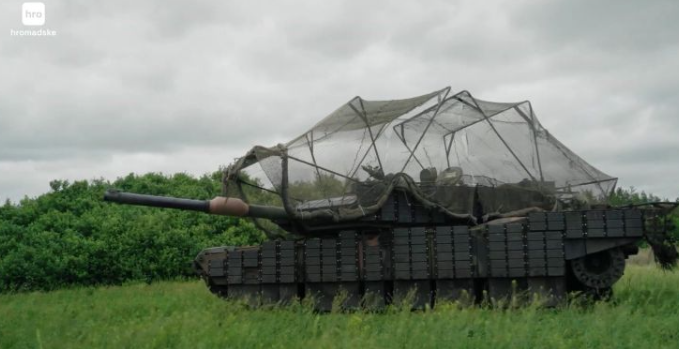
The photographs of Ukrainian Abrams tanks resemble something from a science-fiction battlefield. Massive anti-drone cages envelop turrets. Additional reactive armor covers exposed surfaces. Improvised protection layers are stacked wherever crews believe incoming FPV drones might strike.
To some observers, the modifications look excessive.
To Ukrainian crews, they look necessary.
Every layer exists because drones have transformed the economics of combat.
A relatively inexpensive FPV drone can threaten a vehicle worth millions of dollars. More importantly, drones don't operate alone. Reconnaissance drones identify targets. Surveillance drones monitor movement routes. Strike drones wait for opportunities. Additional drones assess damage and guide follow-up attacks.
A single threat has evolved into an ecosystem.
That's why surviving twenty drone strikes may no longer be the most important metric.
The real question becomes: can the vehicle operate freely enough to accomplish its mission?
In many cases, the answer increasingly depends on factors beyond the tank itself.
The crews around Pokrovsk describe waiting for fog, rain, and reduced visibility before launching certain operations. Weather became a form of protection. Environmental conditions created temporary gaps in drone surveillance networks and reduced the effectiveness of aerial threats.
That reality would have sounded strange to armored commanders a decade ago.
Today, it seems entirely rational.
The ability to move unnoticed may matter more than the ability to absorb punishment.
This shift has profound implications for armored warfare.
For years, debates about the future of tanks focused on a familiar question: Is the tank obsolete?
Ukraine suggests that question may miss the point entirely.
The Abrams' survival demonstrates that tanks remain extraordinarily resilient. Properly protected and intelligently employed, modern armored vehicles can absorb immense punishment. Reports of the tank's endurance under repeated drone attacks reinforce the value of heavy armor rather than undermine it.
The more interesting question is different.
Can armored formations operate effectively in a battlespace where detection is constant?
The answer increasingly depends on the entire military ecosystem surrounding the vehicle.
Electronic warfare must suppress enemy communications and drone control links. Air defense systems must eliminate reconnaissance assets. Counter-drone capabilities must reduce strike opportunities. Intelligence units must identify launch sites and operators. Engineers must maintain mobility corridors. Logistics networks must recover damaged vehicles quickly.
The tank alone is no longer enough.
Armored warfare is becoming a networked activity rather than a platform-centric one.
This may ultimately be Ukraine's biggest contribution to military thinking in the 21st century.
The future tank is not simply a vehicle with more armor.
It is a vehicle operating inside a protective web of sensors, jammers, intelligence systems, air defenses, and autonomous capabilities.
Without that ecosystem, even the strongest tank can become trapped.
The Abrams around Pokrovsk prove the point perfectly.
More than twenty drone strikes failed to destroy one vehicle.
Yet the crews still face a battlefield where movement itself has become the greatest risk.
That is not a story about tank weakness.
It is a story about how the sky has become the most dangerous part of the battlefield.
In modern war, surviving the attack is no longer enough.
You must also survive being seen.