Europe Is Rearming — But Can It Learn Faster Than War? / by Diego Bavio
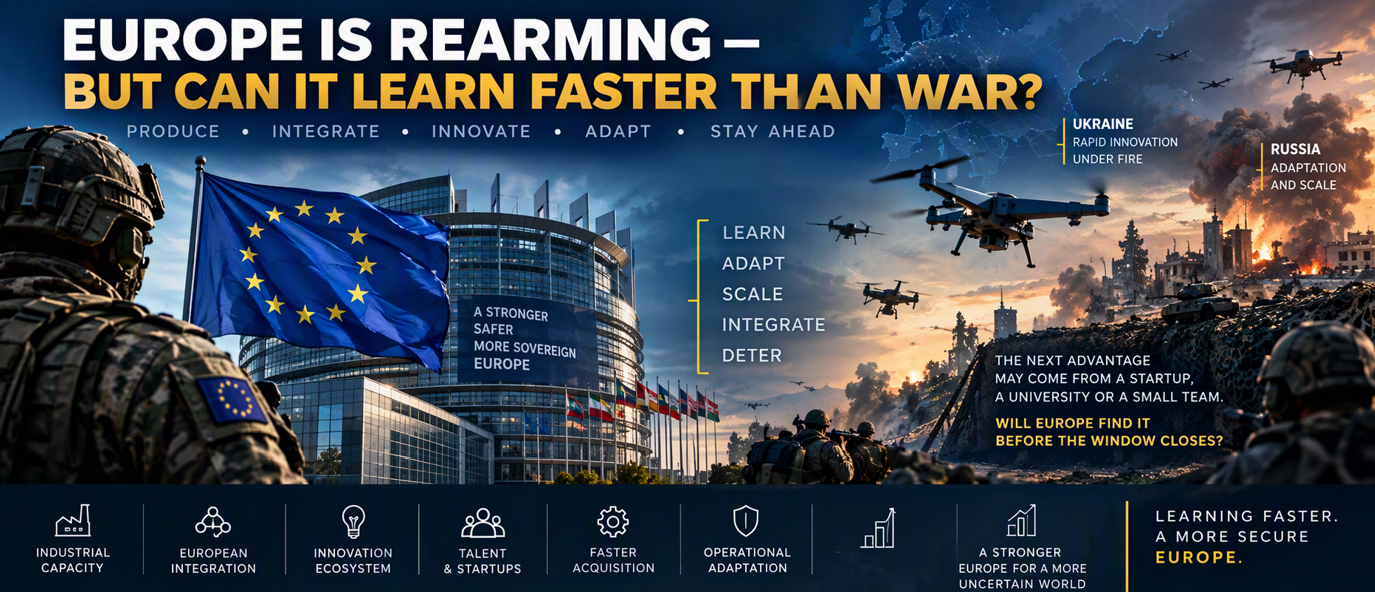
Europe is rearming.
After decades of declining capabilities, dependence on external suppliers and fragmentation across its defense industries, the war in Ukraine has fundamentally changed Europe’s perception of the threat. Defense budgets are rising, factories are expanding production again, and the European Union is attempting to build a defense-industrial base capable of sustaining a high-intensity conflict.
But behind this industrial awakening lies a much harder question:
Can Europe turn this industrial effort into a military capability capable of adapting at the speed of war?
Europe’s challenge is not simply to recover capabilities that were reduced over decades. It is also to build a system capable of learning, adapting and reproducing military capability faster than its adversary.
And that difference may determine the outcome of the next European arms race.
Rearmament Is Not Just a Race to Produce
For much of the Cold War, military competition was strongly associated with the ability to produce platforms, ammunition and weapons systems in large quantities.
That dimension is fundamental again.
Europe needs to rebuild stocks, expand industrial capacity and reconstruct supply chains. But the war in Ukraine has introduced another variable that may prove even more decisive: the speed at which an organization can transform what has just happened on the battlefield into a new military capability.
A system may be excellent today and inadequate tomorrow.
A frequency can be jammed. A sensor can be deceived. A drone can be detected. An algorithm can be defeated.
The answer does not necessarily require developing an entirely new technology. In many cases, it means rapidly modifying an existing capability, changing how it is employed or combining it with another technology.
This makes relative learning speed a new strategic variable.
It is not simply a question of how long Europe takes to develop a capability.
It is how long Europe takes relative to the time its adversary needs to develop a response.
The Learning Cycle as a Strategic Variable
A learning cycle cannot be measured in absolute terms.
A six-month cycle may appear extraordinarily fast. But if the adversary completes its own cycle in three months, that speed becomes a disadvantage.
And if that difference is repeated, the disadvantage becomes cumulative.
Military Learning Velocity is, by definition, a relative variable.
The question is not simply how long an organization takes to learn.
The question is how long it takes to learn relative to the actor trying to defeat it.
Modern warfare can therefore be understood, to a significant extent, as a competition between learning cycles.
This takes us directly to another central concept: the operational window.
A new capability creates an advantage while the adversary lacks an effective response. But that window should not be understood as a static opportunity that simply opens and closes.
In a war of accelerated adaptation, an operational window can be created, exploited, closed and created again through successive cycles of adaptation.
The objective, therefore, is not simply to find an advantage.
It is to generate the next advantage before the adversary has managed to close the previous one.
This creates a fundamental distinction between possessing a technology and possessing a system capable of learning.
The first can produce a temporary advantage.
The second can produce a succession of advantages.
Europe Enters This Race Late
This is one of the central problems behind Europe’s current awakening.
Europe is not starting this race from the starting line.
Russia and Ukraine have spent years accumulating learning cycles in a high-intensity war, while much of Europe is only now attempting to adapt its industrial structures, acquisition processes and innovation mechanisms to the demands of this new environment.
This does not mean that Russia or Ukraine are technologically superior to Europe in general terms.
Nor does it mean that every combat experience automatically becomes useful learning.
It means something more specific: they have had the opportunity to subject their capabilities to successive cycles of employment, observation, adaptation and re-employment under real operational pressure.
For decades, much of Europe’s armed forces prepared for hypothetical scenarios, conducted exercises and acquired systems through relatively long development and procurement cycles.
Russia and Ukraine, by contrast, have had to modify capabilities while employing them and while the adversary was simultaneously trying to neutralize them.
That difference matters because military learning does not emerge simply from having experience.
It emerges from the ability to transform experience into effective changes in technology, doctrine, organization and production — and to do so before the adversary completes its own cycle.
Europe therefore faces a disadvantage that does not necessarily appear in comparisons of inventories or available technologies:
the accumulated delay in learning cycles.
Europe does not simply need to recover capabilities.
It needs to recover time.
And recovering that time does not mean marginally accelerating its existing processes. It means achieving a learning velocity high enough to close the gap in cycles while Russia and Ukraine continue to learn.
Ukraine: Turning War Into Industry
Ukraine is probably the clearest example of this new dynamic.
But it is important to understand what is actually happening.
Drones are not new. The MQ-9 Reaper belongs to an earlier technological generation and has demonstrated the potential of unmanned systems for decades.
Ukraine’s innovation does not lie in having invented the drone.
It lies in developing an extraordinarily rapid ability to adapt technologies, combine components and modify systems in response to concrete operational problems.
The difference is the cycle.
A problem appears on the battlefield, and someone attempts to solve it. A prototype is developed, tested and employed, generating information about its performance. When it fails, it is modified; when it works, efforts are made to scale it. And when the adversary develops a response, the process begins again. War becomes a permanent innovation laboratory. But the real value does not lie solely in the speed of each iteration.
It lies in the ability to turn each iteration into reusable knowledge and move that knowledge rapidly from the user to the developer and back to the battlefield.
That mechanism allows an individual experience to stop being merely a lesson for one unit and become an improvement to a system, a family of systems or even an entire industry.
And here Europe should pay particular attention:
operational knowledge is beginning to become an exportable industrial asset.
The Ukrainian engineer arriving in Europe with a drone under his arm is not merely selling a product.
He is selling a solution that has been subjected to a test no laboratory can fully reproduce, real combat.
But even that may be insufficient if interpreted statically.
Ukraine’s real advantage will not necessarily be the drone that works today.
It will be the ability to develop the drone that works tomorrow, after the adversary has learned how to defeat the current one.
The strategic asset is therefore not simply the product.
It is the ability to move rapidly through the cycle required to replace it.
Ukraine is not only beginning to export systems developed during the war.
It is beginning to export the learning cycles that made those systems possible.
Russia Is Not Waiting for the Window to Close
But it would be a mistake to turn Ukraine into the only reference model.
Europe’s strategic competitor is Russia.
And Russia is not standing still, waiting for solutions developed by Ukraine or the West to determine the next technological balance.
The war forces Russia, just as it does Ukraine, to observe, adapt and modify its capabilities while employing them.
The relevant question is not who produces the best individual system.
It is who can transform battlefield experience into the next generation of capability most rapidly.
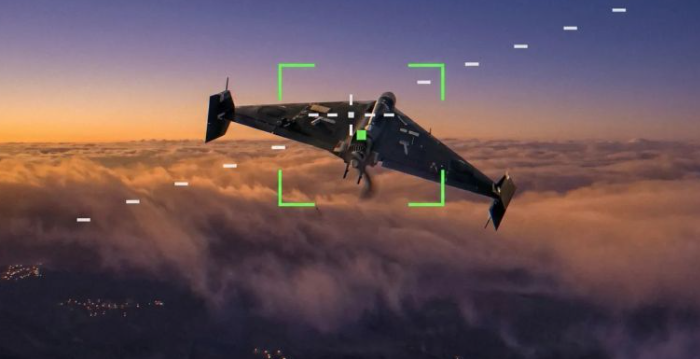
The evolution of the Geran family and the emergence of new systems such as Banderol can be understood within this logic.
A capability that initially succeeds in opening an operational window eventually encounters new defenses.
The response does not necessarily consist of abandoning that capability.
It can mean modifying it, combining it with other technologies, changing how it is employed or developing a new variant.
The cycle can be expressed simply. Create or identify a window. Exploit it. Observe the enemy response. Adapt the capability. Reopen or expand the window.
That is a learning race.
And this reveals an important difference from the traditional understanding of military innovation: innovation does not end when a technology enters service. In a war of permanent adaptation, that moment is merely the beginning of a new cycle. A capability creates an advantage, the adversary learns, and that advantage begins to erode. The user and the developer learn again, the capability is modified, and a new advantage emerges. Competition therefore moves beyond a succession of systems and becomes a succession of cycles.
Russia adds another dimension that is particularly relevant to Europe: the ability to transform operational learning into industrial production and scale.
Ukraine demonstrates the speed that distributed innovation can achieve through startups, military units, engineers and small companies.
Russia demonstrates the importance of rapidly transforming battlefield learning into industrial capability available at scale.
These are not identical models.
And that is precisely why Europe needs to study both.
The European problem is that while it attempts to rebuild its industrial capacity, its potential adversaries are not standing still. Every European cycle will have to compete against an adversary that is learning during the same period.
Europe’s Problem: Integrating Without Freezing Innovation
Here lies the real industrial challenge behind Europe’s rearmament.
Europe needs to integrate its national capabilities.
Historical fragmentation generates duplication, additional costs, different standards and difficulties in building genuinely European systems. The logical response is greater cooperation, multinational programs and, in certain areas, centralized development and procurement.
But integration does not simply mean making systems interoperable.
Europe needs to integrate capabilities without freezing the innovation cycle.
That is a much harder problem.
The recent Belgian case involving the ReDrone counter-UAS system is illustrative.
A system may be presented as open and prepared to incorporate new capabilities. But when the time comes to integrate a new component, issues can arise involving proprietary code, modification rights, certification, warranties and technical knowledge.
The consequence is important.
An open architecture does not necessarily mean an open capacity for evolution.
And in a war where an advantage may last only until the adversary finds a response, that difference ceases to be merely a contractual or technological issue.
It becomes a question of learning velocity.
Imagine Europe builds a future common architecture:
A French radar.
A German electronic-warfare system.
A Polish interceptor.
An Italian command-and-control system.
A drone developed by a startup.
All interoperable.
But who has the right to integrate them, who can modify the software, who can access the data, and who retains the knowledge required to understand how these different components interact? And, most importantly, what happens when a new technology appears that none of the original systems was designed to accommodate?
If each company retains a critical part of the knowledge as a black box, Europe may achieve interoperability while remaining incapable of evolving rapidly.
The problem therefore ceases to be merely industrial.
It becomes a question of sovereignty over the learning cycle.
Centralizing Procurement Creates Another Problem
Europe is also moving toward greater centralization of development and procurement.
That can generate economies of scale, reduce duplication and allow longer-term industrial planning.
But joint procurement immediately raises two questions:
How should production be distributed among participating countries?
And who should control the integration process?
If every program ends up distributing production according to strictly national criteria — “a little for everyone” — Europe may achieve a politically balanced distribution while creating an industrially inefficient system.
More importantly, it may end up optimizing the political distribution of production rather than the speed of European learning.
The criteria should include capability, speed, scale, resilience and the ability to evolve.
But that means accepting that certain countries will produce certain capabilities because they are more efficient at doing so.
And here the political problem becomes enormous.
No government wants to finance a European defense industry if it believes another country will capture most of the production, employment and knowledge.
European integration is therefore not merely a technological or industrial question.
It is also a question of governance.
Who decides the standards?. Who allocates production?. Who controls the architecture?. Who determines what knowledge must be shared?. Who decides when a new company can enter a program?
And fundamentally Who has the authority to accelerate a learning cycle when a multinational structure begins to slow it down?
Europe still does not have sufficiently clear answers to all these questions.
Integration succeeds not when production is distributed equally, but when it allows Europe to learn, adapt and produce faster than its adversary.
The “Nerd of the Day”
While Europe attempts to rebuild and integrate its defense industry, there is another reality it cannot ignore.
The next decisive innovation may not come from any of the major defense contractors.
It may come from a ten-person company, a university laboratory, a group of engineers or a startup that does not yet exist.
Lower technological barriers now allow small teams to work with electronics, software, artificial intelligence, sensors and manufacturing tools that were once reserved for large organizations.
An idea can become a prototype extraordinarily quickly and, if it finds an operational application, initiate a new development cycle just as quickly.
This creates the possibility that the “nerd of the day” could find a solution that changes one part of the battlefield and eventually becomes a new industrial actor.
But the challenge is not simply finding the next innovator.
It is ensuring that the innovation enters the military learning cycle before the operational window closes.
That is why Europe needs its large companies.
It needs scale, production, certification, maintenance and sustainment.
But it also needs an ecosystem open enough for new actors to enter, experiment, fail, learn and scale without becoming trapped for years in the same acquisition processes that Europe is now trying to transform.
The large defense industry must be capable of absorbing external innovation.
And the defense system must be capable of bringing both major industry and startups into the same learning cycle.
Because if the next technological breakthrough appears in a ten-person company but needs five years to navigate the European acquisition system, Europe will have lost precisely what it needs to recover, time.
We do not know who the next major European defense-industry player will be.
Precisely for that reason, the system must be designed to find it.
The Real Arms Race
Europe is waking up.
But it is waking up at a particularly difficult moment.
It must not only rebuild industrial capabilities and increase production. It must transform an industrial and political logic built over decades into a system capable of responding to an environment in which adaptation is permanent and learning speed may determine how long a military advantage survives.
It has to produce more, but also integrate better.
It has to centralize certain procurements and development programs without turning centralization into a new source of rigidity.
It has to distribute industrial capabilities among European states while establishing criteria that prioritize capability, speed, scale and resilience over purely political distribution.
It has to determine who leads integration processes and who possesses the knowledge required to make systems evolve.
It has to learn from Ukraine, which has turned combat into an innovation laboratory, and observe Russia, which is attempting to transform operational learning into production and new capabilities at scale.
And at the same time, it must create space for the next “nerd of the day” to enter the system and move through that learning cycle without becoming trapped in processes designed for another era.
Because all these problems are connected.
They are different components of the same capability:
the speed at which Europe can transform information into learning, and learning into military capability.
That is why the success of European rearmament should not be measured solely by the percentage of GDP allocated to defense, or by the number of tanks, missiles, drones or rounds of ammunition Europe can manufacture.
The fundamental question is different:
How many learning cycles can Europe complete before its adversary completes its own?
Because in a war of permanent adaptation, a capability can become obsolete before it even reaches its maximum deployment.
The real objective is not to find a definitive solution.
It is to build a system capable of generating successive solutions faster than the adversary.
The operational window therefore ceases to be a static opportunity.
It becomes a dynamic competition, create or identify a window, exploit it, force the adversary to adapt, learn from that adaptation, and create the next one.
Russia is already playing that game.
Ukraine is too.
Europe is beginning to rebuild the tools required to do the same.
But it faces an additional difficulty, It does not merely have to accelerate its learning cycles.
It has to recover the cycles it lost while others were already learning.
And that difference may prove decisive.
Europe does not simply need a defense industry capable of manufacturing more weapons.
It needs a defense industry capable of learning faster than war.
Because Europe’s next major advantage may not be the technology it manages to buy today.
It may come from a company that does not yet exist.
And the decisive question will be whether Europe can find it, integrate it, scale it and bring it to the battlefield before the operational window closes.