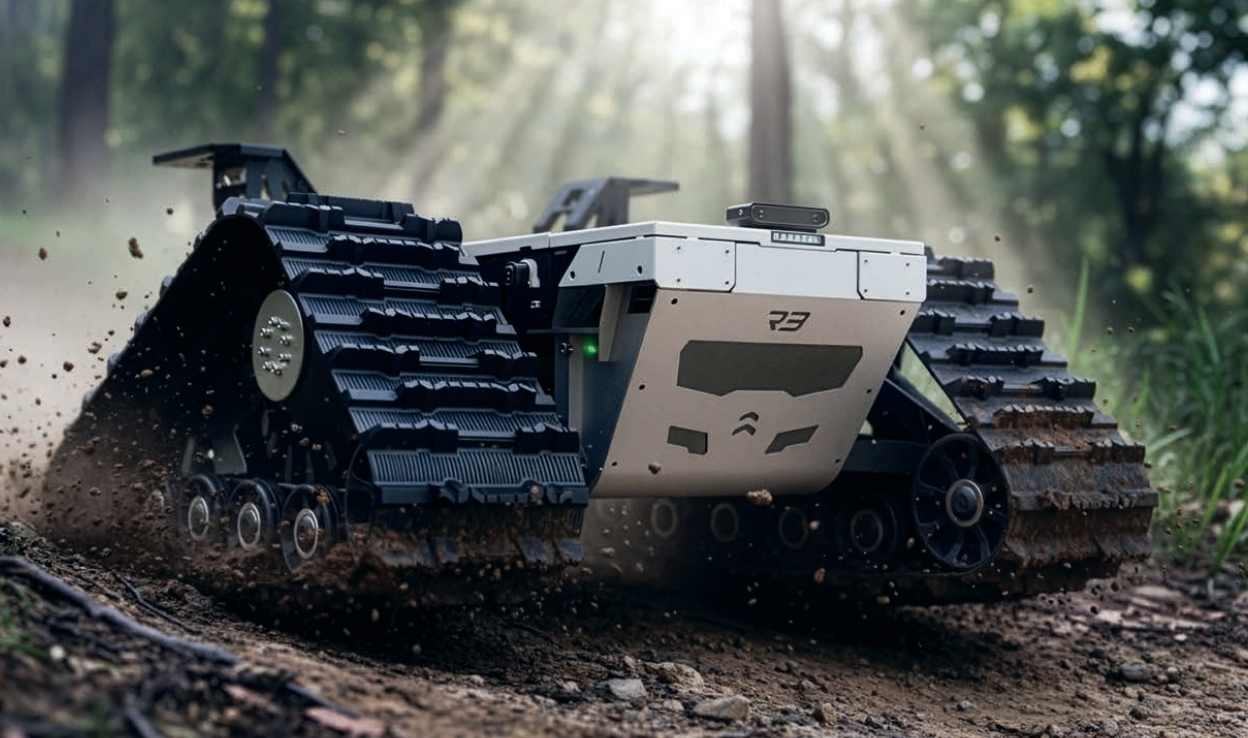
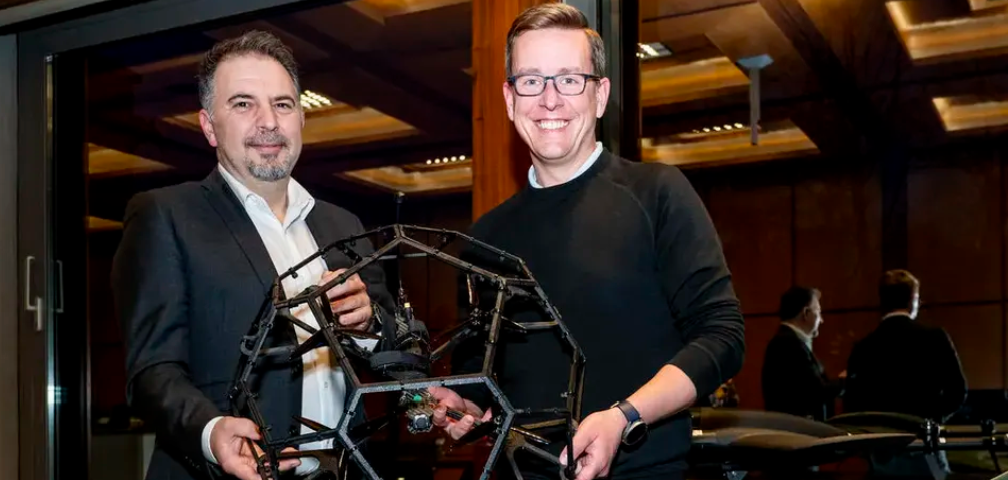
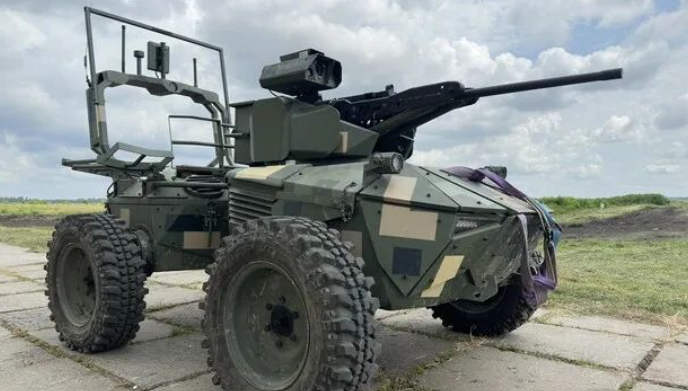
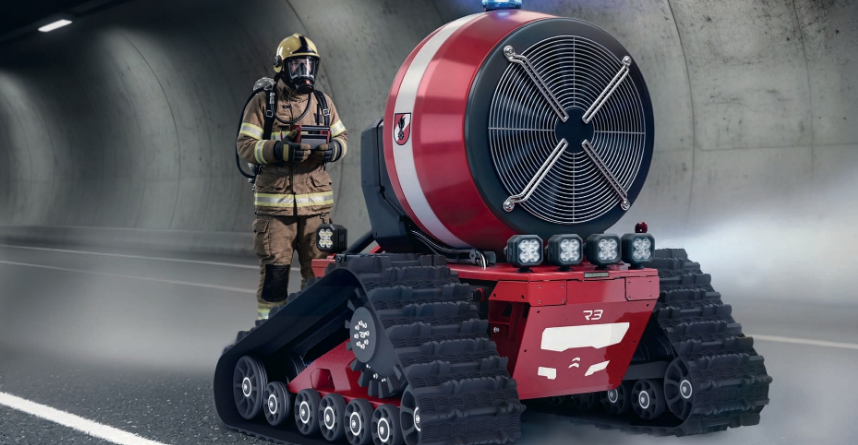
Laser vs. Swarm. ROVO3 UGV from Hentschel System with Anti-Drone-Laser from Inleap Photonics.
Small, expendable, and everywhere, these systems have reshaped the battlefield from Ukraine to the Middle East. A €2,000 quadcopter can now threaten million-euro equipment, critical infrastructure, or infantry units. And that imbalance has forced militaries into a brutal reality:
Defense is becoming unsustainably expensive.
Until now.
Emerging quietly from Europe’s defense ecosystem is a concept that could fundamentally change that equation: a mobile, laser-based counter-drone system mounted on a small unmanned ground vehicle. Built on the ROVO3 UGV platform by Hentschel System and equipped with an advanced anti-drone laser from Inleap Photonics, the system doesn’t aim to dominate the air—it aims to outthink it.
At first glance, the approach seems almost underwhelming. A compact electric UGV, capable of carrying a few hundred kilograms, rolling across terrain—hardly a revolutionary image in an era of hypersonic weapons and AI-driven swarms.
But the real disruption sits on top.
Instead of relying on missiles, interceptors, or jamming systems, this platform uses focused energy—a laser designed not for brute force, but for precision. And its innovation lies not just in power, but in how the beam is controlled.
Where traditional laser systems rely on moving mechanical mirrors to direct energy, this system bends the beam itself—using changes in the refractive index triggered by electrical signals. It’s a subtle shift, but a critical one.
Because mechanical systems have limits. Physics does not.
The potential implication is speed—extreme speed. Target acquisition, tracking, and engagement may happen in fractions of a second, potentially faster than conventional defenses can react. In a world where drone swarms attack unpredictably and in numbers, reaction time is no longer a technical detail.
It is survival.
This is where the system becomes provocative.
The real battle against drones isn’t just about hitting them—it’s about affordability. Missiles are too costly. Kinetic interceptors struggle to scale. Electronic warfare can interfere with friendly systems as much as enemy ones.
Lasers promise something different: near-zero cost per shot.
Once deployed, the energy required to engage a target is minimal compared to traditional munitions. That means the defense no longer loses economically with every engagement. Instead, it flips the model entirely.
A cheap drone meets an even cheaper response.
This is the long-sought “cost inversion” that defense analysts have been chasing for years.
But there’s a reason this problem hasn’t been solved yet.
Reality.
Laser systems, for all their promise, face fundamental environmental challenges. Rain, fog, dust, and atmospheric distortion can scatter or weaken the beam. Precision in ideal conditions does not always translate to reliability in the chaos of combat.
The developers seem aware of this. The concept reportedly emphasizes layered defense—combining laser engagement with interceptor drones or alternative systems when conditions degrade. It’s a pragmatic approach, but one that acknowledges a critical truth:
No single system wins the drone war alone.
Then there is mobility.
Mounting the system on a UGV solves one problem—flexibility—but creates another. A mobile platform can reposition quickly, cover vulnerable areas, and adapt to changing threats. But it can also be targeted, jammed, or disabled.
Survivability becomes as important as capability.
And that is why Ukraine matters.
If this system is deployed or tested there, it will not be judged by specifications or concepts. It will be tested in the harshest environment possible—against saturation attacks, electronic warfare, and real adversaries.
In Ukraine, technology doesn’t evolve slowly.
It either works—or it disappears.
That is what makes this system significant. Not because it is perfect, but because it represents a shift. A move away from centralized, expensive, slow-to-adapt systems toward something else:
Distributed.
Mobile.
Affordable.
Fast.
A system that matches the tempo of modern threats instead of trying to overpower them.
If it succeeds, Europe may have found a scalable answer to the drone problem. If it fails, it will still accelerate the learning curve for everyone involved.
Because in today’s battlefield, innovation is not measured in years.
It is measured in engagements.
And sometimes, in milliseconds.