Jesse Eisenberg’s Night in Ukraine Shatters the Distance of War
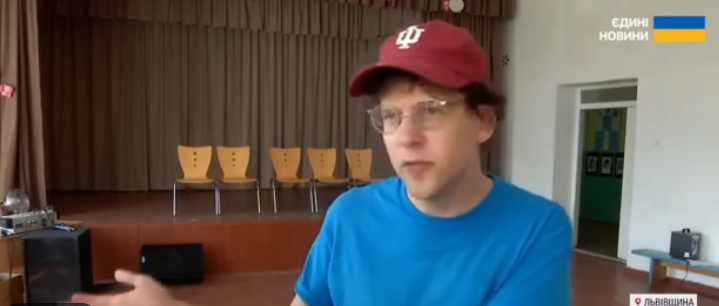
For millions of people around the world, the war in Ukraine arrives through screens.
It is measured in headlines, casualty statistics, diplomatic statements, maps, and social media clips. A distant conflict. A recurring notification. Another update in an endless news cycle.
Then there is the moment when the siren goes off.
Suddenly, war is no longer a headline.
It is a sound.
Hollywood actor Jesse Eisenberg recently experienced that transformation firsthand during a discreet visit to the Ukrainian city of Lviv. Known globally for portraying Facebook founder Mark Zuckerberg in The Social Network and starring in the Now You See Me franchise, Eisenberg had traveled to Ukraine to participate in a charity initiative supporting children affected by the war.
What awaited him was not a red carpet.
It was the reality Ukrainians have lived with for years.
During the night, air raid sirens pierced the darkness. Eisenberg and his team were rushed to a shelter. Hours later, he emerged to witness the aftermath of a Russian strike.
The experience, he said, devastated and shocked him.
Yet perhaps the most revealing part of his reaction was not the fear.
It was the comparison.
Looking at Lviv, Eisenberg reportedly imagined what it would feel like if New York were bombed.
The Power of an Uncomfortable Comparison
That observation strikes at the heart of why the war in Ukraine remains difficult for many outsiders to fully comprehend.
Lviv does not resemble the stereotypical image of a war zone that often exists in Western imagination.
It is not a city of ruins.
It is a city of cafés, schools, parks, apartment buildings, universities and families. Children play football. Couples walk through historic streets. Businesses open every morning.
Life goes on.
Until the sirens begin.
For Eisenberg, the resemblance to New York made the conflict suddenly personal. The mental barrier separating "their war" from "our lives" disappeared.
This is precisely what statistics often fail to accomplish.
Numbers inform.
Stories humanize.
A missile strike reported on television feels abstract. A famous actor standing in a shelter imagining Times Square under bombardment suddenly makes the same event tangible.
Europe’s Closest War and the World's Most Distant Crisis
The paradox of Ukraine is striking.
The war is geographically close to hundreds of millions of Europeans. Yet psychologically, it often feels remote.
In an era saturated by information, repetition can create emotional numbness. People adapt to seeing destruction. Outrage becomes routine. Tragedy competes with entertainment on the same screen.
This is where visits by globally recognized figures become significant.
Not because celebrity voices carry greater moral authority.
But because they attract attention.
When an actor known to audiences from Hollywood blockbusters speaks about spending a night in a bomb shelter, people who may never read a military analysis or geopolitical report suddenly pay attention.
For a brief moment, the war re-enters public consciousness.
The Normality That Makes It More Terrifying
Perhaps the most unsettling aspect of Eisenberg's account is how ordinary everything appeared before the sirens sounded.
That is the defining characteristic of modern Ukrainian life.
The extraordinary has become routine.
People attend meetings, concerts, birthdays, and university lectures while simultaneously monitoring air raid alerts. Families make dinner knowing a shelter may become necessary before dessert.
A generation of Ukrainians has learned to live between normality and catastrophe.
The rest of the world watches from a distance.
Visitors experience only a glimpse.
For Ukrainians, it is every day.
Beyond the Headlines
Jesse Eisenberg did not travel to Ukraine seeking political symbolism or dramatic headlines. He arrived for a humanitarian mission focused on children whose lives have been shaped by war.
Yet his most powerful contribution may have been something unintended.
He provided an outsider's perspective on a reality that Ukrainians often struggle to explain to those who have never heard an air raid siren at 3 a.m.
His question lingers long after the shelter doors close:
What if this happened in New York?
Or Berlin.
Or Paris.
Or London.
The uncomfortable truth is that war becomes real only when people can imagine it reaching their own streets.
For one night in Lviv, a Hollywood star stopped imagining.
He experienced it.
And that experience may have taught him more about the war than years of headlines ever could.