Italy's €3 Billion Bet on Ukraine's Sky: Rome May Have Just Moved From Supporting Ukraine to Rebuilding Its Air Shield
For more than four years, military assistance to Ukraine has largely followed a familiar pattern.
Governments announced new aid packages.
Missiles crossed borders.
Air-defense interceptors were delivered.
Stockpiles were reduced.
The process repeated itself.
But if reports about Italy's latest military package prove accurate, Europe may be entering a new phase of support.
One that goes beyond supplying weapons.
One that focuses on sustaining a country's ability to defend itself indefinitely.
According to reports, Rome is preparing a military assistance package valued at approximately €3 billion, centered around advanced air-defense capabilities, long-range radar systems, interceptor missiles, and potentially something even more significant: local production capacity.
If confirmed, this would represent far more than another shipment.
It would represent strategic investment.
The War Above Ukraine Is Intensifying
The battlefield most critical to Ukraine may no longer be the trenches.
It may be the sky.
Every night, Ukraine faces a growing mix of threats:
Cruise missiles.
Ballistic missiles.
Long-range drones.
Loitering munitions.
Electronic warfare.
And increasingly sophisticated attack systems designed to overwhelm defenses through scale.
Modern air defense has therefore become more than a protective layer.
It has become the foundation that allows everything else to function.
Cities.
Energy infrastructure.
Industrial production.
Military logistics.
Economic activity.
Without effective air defense, every other capability becomes vulnerable.
This explains why advanced interceptor systems have become some of the most sought-after military assets in the world.
And why every additional battery carries strategic value far beyond its physical footprint.
Europe's Alternative to Patriot
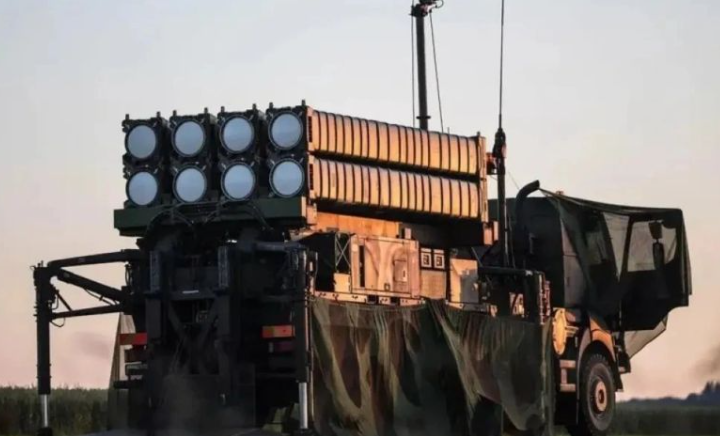
Much of the attention surrounding the reported package focuses on the possibility of additional SAMP/T NG systems.
Often described as Europe's closest equivalent to the Patriot system, SAMP/T represents one of the continent's most sophisticated integrated air-defense capabilities.
But what makes the reported package particularly noteworthy is not merely the launchers themselves.
It is the broader ecosystem.
Missiles.
Sensors.
Radars.
Networking.
Command-and-control.
Modern air defense operates as a system of systems.
A launcher without interceptors has limited value.
A radar without a response capability offers warning but not protection.
The real strength comes from integration.
This is why the reported inclusion of long-range radar systems could be as strategically important as the missile batteries themselves.
Detection remains the first step in every interception.
The side that sees first often reacts first.
And in modern warfare, seconds matter.
The Most Important Detail May Not Be the Missiles
The most consequential aspect of the reports may be the discussion surrounding local production.
For years, military aid has relied heavily on inventories produced elsewhere and delivered to Ukraine.
That model has limitations.
Stockpiles shrink.
Production lines struggle to keep pace.
Demand exceeds supply.
The result is a constant race between consumption and replenishment.
The idea that Ukraine could eventually manufacture advanced interceptor systems or components domestically would represent a profound shift.
A country under constant attack would gradually become less dependent on external deliveries and more capable of sustaining its own defense requirements.
That changes the strategic equation.
Because the strongest defense system is not necessarily the one with the most missiles.
It is the one that can continue producing missiles when the war lasts longer than expected.
A Signal to Moscow and Europe
The reported Italian package sends two messages simultaneously.
The first is directed eastward.
Ukraine's partners continue searching for ways to strengthen long-term resilience rather than merely addressing immediate shortages.
The second message is directed toward Europe itself.
The continent's defense posture is evolving.
Increasingly, military assistance is becoming intertwined with industrial cooperation, production partnerships, and technology transfer.
The objective is no longer simply delivering capability.
It is creating capability.
That distinction may define European defense policy for the next decade.
The Real Story Is Sustainability
The reported €3 billion figure will attract headlines.
The missile systems will generate debate.
The radar networks will receive attention.
Yet the deeper significance lies elsewhere.
Modern warfare is increasingly becoming a competition of endurance.
Who can produce more?
Who can replace losses faster?
Who can sustain operations longer?
Who can adapt industrially while under pressure?
Those questions are becoming as important as battlefield tactics.
If the reported package ultimately includes both advanced air-defense systems and pathways toward local production, it reflects a realization spreading across Europe:
Victory is not simply about having weapons.
It is about ensuring those weapons can be replenished, maintained, upgraded, and produced for as long as necessary.
In today's security environment, resilience may be the most powerful weapon of all.