IMPACT DRONES. The Startup Building What Nations Actually Need
For years, Silicon Valley has celebrated a simple mantra:
Build something people want.
It became the defining philosophy of startup culture. Create demand. Solve inconvenience. Build the next platform, app, or marketplace. If users love it, success follows.
But the world has changed.
The most urgent technologies of this decade are not necessarily the ones people want.
They are the ones societies desperately need.
And few companies illustrate that shift more clearly than IMPACT DRONES (YC S26).
In an era when low-cost drones are transforming warfare, critical infrastructure is facing a problem that traditional air defense was never designed to solve.
The economics are brutal.
A drone costing a few hundred or a few thousand dollars can threaten assets worth millions. Airports, power stations, communication hubs, logistics centers, military facilities, and industrial sites are increasingly exposed to attacks that are cheap to execute and expensive to stop.
Defenders face a growing asymmetry.
Attackers need only one drone to get through.
Defenders must stop every single one.
That reality is forcing a fundamental rethink of air defense.
And IMPACT DRONES believes the answer is automation.
The company is developing an autonomous, all-weather "drone-in-a-box" defense system designed to intercept incoming aerial threats within seconds.
Always on.
Always ready.
Rain, dust, or extreme heat.
No lengthy deployment.
No waiting for operators.
No scrambling for responses after detection.
The system is built around two products that form the foundation of the company's Air Defense as a Service (ADaaS) vision:
HUNTER and SABLE.
The most striking development is how quickly the technology is advancing.
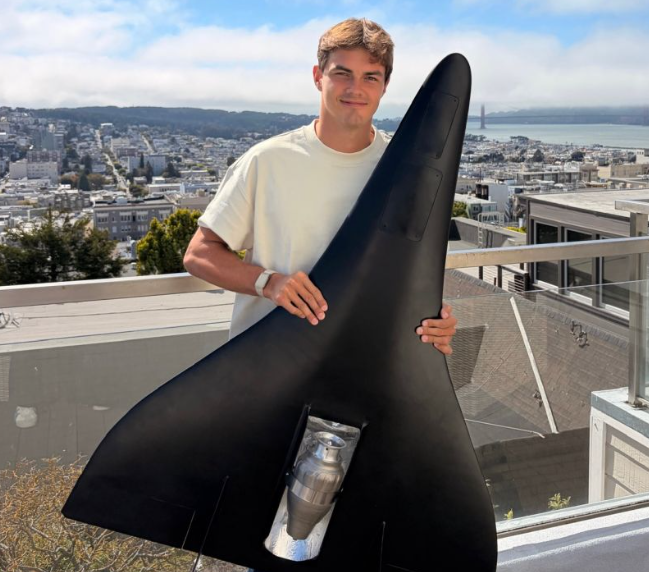
According to the company, the first SABLE prototype, a high-speed jet interceptor, was built in just two weeks.
That alone tells an important story.
The pace of drone innovation is no longer measured in years.
It is measured in weeks.
And that speed is becoming a strategic advantage.
For decades, military procurement often moved slower than technological change. By the time a system reached operational maturity, the threat landscape had already evolved.
The drone revolution has accelerated this cycle dramatically.
Today's battlefield innovations emerge from engineering teams operating with startup speed rather than traditional defense timelines.
The emergence of autonomous interceptors reflects a deeper trend taking shape across the defense sector.
Future air defense may no longer focus primarily on increasingly expensive missiles.
Instead, it may resemble a networked software platform capable of detecting, tracking, launching, intercepting, and learning continuously with minimal human intervention.
The objective is straightforward:
Reduce the cost of defense below the cost of attack.
That may become one of the defining technological challenges of modern security.
If a nation spends hundreds of thousands of dollars stopping drones that cost a fraction of that amount, the attacker retains the advantage.
If autonomous systems reverse that equation, the strategic balance changes.
Critically, the significance of companies like IMPACT DRONES extends beyond military applications.
Critical infrastructure is becoming a frontline domain.
Energy facilities, transportation networks, telecommunications systems, and industrial complexes increasingly require air defense capabilities once reserved for military installations.
The distinction between battlefield protection and infrastructure protection is beginning to disappear.
This is precisely where autonomous systems become attractive.
They provide permanent readiness without requiring permanent human presence.
The broader message is perhaps even more important than the technology itself.
A new generation of startups is emerging around necessity rather than convenience.
These companies are not asking what consumers might click on tomorrow.
They are asking what societies will depend on five years from now.
Y Combinator's famous advice was to build something people want.
The geopolitical realities of the 2020s are introducing a different challenge:
Build something people need.
In a world increasingly shaped by autonomous systems, contested infrastructure, and persistent aerial threats, the startups likely to have the greatest impact may not be the ones creating the next social platform.
They may be the ones ensuring the lights stay on.
And when drones can arrive in minutes, air defense that launches in seconds stops being a luxury.
It becomes a necessity.