#FrontlineStoriesUkraine/ Yan "Avgust" Danilko - The Moped, the Morphine, and the Lie. Inside Russia’s System of Breaking Prisoners
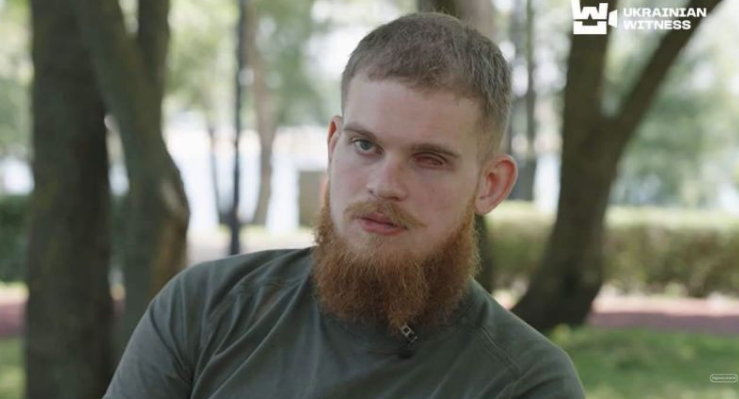
Russia's war against Ukraine has produced countless stories of destruction. Few, however, expose the anatomy of cruelty as starkly as the testimony of Yan "Avgust" Danilko, a 27-year-old Azov fighter who survived both Russian captivity and the deadly explosion at Olenivka.
His account is not a story of battle. It is a story of what happens after the battle is over.
The guards had a name for one of their favorite torture methods: "the moped."
Prisoners were handcuffed by their wrists to a metal bar and suspended from it like carcasses in a slaughterhouse. Under the weight of the body, the steel cut into joints and flesh. Fifteen minutes was often enough. As Danilko recalls, "You'll confess to killing Kennedy."
The point was never truth. The point was submission.
Every prison system develops its own vocabulary. In Russian captivity, even violence became bureaucratized. The first beating was called "reception." Upon arrival, prisoners were forced into humiliating positions while guards rained down punches and kicks. It was an initiation ritual into a world where pain was policy.
One of Danilko's cellmates suffered a stroke. The guards refused to believe him. Instead of calling for medical assistance, they tested his condition with a lighter and needles, burning his skin and stabbing his legs to see whether he reacted. Human suffering became entertainment.
The beatings never stopped.
Through the walls of his cell, Danilko could hear guards assaulting other prisoners, demanding confessions to crimes they had never committed. Every scream carried the same message: resistance is futile.
Yet amid the noise, something extraordinary happened.
Danilko and a fellow prisoner, a former language teacher, spent their captivity studying German.
It sounds absurd. Men locked inside a torture system discussing grammar while violence echoed through concrete corridors. But perhaps that is precisely why it mattered.
Captivity is designed to strip a person of identity. Learning is an act of defiance. Every new word was proof that the guards controlled their bodies, but not their minds.
"Nothing is impossible," Danilko says. "It's all in your head."
That determination would be tested brutally at Olenivka.
In July 2022, an explosion ripped through the prison facility where Ukrainian prisoners of war were being held. The blast was devastating. Many men died instantly. Others did not.
According to Danilko, something felt wrong even before the explosion. Guards were reportedly removing prisoners according to a pattern, selecting every fourth or fifth man, specifically Azov fighters, and lining them up outside shortly beforehand.
Then came the blast.
The wounded lay abandoned for hours.
Danilko, badly injured, tore off his own bandage and fashioned a tourniquet around his leg. He remained that way for nine agonizing hours before reaching a hospital. By then, doctors delivered a brutal choice: save the patient or save the limb.
The patient survived.
Even there, however, the war against truth continued.
On the second day after surgery, while heavily medicated with morphine and confined to intensive care, Russian journalists entered his room with cameras. Armed men in balaclavas stood behind them. The message was unmistakable.
His medical treatment depended on what he said next.
It was propaganda with a rifle in the background.
Yet even within a system built on fear, individuals emerged who chose humanity.
A nurse secretly spent her own salary to buy antibiotics and eye drops for the wounded prisoner. To avoid suspicion, she told guards that a doctor had prescribed them.
Her gesture was small. Its significance was enormous.
It demonstrated a truth that every authoritarian system fears: cruelty can be enforced, but compassion remains impossible to eradicate completely.
Danilko says he does not consider a single day of captivity wasted. To do so, he argues, would hand victory to those who tried to destroy him.
That may be the most unsettling aspect of his story.
Not the torture. Not the explosions. Not the forced confessions.
But the fact that after everything, they still failed.
The prison was designed to break prisoners.
Instead, it produced witnesses.