Forget Jamming. What If You Could Shoot Down a Drone With Sound?
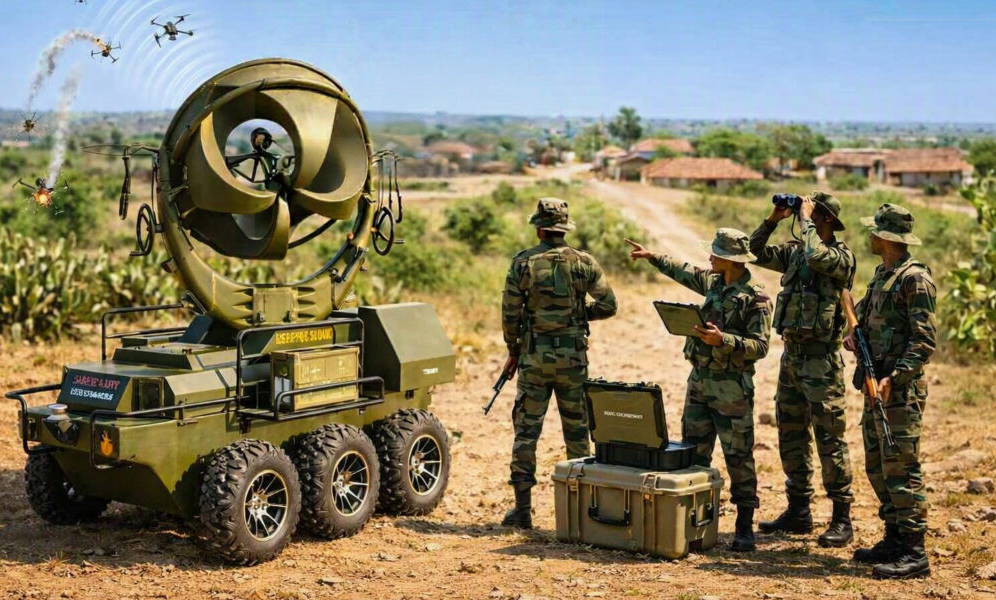
The next anti-drone weapon might not fire bullets, launch missiles, jam radio signals or burn targets with a laser.
It might simply make a lot of noise.
Indian researchers at the Central Scientific Instruments Organisation (CSIO) in Chandigarh have developed an experimental acoustic counter-drone system with a fascinating approach: instead of attacking the drone itself, it attacks the tiny sensors the aircraft depends on to remain stable.
The target is the MEMS gyroscope.
And that makes the idea particularly interesting.
Don't jam the drone. Confuse its sense of reality.
Modern drones constantly need to understand their orientation.
Am I level?
Am I rotating?
Am I tilting?
To answer those questions, their flight-control systems rely on tiny microelectromechanical sensors, including gyroscopes.
The Indian concept reportedly directs high-intensity sound at those sensors using specialized acoustic transducers.
The trick is resonance.
When acoustic energy is transmitted at frequencies corresponding to the sensor's resonant behavior, the gyroscope can begin producing incorrect measurements.
The flight computer then receives a distorted picture of reality.
It thinks the drone is moving when it isn't.
So it corrects.
But because the movement never happened, the correction itself creates a real movement.
The controller detects another false condition, responds again, and the aircraft can rapidly become unstable.
Within seconds, according to the report, the drone can begin oscillating and crash.
In other words, the system doesn't physically destroy the drone.
It potentially convinces the drone to destroy its own stability.
Autonomous drones don't solve the problem
This also addresses one of the major limitations of conventional electronic warfare.
Radio-frequency jammers generally attack communications or navigation links. But drones are increasingly becoming more autonomous.
If an aircraft can navigate and attack without continuous communication with an operator, simply disrupting its command link may accomplish very little.
Fiber-optic drones create another challenge because their control connection cannot be defeated using conventional RF command-link jamming.
An acoustic attack against onboard inertial sensors works according to a completely different principle.
It doesn't necessarily care whether the drone is controlled by radio, fiber or autonomous software.
If the aircraft depends on a vulnerable physical sensor to stabilize itself, that sensor becomes the attack surface.
The physics becomes the cyberattack
That is perhaps the most fascinating aspect of the technology.
We normally imagine hacking as manipulating software or communications.
Here, the attack occurs at the boundary between the physical and digital worlds.
The software itself may be functioning perfectly.
The problem is that the information entering it is wrong.
The flight controller effectively asks:
“What is happening to me?”
The sensor lies.
The software believes it.
And the machine reacts accordingly.
But sound isn't a magic anti-drone shield
There are major limitations.
The reported effective range of acoustic counter-drone concepts is only a few hundred meters. Environmental conditions such as wind, temperature and strong background noise can affect performance.
That makes the technology unlikely to replace radar, electronic warfare or kinetic interceptors.
Instead, its natural role could be point defense.
Military installations, airports, prisons, government buildings, ammunition depots or other sensitive locations could potentially use acoustic systems as another layer against small drones approaching at short range.
Urban environments are particularly interesting because detecting tiny, low-flying drones with conventional radar can be difficult amid buildings and clutter.
The reported system is also intended to distinguish between hostile and authorized drones operating in the same airspace.
Counter-drone warfare is becoming a battle of vulnerabilities
The larger lesson goes beyond this particular Indian project.
Every solution to the drone problem creates another adaptation.
Jam radio control? Build autonomy.
Jam GPS? Add inertial navigation.
Jam RF links? Use fiber.
Improve electronic protection?
Then perhaps someone attacks the gyroscope itself.
That is why the future of counter-UAS will probably not belong to one miraculous weapon.
It will belong to layered defenses exploiting different vulnerabilities simultaneously.
Radar. Electronic warfare. Interceptor drones. Guns. Lasers.
And perhaps now, sound.
Because the cheapest way to defeat a flying computer may not be to destroy it.
It may be to make the machine stop understanding which way is up.