Fixing Space Instead of Abandoning It. DARPA’s Robot Could Rewrite the Economics of Orbit
For decades, space has operated on a brutal logic: build it, launch it, use it—then abandon it.
Now DARPA wants to break that model.
With its long-delayed Robotic Servicing of Geosynchronous Satellites (RSGS) mission finally approaching launch in 2026, the U.S. defense research agency is attempting something profoundly disruptive: turning satellites from disposable assets into maintainable infrastructure.
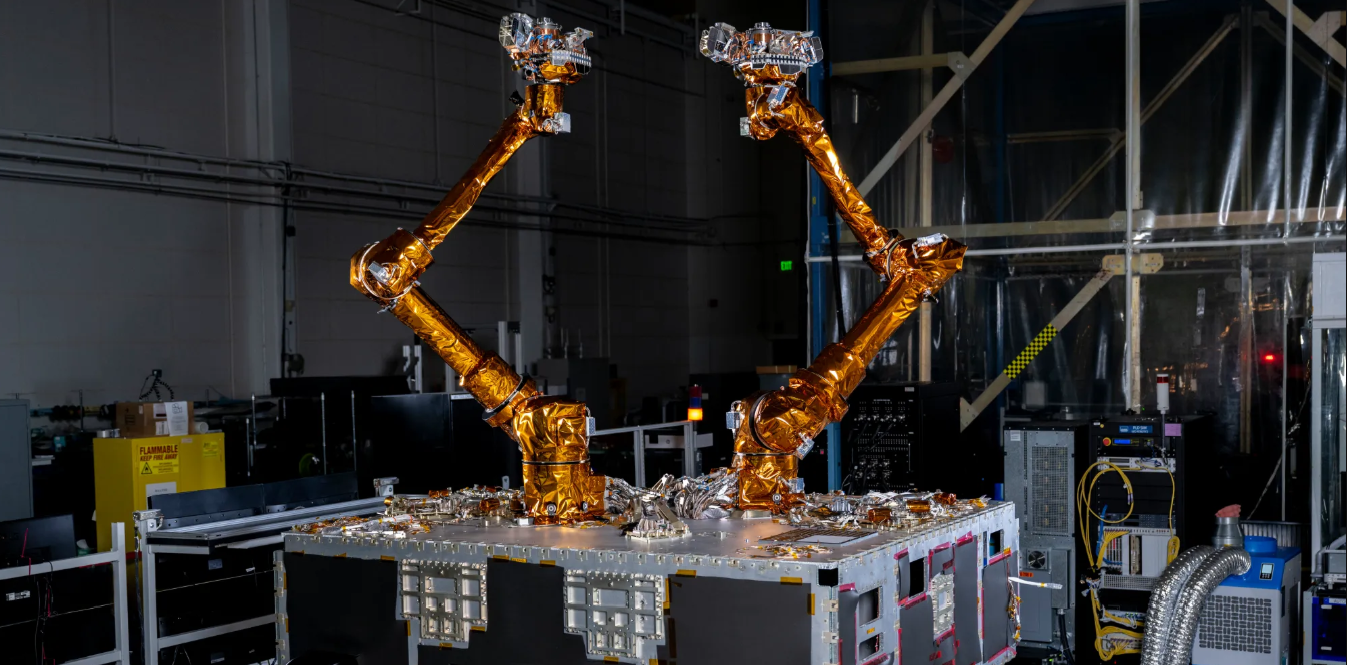
At the center of this shift is the Mission Robotic Vehicle (MRV), a spacecraft equipped with a highly dexterous robotic servicing suite—essentially a space mechanic capable of performing inspections, upgrades, repairs, and even repositioning operations 36,000 kilometers above Earth.
If it works, it could trigger one of the most important paradigm shifts in the history of space operations.
The End of “Use It and Lose It”
Today’s geostationary satellites are technological marvels—and financial burdens. Positioned in a precise orbital slot, they provide everything from global communications to weather forecasting and national security monitoring.
But they come with a fatal limitation: once their fuel runs out or a subsystem fails, they are effectively finished.
No repair. No upgrade. No second chance.
The cost of that limitation is enormous. A single GEO satellite can cost hundreds of millions of dollars and is expected to operate for around 15 years—after which it is often replaced, regardless of whether most systems still function.
DARPA’s RSGS program challenges this wasteful reality.
By enabling on-orbit servicing, the agency aims to create a new operating model where satellites can be maintained, upgraded, and extended—just like infrastructure on Earth.
That shift may sound obvious. In space, it is revolutionary.
Robots in Orbit: Technology Meets Risk
Technically, the mission borders on science fiction.
The MRV is designed to approach client satellites autonomously in the harsh environment of geostationary orbit and use robotic arms to perform delicate mechanical operations—while both objects travel at thousands of kilometers per hour relative to Earth.
It will rely on advanced sensors, cameras, and proximity operations systems to safely rendezvous, inspect, and manipulate satellites that were never designed to be serviced.
This is not just engineering complexity—it is operational risk.
Because a mistake doesn’t mean downtime. It could mean collision, debris generation, or damage to assets worth hundreds of millions.
This is why DARPA’s approach focuses not just on capability—but on repeatability and safety.
The goal is not a single demonstration, but a proof that in-orbit servicing can become routine.
A New Space Economy Emerges
If RSGS succeeds, its biggest impact may not be technological—but economic.
The shift from “replace” to “repair” could fundamentally alter the satellite business model. Operators might invest less in redundancy and fuel reserves, knowing that servicing options exist. Manufacturers might design satellites with standardized interfaces for future robotic intervention.
In other words, space could start to look more like a service industry—and less like a one-shot deployment model.
This also aligns with a growing trend across the aerospace sector: treating space as an ecosystem rather than a battlefield of isolated missions.
Companies and agencies alike are already exploring in-orbit logistics, refueling, inspection, and debris mitigation strategies that extend asset lifecycles and reduce environmental impact.
The Sustainability Angle No One Can Ignore
Beyond economics, there is a second driver: sustainability.
Earth’s orbital environment is getting crowded—and dangerous. Rising levels of space debris increase collision risks, threaten active missions, and raise insurance costs.
Servicing satellites instead of replacing them could reduce launches, limit debris creation, and support a more sustainable orbital ecosystem.
In that sense, DARPA’s robot isn’t just about maintenance.
It’s about survival.
The Real Test: Not Technology, But Trust
Despite the hype, the real challenge for RSGS is not building a robot that works.
It’s convincing an industry to trust it.
Satellite operators are notoriously risk-averse—and for good reason. Any intervention in orbit carries potential consequences. The idea of letting a robotic system approach and manipulate high-value assets requires a level of confidence that has yet to be fully established.
This is why the upcoming mission matters so much.
If DARPA can demonstrate safe, repeatable servicing operations, it could unlock a new category of space capability—one where satellites are no longer terminal investments but evolving, upgradeable platforms.
If it fails, the industry may retreat back to its familiar model of disposable hardware.
A Turning Point Above Earth
What DARPA is attempting is bigger than a robotics experiment.
It is a bet on a different philosophy of space.
Not exploration—but maintenance.
Not expansion—but optimization.
And perhaps most importantly:
Not abandoning what we build—but learning how to sustain it.
If successful, the implications will extend far beyond GEO.
Because once you can fix satellites in orbit, you change the economics—and the imagination—of space itself.