Security Is Built in Factories. How Rheinland-Pfalz Is Positioning Itself for Europe’s Defense Future
Eurosatory 2026 in Paris made one thing unmistakably clear: Europe’s security will not be decided only by military doctrine, procurement programs or battlefield technologies. It will also be decided in factories, research laboratories, engineering offices and production halls.
That is why the strong presence of Rheinland-Pfalz at Europe’s leading security and defense exhibition matters. With a delegation of 17 participants, the German federal state used two intensive days at Eurosatory to strengthen networks, exchange ideas with key industry players and demonstrate its role as an industrial partner for Europe’s security architecture.
The timing could hardly be more relevant. Europe is facing a new security reality. The so-called Zeitenwende is no longer an abstract political term. It is a practical industrial challenge. Defense capability now depends on resilient supply chains, scalable production capacity, technological sovereignty and closer cooperation between politics, armed forces, large defense companies and small and medium-sized enterprises.
At Eurosatory, these topics were at the center of numerous high-level discussions. Representatives from Rheinland-Pfalz exchanged views with leading figures from the European security and defense industry, including companies such as GDELS Santa Bárbara Sistemas, Rheinmetall, Daimler Truck, Scania Group and KNDS Deutschland. The focus was clear: Europe must become faster, more resilient and more coordinated if it wants to respond effectively to today’s security challenges.
But the real message goes beyond individual meetings. Rheinland-Pfalz is not positioning itself as a passive observer in Europe’s defense transformation. It is presenting itself as an active industrial contributor.
The state has a strong mix of innovative SMEs, specialized suppliers, research organizations and major industrial sites. Companies such as Aaronia AG, Fritz Stephan GmbH - Medizintechnik, Dronivo GmbH, MANN+HUMMEL and Metallwerk Elisenhütte GmbH show how diverse the regional contribution to security can be. These are not only traditional defense topics. They include sensor technology, medical technology, drone-related capabilities, filtration systems, materials, production expertise and specialized industrial solutions.
This matters because modern defense capability is not built by prime contractors alone. Large systems depend on thousands of components, suppliers, sub-suppliers, engineers and production specialists. Without reliable SMEs, there is no resilient defense ecosystem. Without regional industrial strength, there is no European strategic autonomy.
The visit also underlined the importance of mobility and heavy industry. With Daimler Truck’s strong presence in Wörth, Rheinland-Pfalz is home to a major industrial location with relevance far beyond civilian transportation. In a security environment where logistics, mobility and industrial scalability are becoming strategic factors, such sites are part of the broader defense equation.
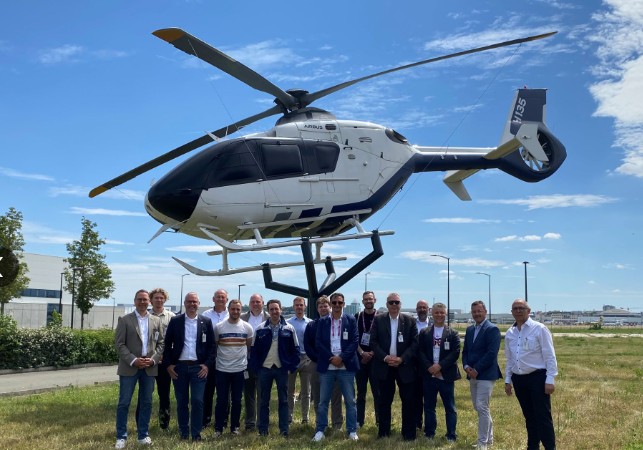
A fitting conclusion to the delegation’s visit was the tour at Airbus Helicopters. The visit highlighted how European cooperation, advanced technology and industrial excellence can come together in practice. Helicopters, defense vehicles, electronic systems, unmanned technologies, medical support systems and specialized components may look like separate fields. In reality, they are part of the same security ecosystem.
This is one of the most important lessons from Eurosatory 2026: security is no longer a narrow military topic. It is an industrial, technological and political project.
For Europe, that means the challenge is not only to buy more equipment. It is to build and maintain the industrial capacity required to produce, repair, modernize and scale that equipment over time. It is to connect major defense players with agile SMEs. It is to protect supply chains, accelerate innovation and ensure that technological expertise remains available in Europe.
Rheinland-Pfalz appears ready to play a serious role in that effort. Its combination of industry, research, SMEs and strategic production sites gives it a meaningful position in the European defense and security landscape.
Eurosatory 2026 showed that the future of European security will depend on more than weapons platforms. It will depend on networks, partnerships and the ability to turn industrial capability into operational resilience.
In that sense, Rheinland-Pfalz is not just another regional participant in the defense conversation. It is a reminder that Europe’s security starts long before a crisis reaches the front line. It starts with companies that can produce, innovate and deliver when it matters.