Germany Builds the Rockets the World Flies — But Not Its Own
Germany’s space industry is having a moment. Quietly, methodically, and with typical engineering precision, German suppliers are becoming indispensable to some of the world’s most ambitious launch systems. When the United States’ newest heavy‑lift rocket, New Glenn, lifts off under the Blue Origin banner, critical components inside it trace their origins not to Florida or Texas—but to Germany.
This is not coincidence. It is the result of decades of investment in high‑precision manufacturing, advanced materials, propulsion subsystems, and space‑grade electronics. German and European suppliers have built a reputation as the industry’s “hidden backbone”: rarely visible to the public, but crucial to mission success. International partners don’t source from Germany out of sentiment—they do so because reliability in space is not optional.
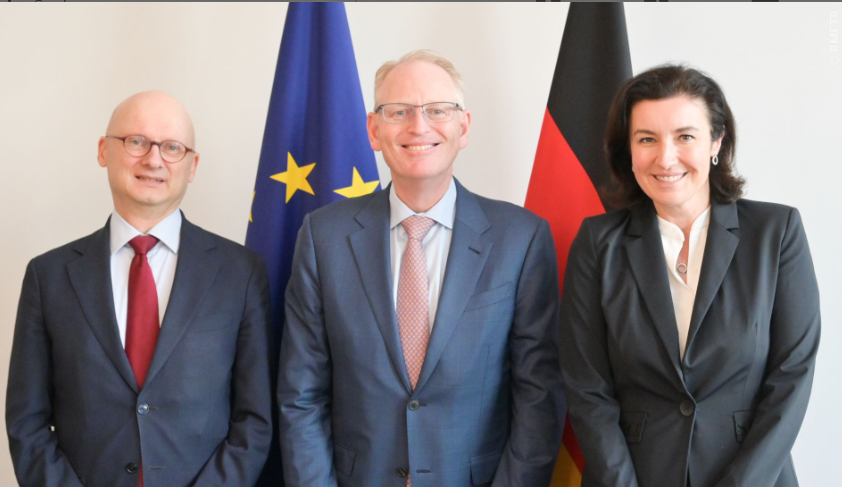
That message was publicly reinforced when Germany’s Minister for Space, Dorothee Bär, met with David Limp, CEO of Blue Origin. The conversation underscored what insiders already know: global launch providers increasingly rely on European technology to de‑risk their programs and accelerate readiness.
And yet, this success exposes a strategic paradox.
Germany helps build rockets that launch satellites, probes, and ambitions into orbit—yet Europe still depends on others to launch many of its own missions.
Industrial strength without launch autonomy
New Glenn, Blue Origin’s first orbital-class, reusable heavy‑lift rocket, represents a new generation of launch vehicles. Designed to carry large payloads to low Earth orbit and beyond, it is positioned as a long‑term competitor in the global launch market. German‑made components embedded in this system speak volumes about Europe’s technological depth.
But depth is not the same as autonomy.
Access to space is no longer a technical luxury—it is strategic infrastructure. Satellites underpin navigation, climate monitoring, secure communications, defense readiness, and economic competitiveness. When launch capability lies elsewhere, so does control over timelines, priorities, and resilience in times of crisis.
Recent years have made this painfully clear. Launch bottlenecks, geopolitical tensions, and shifting alliances have reminded Europe that sovereignty in space begins on the launchpad, not in the factory.
Why the launcher question matters now
Europe’s dilemma is not a lack of expertise. It is a lack of competitive, flexible launch systems that match today’s commercial and strategic reality: faster iteration, lower cost, and higher launch cadence. While European companies excel as suppliers, system integration and full-launch capability remain the missing piece.
This is where policy enters the frame.
Germany’s Federal Ministry for Research, Technology and Space (BMFTR) is backing initiatives to close this gap—most notably through the European Launcher Challenge, led by the European Space Agency (ESA). The goal is clear: stimulate competition, support innovative launcher startups, and develop European systems capable of delivering sovereign access to space.
The challenge is not symbolic. It is existential.
Component champions or space power?
Europe now stands at a crossroads.
One path continues the current trajectory: being the world’s premium subcontractor, indispensable but dependent. The other path demands political will, industrial risk, and long‑term commitment—to build launch systems that fly European missions, from European soil, on European terms.
Germany’s space industry has already proven it belongs in the top tier. The question is whether Europe is prepared to match industrial excellence with strategic ambition.
Because in the 21st‑century space economy, building the engine is not enough.
You also need to own the countdown.