China's Alleged Drone Supply Chain to Russia Faces New Scrutiny
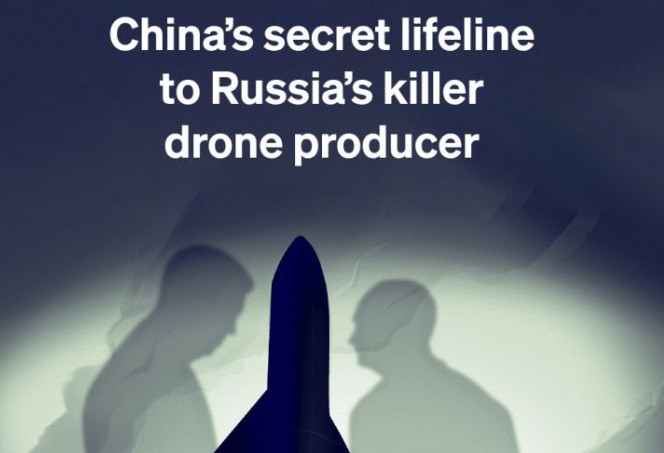
London/Washington/Moscow, September 2026 – A new investigation has intensified international scrutiny of China's relationship with Russia's defense-industrial sector, after documents reviewed by Western governments reportedly revealed direct shipments of key drone-production materials from a Chinese state-owned company to a sanctioned Russian enterprise.
The findings, first reported by POLITICO, center on shipments allegedly made by Jilin Chemical Fiber Group, a Chinese state-owned producer of advanced synthetic materials. According to the investigation, the company supplied approximately 46 tons of polyacrylonitrile (PAN) precursor, a critical ingredient in the production of military-grade carbon fiber, to Alabuga-Volokno, a subsidiary of Russia's state-owned nuclear and advanced materials giant Rosatom.
The significance of the shipment lies not only in its volume, but in what PAN precursor ultimately becomes. Once processed, the material is transformed into lightweight, high-strength carbon fiber used in aerospace applications, including unmanned aerial vehicles. Defense analysts cited in multiple reports argue that the quantity allegedly delivered could be sufficient to support the production of up to 1,300 long-range attack drones.
If confirmed, the documents could represent some of the strongest publicly reported evidence linking a Chinese state enterprise directly to a critical segment of Russia's wartime drone production chain. While Chinese-made electronic components have frequently been identified in Russian weapons systems recovered in Ukraine, investigators say these records suggest something different: the supply of essential industrial raw materials rather than finished civilian components.
At the center of the controversy is the allegation that the shipment was disguised using customs classifications associated with civilian synthetic fibers rather than dual-use industrial materials. Experts interviewed by multiple publications argue that such classification could mask the strategic significance of the cargo.
The documents were reportedly obtained from Russian sources by the Ukrainian Security and Cooperation Centre (USCC), a Kyiv-based organization, and subsequently shared with U.S. and U.K. authorities. According to reports, U.S. officials and members of the House Select Committee on China reviewed the records and considered them authentic. Ukrainian authorities have also reportedly confirmed the documents' legitimacy.
The timing of the revelations is particularly significant.
Relations between Washington and Beijing remain under close scrutiny as policymakers debate China's role in supporting Russia's economy and military-industrial base. The allegations are likely to increase pressure on Western governments to consider additional sanctions and export-control measures targeting entities involved in supplying dual-use materials to Russia.
China has consistently rejected accusations that it is supplying weapons to Russia. Chinese officials have repeatedly maintained that Beijing does not provide lethal military assistance to any party involved in the conflict and that export controls on dual-use items are strictly enforced. Chinese representatives cited in media reports described allegations of support for Russia's drone industry as unfounded.
Russia has also rejected allegations of wrongdoing. Rosatom stated that its companies operate in compliance with applicable laws and regulations and dismissed claims suggesting sanctions violations.
Yet regardless of how governments respond, the reported shipment highlights a broader reality of modern conflict: wars are increasingly shaped not only by weapons on the battlefield, but by global industrial supply chains operating thousands of kilometers away.
The production of modern drones depends on access to specialized materials, electronics, engines, composites, software, and manufacturing infrastructure. While sanctions aim to restrict those resources, global trade networks have proven remarkably resilient and adaptable.
As drone warfare continues to evolve, understanding who supplies the materials behind the systems may become just as important as tracking the drones themselves.
For policymakers, intelligence agencies, and defense planners, the controversy surrounding these alleged shipments underscores a growing challenge: controlling the flow of dual-use technologies in an interconnected global economy where industrial materials can serve both civilian and military purposes.