Challenger Research Group webinar on April 7, 2026 - The UAS Governance Gap
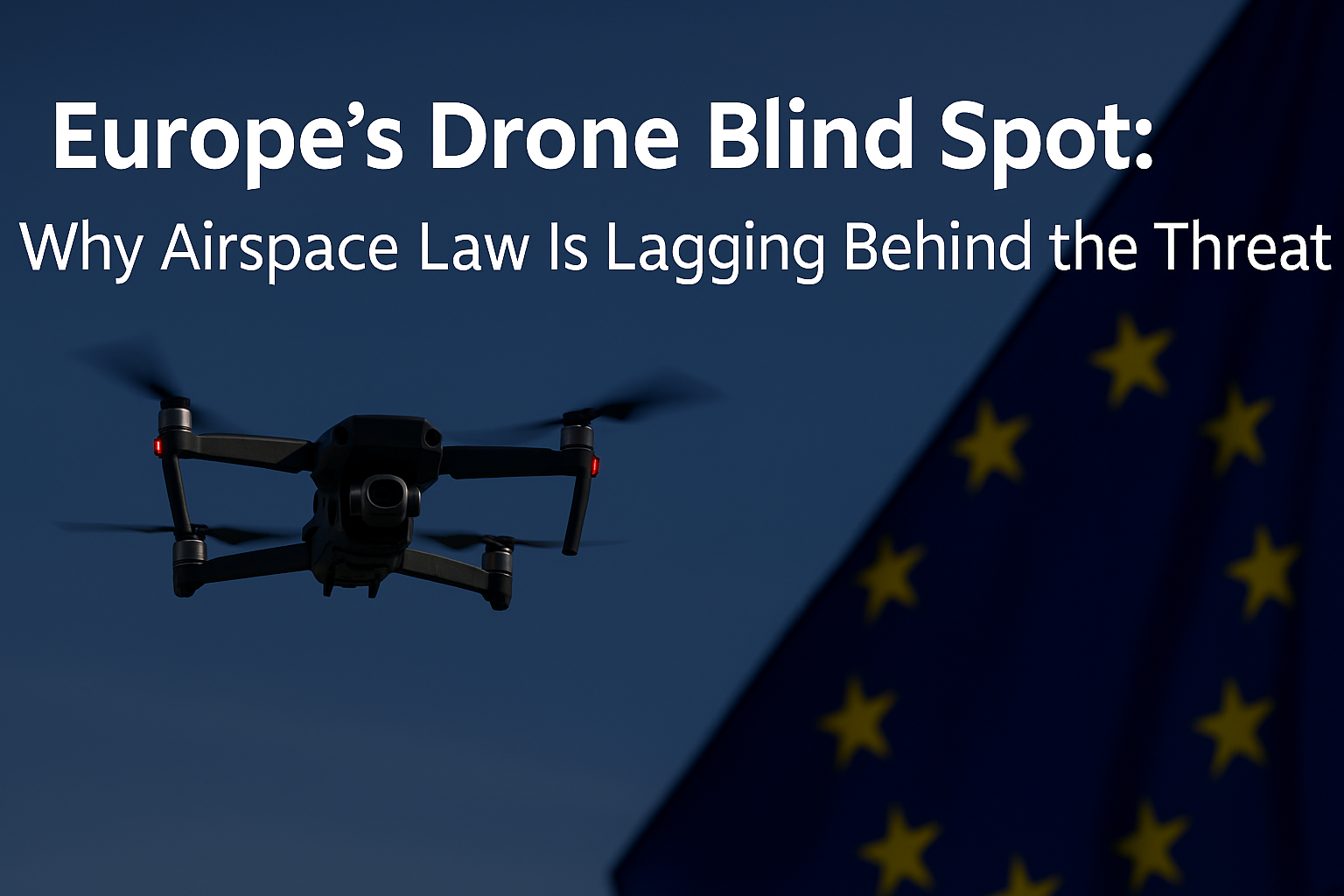
Europe’s airspace is increasingly contested - not by fighter jets or missiles, but by small, agile drones operating below the threshold of armed conflict. Detection technologies have improved rapidly, yet the legal authority to act on those detections remains fragmented, slow and politically constrained. The result is a growing governance gap that leaves critical infrastructure exposed and deterrence uncertain.
This challenge sits at the centre of The UAS Governance Gap, an executive briefing hosted by Challenger Research Group on April 7. Register now. Drawing on cross-UK and EU analysis, the session examines how unmanned aerial systems (UAS) are advancing faster than Europe’s regulatory and legal frameworks can adapt.
At the heart of the problem is a mismatch between responsibility and authority. In many EU member states, responsibility for counter-UAS (C-UAS) operations is distributed across police forces, aviation authorities, military units and infrastructure operators. Yet no single actor holds clear, rapid authority to neutralise a hostile drone in peacetime conditions. Detection may occur within seconds, but legal clarity often does not.
This fragmentation becomes stark when comparing national approaches. Poland, the UK, Germany and Italy have each developed distinct C-UAS frameworks shaped by different threat perceptions, legal traditions and civil-military relationships. While some states centralise authority within defence structures, others rely heavily on civilian agencies whose mandates were never designed for persistent aerial threats. The result is operational divergence across Europe - and uneven resilience.
Compounding the issue is an awareness gap between political decision-makers and those closest to the operational risk. Infrastructure operators, airport authorities and energy providers increasingly report frequent drone incursions. Yet at the political level, urgency often remains muted. Drones are still treated as isolated security incidents rather than systemic strategic vulnerabilities.
This divergence matters. Policy momentum tends to follow crisis, not foresight. Where awareness and concern are misaligned, reform timelines stretch, consultations stall and responsibility remains diffuse. History suggests that governance gaps of this kind rarely close without a triggering event.
Meanwhile, defence expenditure tells a contradictory story. Across Europe, spending on counter-drone technologies is rising. Sensors, effectors and integrated systems are being procured at pace. But investment in legal authority, testing frameworks and regulatory clarity has not kept pace. Technology is advancing into a legal vacuum.
This misalignment risks undermining deterrence. An adversary does not need to defeat Europe’s detection capabilities - only to exploit uncertainty over who is allowed to act, when, and under what legal conditions. Below the threshold of armed conflict, ambiguity becomes a tool.
The Challenger Research briefing brings together expertise from defence, regulatory design and political strategy to map these vulnerabilities. Managing Director Dr James Reeves leads the strategic assessment, while Regulatory Lead Seyide Direk examines statutory authority and compliance architecture across EU frameworks. Policy Analyst Sofia Zanin focuses on attribution challenges and civil-military coordination in grey-zone environments, and Thomas Welborn addresses the political dynamics that shape public engagement and reform inertia.
The conclusion is not alarmist, but sobering. Europe faces a narrowing window to align legal authority with operational reality - before a crisis forces clarity on far less favourable terms. Drones are no longer an emerging risk. They are a present one, and governance is now the weakest link in airspace security.
.png)