Enforce Tac 2026 - How It Was? Drones Security by Quantum Systems, Helsing, STARK, Rheinmetall and Dronivo plus Software Licensing

Nuremberg’s Enforce Tac has always positioned itself as a professional space for internal and external security. In 2026, it felt less like a trade fair and more like a compressed forecast of Europe’s next decade: unmanned systems everywhere, counter-UAS on nearly every second stand, and a growing understanding that whoever controls the software layer will increasingly control operational dominance.
The atmosphere was unmistakable. Beyond small arms, protective equipment and traditional defence hardware, the real gravitational center of the exhibition was autonomy. Electronics, AI-enabled systems and networked command architectures dominated discussions. Panels and exhibitor narratives made it clear: security is no longer primarily about equipment - it is about integration, data flow and system orchestration.
Quantum Systems: Expanding Autonomy to the Ground
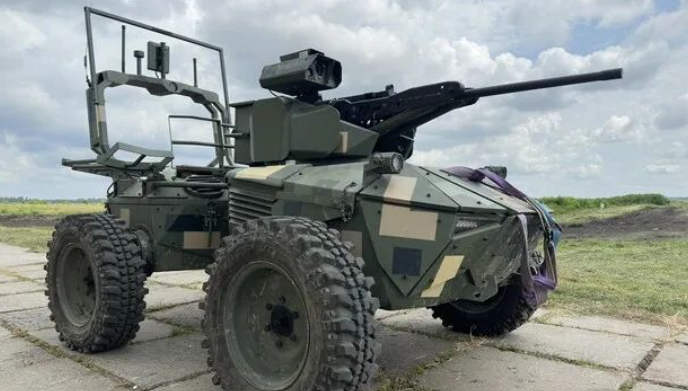
Quantum Systems used Enforce Tac 2026 to signal strategic expansion beyond aerial ISR. The company introduced its first unmanned ground vehicle, MANDRILL, marking the launch of a new ground robotics domain. Rather than presenting MANDRILL as a standalone platform, Quantum framed it as part of a broader ecosystem.
The key concept was integration. Through its MOSAIC UXS architecture, Quantum positioned MANDRILL as one node within a multi-domain system capable of sharing situational data and coordinating missions across air and ground assets. The narrative was clear: the future lies not in isolated platforms but in interoperable networks. MANDRILL’s high payload capacity, mobility and modular configuration suggested applications ranging from logistics and reconnaissance to electronic warfare and casualty evacuation.
Quantum did not merely showcase hardware - it presented a scalable systems philosophy.
Helsing: Normalizing the One-Way Effector
At the Helsing stand, the HX-2 loitering munition was prominently displayed. Its physical presence on the exhibition floor carried symbolic weight. What once would have been framed as controversial is increasingly treated as a practical capability under development and integration.
The message was not subtle. Loitering munitions are no longer experimental tools at the margins of defence planning - they are becoming central components of modern operational doctrine. By presenting the HX-2 openly and confidently, Helsing reinforced the sense that one-way attack drones are moving from debate to deployment.
In this context, Enforce Tac 2026 felt like a turning point in perception as much as technology.
STARK: Integration as Strategy
STARK’s presentation centered on integration across domains. Its VIRTUS loitering munition, VANTA unmanned surface vehicle and MINERVA command-and-control software were positioned not as separate offerings but as a unified defence stack.
The emphasis was on coordinated systems - air and maritime platforms operating under a shared C2 architecture. STARK’s messaging highlighted scalable production, AI-enabled control and sovereign European defence capability. The strategic positioning was clear: success in modern conflict depends less on individual effectors and more on the software layer that synchronizes them.
Integration was not a feature - it was the product.
Dronivo: Mission-Ready Pragmatism
While others emphasized ecosystem architecture and strategic integration, Dronivo focused on operational readiness. At its booth, visitors explored mission-ready UAV solutions including eBee Vision, eBee TAC, Milan 17 and Parrot Anafi UKR, alongside counter-UAS capabilities and a hands-on flight simulator.
The emphasis was practical. Reliable systems, proven workflows and real-world deployment mattered more than futuristic narratives. Dronivo positioned itself as a provider of field-tested tools for professional security applications, bridging commercial UAV heritage with defence requirements.
In contrast to ecosystem-heavy messaging elsewhere, Dronivo’s presence highlighted the ongoing demand for deployable, dependable systems.
Rheinmetall: RCWS320C-UAS
Rheinmetall presented the RCWS320C-UAS, a remotely controlled weapon station designed to protect vehicles and fixed positions against drones and other fast-moving threats. The system combines the SEOSS-320 electro-optical sensor suite with a Dillon Aero M134D Minigun, delivering a high rate of fire within an NGVA-compliant, modular architecture. Integration is envisioned across tracked and wheeled armored platforms, unmanned ground systems, and static protection roles.
Conceptually, the configuration makes sense. High rate of fire, stabilized optics, and vehicle integration form a logical kinetic response to close-range drone threats. On paper, this is how you counter low-altitude, fast-approaching UAVs.
But four years into full-scale drone-saturated warfare, the key question is no longer about specifications. It is about proof under realistic conditions.
Where is the demonstration footage of a moving armored vehicle engaging maneuvering drones under battlefield constraints? Most public demonstrations still feature stationary platforms, predictable drone flight paths, and controlled engagement geometry. That is not the operational environment modern brigades face.
The real test for any kinetic counter-UAS system is engagement on the move, against evasive, terrain-masked FPVs, while dealing with vibration, dust, latency, and network friction. A high rate of fire does not automatically translate into a high probability of kill.
Until credible dynamic trials are shown, the debate remains open: optimized for exhibitions — or for combat reality?
The Dominant Theme: Counter-UAS Everywhere
Across the exhibition halls, counter-drone solutions were ubiquitous. Detection systems, electronic mitigation, portable counter-UAS units and layered defence concepts reflected an industry responding to rapidly evolving aerial threats.
The density of counter-UAS offerings suggested a market reality: the drone is no longer the novelty - it is the baseline threat environment.
The Bigger Picture
Enforce Tac 2026 was not simply a showcase of new equipment. It was a snapshot of a defence sector reorganizing around autonomy, integration and scalable production. The most successful exhibitors were not those with the most dramatic hardware displays, but those articulating coherent system narratives.
The future presented in Nuremberg was clear: hardware matters, but control, coordination and software-defined integration matter more. Autonomy is no longer an add-on - it is becoming infrastructure.
Enforce Tac 2026 did not feel like a distant projection of tomorrow’s battlefield. It felt like a preview of what is already unfolding.
.jpg)

.jpg)