A Bicycle, Three RPGs and an Army Coming for Kyiv: The Ukrainian Warrior Behind an Iconic Image Is Dead
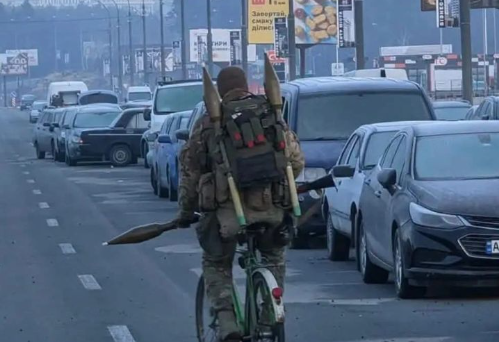
There are photographs that document a war. And then there are photographs that seem to explain an entire war in a single frame.
In the opening days of Russia's full-scale invasion of Ukraine, one such image emerged from the battle for the approaches to Kyiv: a Ukrainian soldier riding a bicycle with three RPG-7 grenade launchers slung across his shoulders.
His call sign was “Borets.”
A few days ago, according to reports announcing his death, the Ukrainian serviceman was killed in an enemy air strike.
Years after that extraordinary photograph was taken, its protagonist is gone. But the image remains a striking symbol of what happened around Kyiv in February and March 2022.
A Bicycle Against an Armored Advance
The circumstances surrounding the photograph almost sound fictional.
Russian forces were pushing toward Hostomel, Irpin and Bucha as part of the attempt to seize Kyiv. Armored columns were moving through the region while civilians desperately tried to escape.
Roads became clogged. Cars were abandoned. Families fled with whatever they could carry.
Borets went in the opposite direction.
A member of the “Tengri” sniper unit associated with Ukraine's Main Intelligence Directorate, he reportedly took a bicycle, loaded himself with three RPG-7 anti-tank grenade launchers and headed toward a bridge in Irpin to help confront the advancing Russian forces.
The imbalance captured by the photograph was extraordinary.
A bicycle and shoulder-fired weapons on one side.
An invading force equipped with armored vehicles, artillery, aircraft and missiles on the other.
Yet the Russian attempt to rapidly capture Kyiv ultimately failed.
The Human Factor Russia Miscalculated
Much has since been written about Russia's logistical failures, Ukrainian intelligence, Western support, anti-tank weapons and the tactical decisions that shaped the Battle of Kyiv.
But military hardware alone does not explain those first weeks.
There was another factor that is much harder to quantify: thousands of Ukrainians deciding that they would resist even when the military balance appeared overwhelmingly unfavorable.
Borets became a visual representation of that decision.
The photograph is powerful precisely because there is almost nothing futuristic about it. There is no sophisticated weapons platform dominating the frame. There is simply a man, a bicycle and enough weapons to make himself dangerous.
It captures the improvisation that defined the defense of Kyiv.
From Irpin to Command
The soldier in that photograph did not disappear after the Battle of Kyiv.
According to accounts published following his death, Borets continued fighting and eventually became the commander of a marine unit.
Reports describing his service credit him and the units in which he fought with an extensive combat record. Precise figures are difficult to independently establish, particularly given the classified nature of intelligence and special operations.
What is clearer is the reputation he left among those who served alongside him: determined, aggressive in battle and capable of leading others under extreme pressure.
That makes the famous photograph look different today.
At first glance, it can appear almost absurd: a cyclist heading toward mechanized warfare.
In retrospect, it represents something much larger.
One Photograph, an Entire War
Modern wars are increasingly defined by drones, satellites, artificial intelligence, electronic warfare and precision-guided weapons.
Yet wars still ultimately depend on people deciding whether to advance, retreat, resist or surrender.
In early 2022, many expected Kyiv to fall quickly.
It did not.
Thousands of individual decisions contributed to that outcome. Some were made in command centers. Others were made on streets, bridges and checkpoints by people who had no guarantee that they would survive the day.
Borets made his choice.
He got on a bicycle and rode toward the invasion.
Years later, after continuing to fight and eventually commanding other soldiers, his war has ended.
The photograph has not.
It will remain one of those rare images in which an enormous historical event is reduced to something almost impossibly simple:
one man, one bicycle, three RPGs—and an army coming the other way.