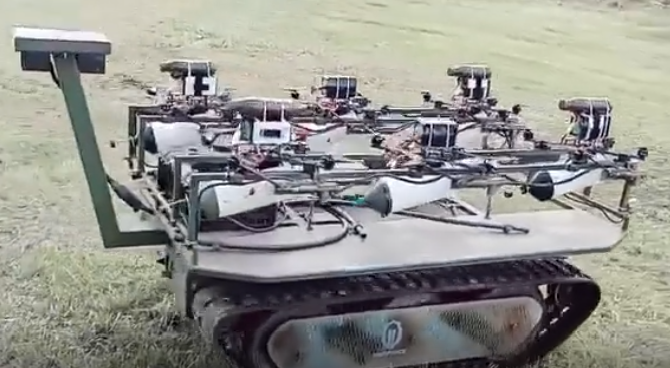
50,000 Killer Drones. Germany Is Betting That Mass Will Win the Drone War

The future of warfare may not arrive in the form of a next-generation fighter jet, a hypersonic missile, or a billion-euro air-defense system.
It may arrive as 50,000 small drones.
Germany has reportedly committed approximately €90 million to finance the procurement of 50,000 Shrike FPV combat drones for Ukraine, marking one of Europe's largest publicly known investments in tactical drone warfare to date.
The message behind the decision is impossible to ignore:
Quantity has become a strategic weapon.
For decades, military power was measured through expensive platforms—tanks, aircraft, warships, and sophisticated missile systems. The battlefield in Ukraine is creating a radically different reality. Today, relatively inexpensive FPV drones are destroying tanks, artillery systems, air-defense assets, and logistics vehicles worth millions.
The economics of warfare are being rewritten in real time.
The Rise of the Shrike
The drones funded by Germany are manufactured by Ukrainian defense company Skyfall, one of the country's fastest-growing producers of unmanned systems.
The selected platform is the Shrike FPV family, equipped with software from Auterion that enables automatic target tracking.
That capability matters.
Traditional FPV drones require highly skilled operators to maintain visual contact and guide the aircraft to impact. AI-assisted target tracking increases engagement effectiveness and reduces operator workload, helping maintain lethality even in highly contested environments.
In modern warfare, software increasingly matters as much as hardware.
The Shrike family represents exactly that trend.
Why the US Army Took Notice
The growing attention surrounding Skyfall is not limited to Ukraine.
The company recently attracted widespread interest after its Shrike 10 Fiber reportedly achieved the highest score in the US Army's Drone Dominance Competition.
The system earned 99.3 out of 100 points, outperforming competitors in demanding evaluation scenarios designed to replicate real battlefield conditions.
Perhaps the most remarkable detail is not the score itself.
US Army participants reportedly received only minimal system familiarization and very limited flight training before executing operational missions.
Yet multiple pilots successfully completed the challenge using the platform.
That suggests a critical advantage in future drone warfare:
Ease of use.
The next generation of military systems must not only be effective. They must also be deployable at scale by operators with limited training time.
The Fiber-Optic Revolution
Among Skyfall's most significant developments is the Shrike Fiber variant.
Unlike conventional drones that rely primarily on radio-frequency communications, fiber-optic FPV systems transmit command and video signals through physical fiber connections.
The military implications are profound.
Electronic warfare has become one of the most effective methods of disrupting drone operations. Jamming and signal interference regularly render traditional systems ineffective.
Fiber-optic drones largely bypass that problem.
As battlefield electronic warfare capabilities expand, many experts expect fiber-controlled systems to become increasingly important for high-value missions near the front lines.
In many respects, the drone war is becoming an invisible contest between signal disruption and signal resilience.
The Industrialization of Drone Warfare
The most important part of Germany's order may not be the drones themselves.
It is the scale.
Fifty thousand units represent industrial production, not experimental procurement.
This reflects a fundamental shift in military thinking.
Success is increasingly determined not only by technological superiority but by manufacturing capacity, supply-chain resilience, and the ability to rapidly replace losses.
Drone warfare has transformed attrition from an unfortunate consequence into a deliberate operational strategy.
The side capable of producing, deploying, and replenishing unmanned systems fastest gains a significant advantage.
This is why governments across Europe, North America, and Asia are racing to expand domestic drone production capabilities.
Beyond the Drone
Skyfall's ambitions extend far beyond FPV platforms.
The company produces the Vampire heavy bomber drone, develops various Shrike attack systems, and manufactures the P1 Sun interceptor drone, designed to engage aerial threats including Shahed-type drones.
At the same time, the firm operates the Skyfall Academy, where more than 20,000 pilots, technicians, and instructors have reportedly been trained.
This points toward another reality of modern warfare:
Victory depends not only on technology.
It depends on ecosystems.
Factories, software, training programs, maintenance networks, and industrial scalability have become as important as individual weapons.
A New Military Equation
Germany's decision to fund 50,000 drones may ultimately be remembered as more than a procurement contract.
It may symbolize a broader transformation of military strategy.
The battlefield is increasingly rewarding systems that are affordable, intelligent, scalable, and expendable.
For generations, nations competed to build the most sophisticated weapons.
Today, they are competing to build enough of them.
The era of boutique warfare is ending.
The era of drone mass production has begun.