250,000 Rifles and a Message to Europe. Germany's Rearmament Just Became Rea
Germany's military ambitions were discussed in terms of promises, budgets, strategic reviews, and political speeches. Critics questioned whether Berlin's much-publicized Zeitenwende—the historic shift in defense policy announced following Russia's invasion of Ukraine—would ever fully materialize.
Now, the answer may be arriving one rifle at a time.
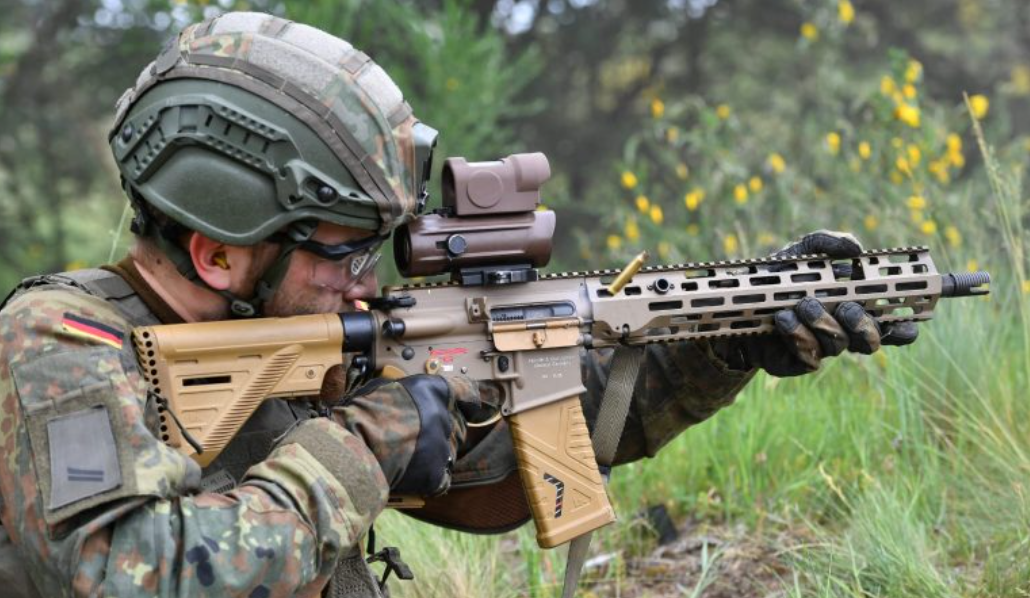
The Bundeswehr's procurement agency has officially triggered the full framework contract for 250,000 G95 assault rifles, completing one of the largest small-arms acquisitions in modern German military history. More importantly, the decision sends a signal extending far beyond infantry equipment.
Germany is no longer preparing for change.
Germany is executing it.
The End of the G36 Era
For nearly three decades, the Heckler & Koch G36 defined the German infantryman. Introduced in the 1990s, it became a symbol of the post-Cold War Bundeswehr—smaller, expeditionary, and largely focused on international stabilization missions rather than large-scale continental defense.
Today's security environment looks dramatically different.
The war in Ukraine, NATO's renewed focus on collective defense, and growing concerns over large-scale conflict have transformed military planning across Europe. Armies are once again being measured by readiness, stockpiles, sustainability, and mass.
The G95 reflects that new reality.
Based on Heckler & Koch's combat-proven HK416 platform, the rifle has been selected as the Bundeswehr's next-generation standard weapon. Available in both the G95A1 and the more compact G95KA1 configuration, the system features ambidextrous controls, modern optics integration, and compatibility with NATO's standard 5.56×45 mm ammunition.
But the significance lies not in the specifications.
It lies in the quantity.
Why 250,000 Matters
Military procurements often generate headlines, yet few numbers carry strategic meaning quite like 250,000 rifles.
This is no boutique acquisition for elite units.
This is force-wide modernization.
The original contract, signed in 2023, covered approximately 118,000 rifles. By late 2025, German lawmakers approved a dramatic expansion, more than doubling the procurement ceiling and increasing the program's value to over €800 million.
Now the entire framework has been activated.
The scale reveals an uncomfortable truth increasingly recognized by European defense planners: deterrence requires mass.
For years, Western militaries optimized for efficiency. Smaller forces, lean logistics, and highly specialized units became the norm.
Ukraine has changed that calculation.
Modern warfare consumes personnel, ammunition, equipment, and replacement systems at rates many analysts considered unimaginable only a few years ago.
The lesson is clear.
Quality remains essential.
But quantity matters again.
Heckler & Koch's Strategic Bet
For Heckler & Koch, the complete contract activation represents more than a business success.
It validates a long-term industrial strategy built around production readiness.
While many manufacturers wait for contracts before expanding capacity, the German weapons maker argues that real military readiness begins years earlier through sustained investment.
The company has already completed its HK100 modernization program and is continuing expansion through its "HK Evolution" initiative. According to company statements, more than €230 million is being invested in production facilities, advanced manufacturing technologies, infrastructure, and international operations.
This reflects a broader transformation occurring throughout the defense sector.
The key competitive advantage is no longer simply designing advanced weapons.
It is producing them quickly, reliably, and at scale.
In an era where governments increasingly discuss "war-time production capacity," industrial resilience has become a strategic capability of its own.
The Bigger Question: Is 250,000 Enough?
Ironically, the completion of Germany's largest rifle acquisition may immediately trigger the next debate.
Several defense observers believe that a fully modernized Bundeswehr—including reserves and expanded force structures—could ultimately require significantly more weapons than currently planned.
Some industry estimates suggest long-term requirements might approach half a million rifles if reserve formations receive the same level of modernization as active units.
No official decision exists.
But the conversation itself is revealing.
Five years ago, discussing 500,000 new assault rifles in Germany would have sounded politically impossible.
Today, it sounds plausible.
From Symbol to Capability
The G95 program ultimately represents something larger than a firearms procurement.
It demonstrates the transition from strategic rhetoric to material capability.
Military power is not measured by speeches, white papers, or budget announcements.
It is measured in factories producing equipment, soldiers receiving equipment, and units training with equipment.
That process is now underway.
The Bundeswehr's new standard rifle is not simply replacing the G36.
It is becoming one of the clearest symbols yet that Germany's rearmament is no longer a future ambition.
It is an active industrial reality.
And Europe is paying attention.
.jpg)