$1.4 Billion on Physical AI. NEURA Robotics Bets the Real World Will Outpace the Screen
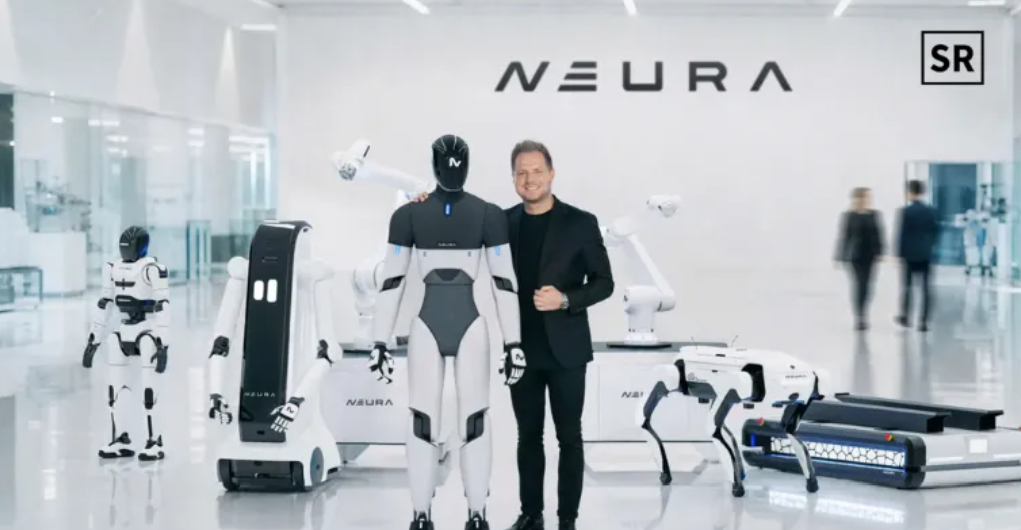
For years, artificial intelligence has lived behind screens—generating text, analyzing data, optimizing workflows. But NEURA Robotics is making a bold, expensive bet: the future of AI won’t stay digital. It will move into the physical world—and take over entire industries.
With up to $1.4 billion in fresh Series C funding, the German robotics company is positioning itself at the forefront of what it calls “physical AI.” And if the scale of the investment is any indication, the market is starting to believe.
Backed by a heavyweight coalition—including Amazon, NVIDIA, Qualcomm, Bosch, and the European Investment Bank—this is not just another startup funding round. It is a signal: robotics is no longer a niche sector. It is becoming a core pillar of the next technological wave.
And NEURA does not aim to build just robots.
It aims to build an ecosystem.
At the heart of the company’s vision is something called the Neuraverse—a platform where robots don’t just execute tasks, but learn, collaborate, and evolve together. Unlike traditional industrial machines, which are typically programmed for specific, repetitive operations, NEURA’s approach integrates AI, sensors, edge computing, and large-scale learning into a connected system.
In other words: robots that behave less like machines—and more like a network.
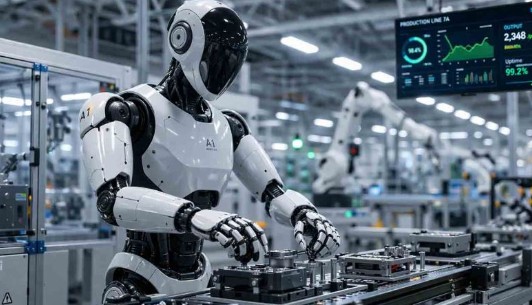
This is where the comparison to current AI trends becomes sharp. While generative AI has dominated headlines, much of it remains confined to software environments. NEURA is betting that the real disruption lies in taking AI out of the cloud and embedding it directly into physical systems that interact with the world.
CEO David Reger puts it bluntly: the future of AI will move, interact, and work alongside humans.
That shift, if realized, would fundamentally change how industries operate.
Manufacturing, logistics, healthcare, service industries—even homes—are all facing the same structural challenge: labor shortages and increasing demand for efficiency. Aging populations in Europe and other developed regions only intensify this pressure. In this context, intelligent robotics is not just an innovation—it becomes an economic necessity.
But scaling that vision is the real challenge.
NEURA’s ambition to produce millions of robots by 2030 highlights the magnitude of what it is attempting. This is not incremental growth. It is industrial-scale transformation. And to achieve it, the company is investing heavily in “NEURA Gyms”—real-world training environments where robots can learn new tasks and refine their capabilities.
It’s a telling detail.
Training AI models in the virtual world is relatively straightforward. Training robots in the real world is messy, unpredictable, and expensive. Every movement, every interaction, every failure has to be learned physically. That complexity is one of the biggest barriers to scaling robotics—and also the biggest opportunity for companies that manage to solve it.
NEURA is betting it can.
The presence of investors like NVIDIA and Qualcomm underscores another layer of the story: this is not just about robotics hardware. It is about computing power, AI models, and data infrastructure working together. The convergence of these domains is what enables physical AI to become viable at scale.
And that convergence is accelerating.
Yet, as with all ambitious visions, there are questions.
Can a single platform truly unify such diverse applications across industries? Will companies be willing to adopt fully integrated systems rather than specialized solutions? And can NEURA maintain technological leadership in a space that is attracting increasing global competition—from U.S. tech giants to Asian robotics powerhouses?
The answers are far from certain.
But what is certain is this: the narrative around AI is shifting.
The next phase is not just about intelligence—it is about embodiment.
If NEURA succeeds, the impact will reach far beyond factories or warehouses. It will reshape how humans interact with technology in everyday life—blurring the line between digital intelligence and physical action.
The $1.4 billion investment is not just funding a company.
It is funding an idea—that the biggest AI revolution is not happening on your screen.
It is happening in the real world.