XTRACKS Nano MK.II - The $10K Robot That Might Kill the SUV and Save Autonomy

For years, autonomy has been trapped in a paradox: the systems we trust to drive at 100 km/h are developed in environments that barely allow half that speed. Regulations, safety concerns and cost barriers have turned real-world testing into a bottleneck. The result? Smarter algorithms, but slower progress.
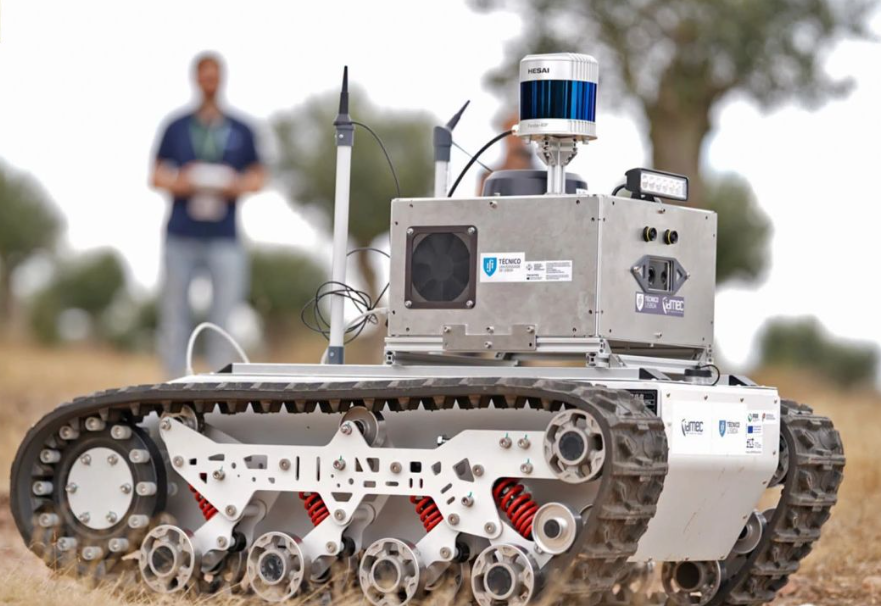
Enter the XTRACKS Nano MK.II—a compact tracked UGV that quietly challenges everything about how we build autonomous systems.
At first glance, it looks like a small research robot. But that’s exactly the point. Instead of chasing scale, XTRACKS-ROBOTICS has engineered something far more disruptive: a low-cost, modular, high-dynamic test platform that enables experimentation without the weight of bureaucracy.
Autonomy doesn’t fail in simulation. It fails in chaos—mud, snow, vibration, unpredictable terrain. That’s where the Nano MK.II thrives.
Its tracked drivetrain delivers extreme stability and traction, allowing consistent performance across environments where wheeled systems struggle. Snow-covered hills, loose gravel, uneven terrain—these aren’t edge cases here; they are the baseline. Stability isn’t just about control; it’s about data quality. Better motion equals better sensing, and better sensing means better decisions.
But the real revolution is not mechanical—it’s architectural.
The Nano MK.II is built as an open system. Sensors, compute modules, AI stacks—everything can be swapped, upgraded or reconfigured. In an industry dominated by closed ecosystems, this level of flexibility is rare. And powerful.
Instead of investing millions into a single-purpose autonomous vehicle, teams can deploy multiple Nano units, each configured differently, testing multiple hypotheses in parallel. It’s not just cheaper—it’s faster learning per euro.
And that changes the economics completely.
Traditional autonomous vehicle programs often burn through budgets before reaching meaningful real-world validation. The Nano flips that equation. With its relatively low cost, universities, startups and even small engineering teams can now access a level of testing previously reserved for large corporations.
More iterations. More failures. More learning.
That’s how innovation actually happens.
The design philosophy behind the Nano MK.II is equally pragmatic. Early prototypes relied on off-the-shelf track systems—and failed. Tracks slipped, components wore out, systems degraded. Instead of patching the problem, XTRACKS redesigned the entire track architecture: modular segments, improved guide geometry, better material distribution.
The result is not perfection. It’s resilience.
And resilience is what autonomy needs.
Performance-wise, the system scales with configuration. Depending on drivetrain setup and power systems, speeds range from controlled research pacing to aggressive high-speed testing. Payload capacity allows integration of LiDAR, cameras, compute units—even experimental sensor stacks.
This makes the Nano MK.II not just a robot, but a platform for ideas.
And then comes the uncomfortable question:
If a small, rugged, affordable tracked robot can do 80% of what large autonomous vehicles do during development… why are we still building those large systems so early?
The implications go beyond research.
In first-response scenarios, a platform like Nano could map disaster zones without risking human life. In defense, its low cost and modularity make it suitable for attritable systems—machines designed to be expendable. In industry, it becomes a mobile sensor node, a data collector, a scout.
Not glamorous. Not futuristic.
But brutally effective.
The future of autonomy may not arrive in a sleek electric SUV.
It might arrive as a small tracked robot, quietly driving through mud, collecting data—and making the entire industry rethink how it builds intelligence.