When the Signal Dies - Starlink, Telegram, and Russia’s Command-and-Control Reality Check
Having parents in Eastern Europe, we often use Telegram. And...modern war is often described through images of tanks, drones, and trenches. But behind every explosion sits something less visible - connectivity. Bandwidth has become as important as ammunition, and command-and-control networks now define the speed and effectiveness of military operations.
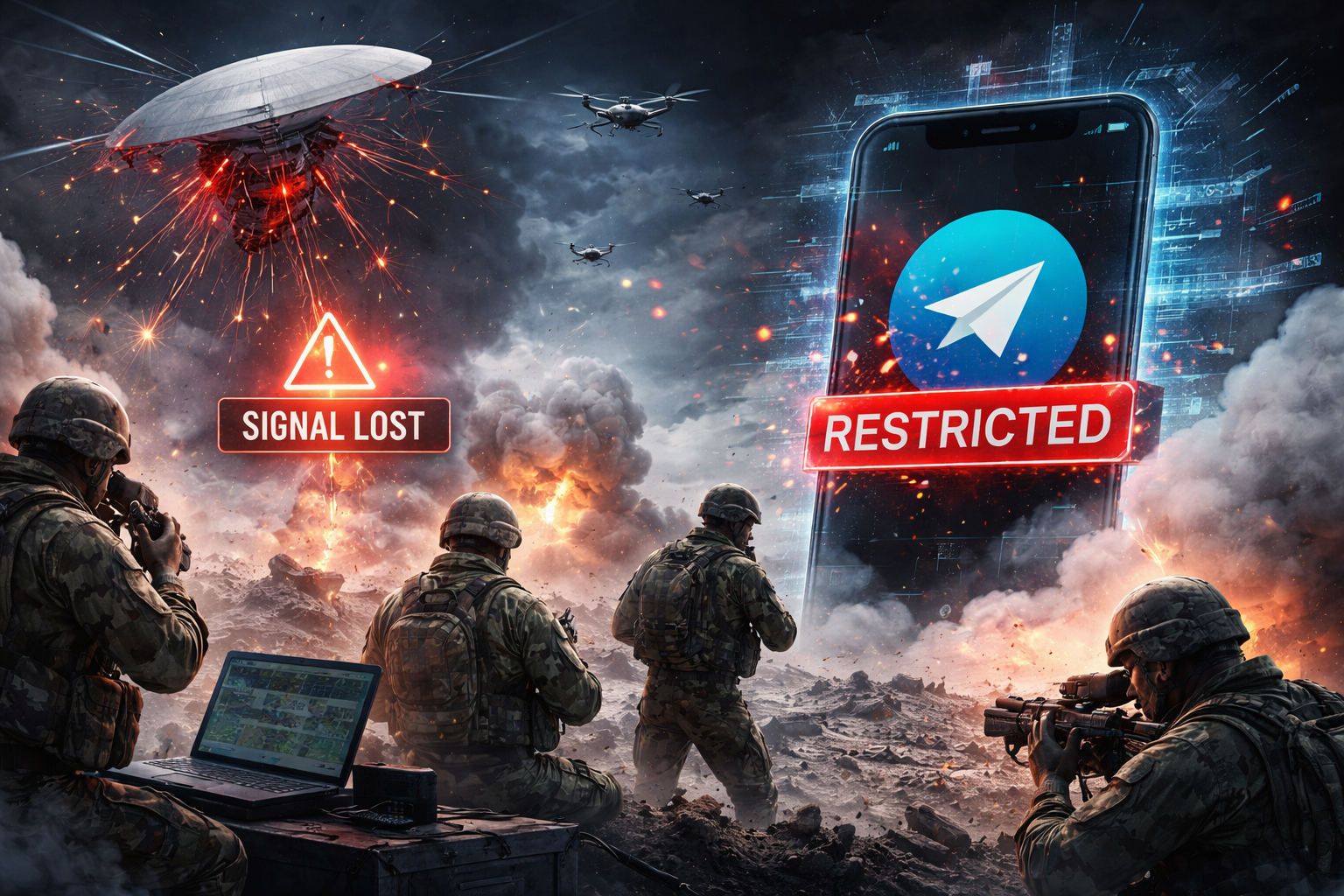
Recent reports suggest that Russian frontline units experienced a sudden connectivity shock following the deactivation of unauthorized satellite terminals and simultaneous restrictions on messaging platforms inside Russia. Whether these events were directly linked or merely overlapping in time, they reveal a deeper reality: modern warfare runs on commercial digital infrastructure.
1. The Drone War Is a Data War
In today’s drone-heavy battlefield, the kill chain is fundamentally a communications problem. A small UAV captures live video, the feed is transmitted instantly to operators, and artillery or strike drones react within seconds. Break the video link, and the tempo collapses.
Military analysts increasingly describe modern conflict as a war of networks rather than platforms. Drone units depend on reliable connectivity to bypass electronic warfare and maintain real-time coordination. When that connection disappears, units often fall back to older, slower communication systems, reducing flexibility and slowing operations.
The lesson is stark: losing connectivity can matter as much as losing weapons.
2. Messaging Apps as an Informal Military Backbone
At the same time, restrictions on messaging platforms triggered unusual backlash from pro-war voices who described these tools as essential for frontline coordination. Soldiers, bloggers, and commentators highlighted how civilian apps have become deeply embedded in logistics, communication, and operational decision-making.
This dependency reveals a paradox. Platforms built for civilian use increasingly function as military infrastructure during conflict. Yet these same platforms remain vulnerable to policy decisions, technical throttling, or regulatory intervention.
When both satellite connectivity and messaging channels face disruption, command-and-control can slow dramatically - not because of battlefield losses, but because the digital backbone weakens.
3. The Fragility of Commercial Warfare
The broader story is not about one tactical episode. It is about fragility.
Both sides in modern conflicts have demonstrated how military effectiveness now depends on commercial technologies never designed for prolonged warfare. Satellite internet, encrypted apps, and consumer-grade systems provide rapid capability but introduce strategic vulnerability.
This creates a new risk landscape:
- policy shifts can influence battlefield performance,
- platform decisions can affect operational tempo,
- and commercial systems become targets for cyber and electronic warfare.
The digital supply chain itself becomes part of the battlefield.
4. A C2 Moment of Truth
Military theory has long emphasized command-and-control as decisive. Recent disruptions underline that principle. Breaking communications slows decision cycles, fragments situational awareness, and forces units into reactive behavior.
The key insight for European security planners is clear: reliance on commercial infrastructure may offer speed and affordability but carries strategic risks in prolonged high-intensity conflict. A force that depends on privately controlled digital platforms can be disrupted without direct engagement.
In the age of electronic warfare, disconnecting the network may be more effective than destroying physical assets.
5. The Bigger Strategic Lesson
Correlation does not prove causation. Yet the timing of connectivity disruptions and communication restrictions highlights a larger truth about modern warfare.
The battlefield of the future is as much about data flows as it is about territory. States that fail to secure resilient, independent communication layers risk losing operational momentum when it matters most.
The provocative reality is simple: in high-intensity conflict, command-and-control is often the decisive weapon long before the first shot is fired.
Break the link, and you break the tempo.