From Sunzi to Clausewitz - Why Strategy Matters More Than the Next AI Model
1. The Illusion of the Next Big Model
Every few months, the tech world declares a new AI breakthrough. A larger model. Faster reasoning. More parameters. The headlines suggest a relentless race toward technological supremacy, where whoever builds the most powerful AI wins.
But history suggests something different. Technology alone rarely decides the outcome. Strategy does.
For decades, the United States dominated each technological wave - hardware, software, the internet, mobile platforms, cloud computing, and now artificial intelligence. The real power of Silicon Valley was never just capital or innovation. It was the ability to set global standards. The world adapted to American platforms, business models, and ecosystems, turning technological leadership into economic dominance.
Now, with AI, that dominance is being challenged in unexpected ways.
2. Sunzi’s Lesson - Winning Without Fighting
China’s approach to AI competition does not always look like direct confrontation. Instead of trying to outspend or out-hype American companies, Chinese firms increasingly release powerful open-source models at minimal cost. The strategy feels deeply aligned with Sunzi’s philosophy: the best victory is achieved when the opponent cannot effectively fight.
When capable alternatives become freely available, monopolistic visions collapse. Revenue expectations shrink, investment narratives weaken, and the gravitational pull of dominant platforms decreases. The goal is not necessarily to defeat US companies head-on but to redefine the playing field so no single player controls it.
This is not new. In the 1990s, Linux played a similar role against Microsoft’s operating system dominance. It didn’t replace the incumbent overnight - but it prevented absolute control.
AI may be repeating that pattern.
3. Europe Between Sovereignty and Rules
Europe enters this strategic chessboard with a different toolkit.
France represents one path - technological sovereignty. In the spirit of De Gaulle’s insistence on independence, French initiatives in large language models signal a desire to control critical capabilities internally. The logic is clear: reliance on foreign technology means vulnerability.
The broader European Union reflects another tradition inspired by Jean Monnet. Rather than racing for raw technological supremacy, Europe focuses on regulatory power. The EU AI Act, often dismissed as bureaucratic, can be understood differently: as an attempt to shape global norms. If companies want access to European markets, they must follow European rules.
This is power through structure rather than scale.
Yet regulation alone cannot define strategy.
4. Clausewitz and the Missing Question
German military thinker Carl von Clausewitz offers a sobering lens. Technology, rules, and resources mean little without a clear political objective. His logic is simple: those who do not define their own strategy become part of someone else’s strategy.
Applied to AI, the message is uncomfortable.
Building models without a clear purpose risks symbolic achievements rather than lasting influence. Regulation without an operational vision risks creating defensive systems that slow innovation without shaping outcomes. Waiting for the next model breakthrough may simply mean arriving too late.
The critical question, then, is not who has the most advanced AI model. It is who knows what they want to achieve with it.
5. Models Are Becoming Commodities
AI models are increasingly interchangeable. Open-source alternatives, rapid iteration cycles, and falling training costs suggest that raw model power will soon be widely accessible. The competitive edge shifts elsewhere - toward applications, integration, and solving real-world problems.
This changes the strategic landscape dramatically. The winners may not be those building the largest models, but those embedding AI into systems where failure is unacceptable: critical infrastructure, healthcare compliance, aerospace, logistics, or legal processes.
In these domains, trust, reliability, and domain expertise matter more than benchmark scores.
6. The Real Strategic Battle
The AI race is no longer simply a technological competition. It is a geopolitical and economic struggle about standards, control, and purpose.
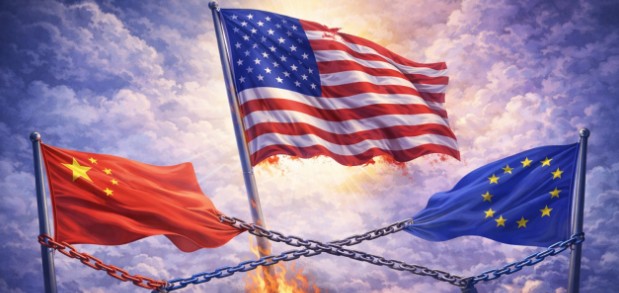
The United States leads through innovation ecosystems. China challenges through openness and structural disruption. Europe seeks influence through regulation and selective sovereignty.
But none of these paths guarantee success.
The provocative reality is that many organizations remain obsessed with choosing the “right model” while ignoring the more important question: what unique problem do they solve that nobody can afford to get wrong?
7. Strategy Is the Application
From Sunzi’s indirect tactics to Clausewitz’s focus on political objectives, one lesson remains constant: tools are secondary to intent.
AI models will evolve, improve, and multiply. But strategy cannot be downloaded or open-sourced.
The future will belong not to those waiting for the next model release, but to those who define clear objectives and align technology accordingly.
In the end, strategy is not the model.
Strategy is the application.