When Propaganda Drops the Mask. The Dangerous Evolution of Russia’s War Narrative
Wars are fought with tanks, missiles, drones, and artillery.
But they are also fought with words.
Sometimes those words reveal more than any battlefield report, intelligence assessment, or military communique. They expose intentions, assumptions, and political calculations that weapons alone cannot.
That is why recent remarks by Petr Tolstoy, Deputy Speaker of the Russian State Duma, have attracted such attention beyond Russia's borders.
Appearing on Russian state television, Tolstoy reportedly argued that the objective of strikes against Ukrainian cities should be to demoralize the population to such an extent that civilians would ultimately accept defeat and welcome advancing forces. He suggested warning residents in advance and allowing them to leave before attacks.
The comments generated immediate controversy.
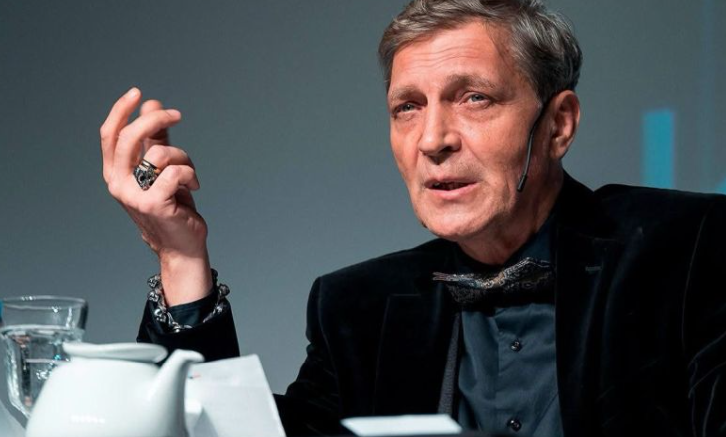
Among the most vocal critics was Russian-born journalist and commentator Alexander Nevzorov, who interpreted the statement as evidence that Russia was increasingly abandoning the language and justifications that had accompanied the war during its earlier phases.
According to Nevzorov, the significance of the statement lies not merely in what was said, but in what it represents: a perceived abandonment of political restraint and a transition toward a far more direct and uncompromising rhetoric.
Whether one agrees with Nevzorov's characterization or not, the episode highlights an important reality.
Narratives matter.
Throughout history, governments have sought to frame military objectives in language that appears strategic, defensive, humanitarian, or ideological. States rarely present their actions simply in terms of raw coercion. Public messaging typically seeks legitimacy as much as victory.
What makes controversial statements like Tolstoy's notable is that they appear to place civilian morale at the center of military strategy.
That idea is hardly unique to modern conflicts.
From strategic bombing campaigns during the Second World War to contemporary debates about civilian resilience, military planners have long grappled with the relationship between pressure on societies and political outcomes. The assumption that suffering can produce capitulation has shaped many campaigns throughout history.
Yet history also suggests that such calculations are often unreliable.
In many cases, attacks intended to break populations have instead hardened resistance.
London during the Blitz.
Germany under Allied bombing.
Ukraine during repeated missile and drone campaigns.
Societies under pressure frequently demonstrate resilience that surprises both observers and adversaries.
This is why rhetoric aimed at civilian morale carries such political weight.
It raises difficult ethical questions.
Can population pressure achieve strategic objectives?
Does fear accelerate conflict resolution, or prolong it?
Where is the line between military necessity and collective punishment?
Such questions have no simple answers, which is why they remain among the most contentious issues in international security debates.
The controversy surrounding Tolstoy's remarks also reflects a broader information war that extends far beyond the battlefield.
Russia and Ukraine are not only competing militarily. They are competing to shape how the war is understood internationally. Every speech, interview, television appearance, social media post, and official statement becomes part of a wider struggle for narrative dominance.
In that environment, words become weapons.
Supporters interpret statements one way.
Critics interpret them another.
Governments assess not only what is said, but how it will be perceived by allies, adversaries, and domestic audiences.
That makes moments like this strategically important regardless of immediate policy consequences.
For European governments, the debate feeds concerns about long-term regional stability. For Ukraine, it reinforces arguments that civilian populations remain central targets of pressure campaigns. For Russia, it raises questions about how official rhetoric is evolving as the conflict continues.
The most striking aspect may be how openly these discussions are now occurring.
Conflicts often begin with carefully crafted messages designed to appeal to international audiences. As wars drag on, language can become more direct, more emotional, and more revealing of underlying frustrations and objectives.
Whether this represents a temporary escalation in rhetoric or a deeper shift in strategic thinking remains uncertain.
What is certain is that statements about civilian morale rarely remain confined to television studios.
They echo far beyond them.
Because in modern warfare, every missile may strike a target.
But every narrative seeks to shape a future.