The Walk That Defied Fear. What Joe Biden's Kyiv Visit Says About Leadership in Times of War
History rarely remembers press conferences.
It remembers images.
A flag planted on a beach. A leader standing in front of a wall. A speech delivered under threat. And sometimes, a walk.
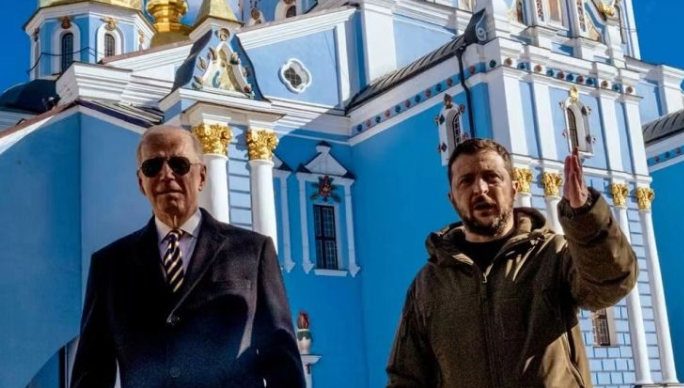
In February 2023, one of the most striking images of the war in Ukraine emerged not from the battlefield, but from the heart of Kyiv. An 80-year-old U.S. president arrived in a country under constant missile threat and walked through its historic center alongside Ukrainian President Volodymyr Zelenskyy while air raid sirens echoed overhead.
Politics immediately followed the moment. Supporters celebrated it. Critics dismissed it. Commentators analyzed every detail.
Yet beneath the partisan noise lies a far more interesting question:
What drives a political leader to enter an active war zone when there is no military necessity to do so?
The answer is simple.
Symbolism.
And in geopolitics, symbolism can be as powerful as weapons.
The journey itself was extraordinary. Biden traveled across multiple modes of transportation, including a lengthy overnight train ride into Ukraine. Security risks were immense. Intelligence agencies were undoubtedly aware of potential dangers. The trip generated no direct economic benefit for Washington and delivered no immediate military advantage.
Its primary purpose was to send a message.
Not to Ukraine.
Not even to Russia.
But to the world.
The message was that the United States was willing to publicly and visibly stand beside Ukraine despite ongoing risks.
For Kyiv, the visit represented reassurance. For allies, it signaled commitment. For adversaries, it demonstrated political resolve.
Critics may argue about the effectiveness of Biden's policies, the cost of Western support, or the broader geopolitical consequences of the war. Those debates are legitimate and necessary.
But courage and policy are not the same thing.
One can disagree with a leader's decisions while acknowledging the personal conviction required to make them.
That distinction has become increasingly rare in an age when political discussions often reduce complex events into simplistic tribal categories.
Leadership has always involved risk.
Winston Churchill refused evacuation during the Blitz. Charles de Gaulle challenged Nazi occupation from exile. Ronald Reagan defied security concerns while redefining Cold War rhetoric. Volodymyr Zelenskyy famously rejected offers to leave Kyiv in the early days of Russia's full-scale invasion.
These moments matter not because they instantly change military realities but because they shape narratives.
Wars are not fought solely with tanks, drones, missiles, and artillery.
They are also fought with perception.
The images of Biden walking through Kyiv resonated globally because they contrasted sharply with one of humanity's most powerful instincts: self-preservation.
Most people avoid danger.
Political leaders are no exception.
Yet history tends to reward those willing to place themselves where others would rather not go.
That is precisely why the recent damage reported at St. Sophia Cathedral carries emotional weight far beyond architecture. Historic landmarks are more than physical structures. They serve as symbols of continuity, culture, and national identity. When they are threatened, societies feel that something larger than stone is under attack.
Biden's walk through Kyiv connected directly with that symbolism.
He was not touring government offices hidden from public view. He was walking through places that embody centuries of Ukrainian history, culture, and resilience.
Whether one applauds or condemns his broader political legacy is ultimately a matter of personal judgment.
But leadership should be evaluated honestly.
And honesty requires acknowledging what occurred.
An 80-year-old president chose to enter a country at war. He chose visibility over safety. He chose symbolism over caution.
In an era when political theater often feels manufactured and focus-group tested, that decision stood out because it carried genuine risk.
History will debate Biden's presidency for decades.
Economists will analyze his policies.
Political scientists will study his coalitions.
Partisans will continue their arguments.
But one image is likely to endure.
An elderly president walking through Kyiv as sirens sounded overhead, sending a message that transcended politics.
Agree or disagree with Joe Biden.
Support or oppose his policies.
But on that day, in that place, one thing was difficult to deny:
He did not look like a coward.