The Space Gold Rush Has Begun. OHB Is Betting Big on Europe’s Orbit Economy
For years, Europe’s space industry was seen as methodical, cautious, and—by global standards—slow. That era is over.
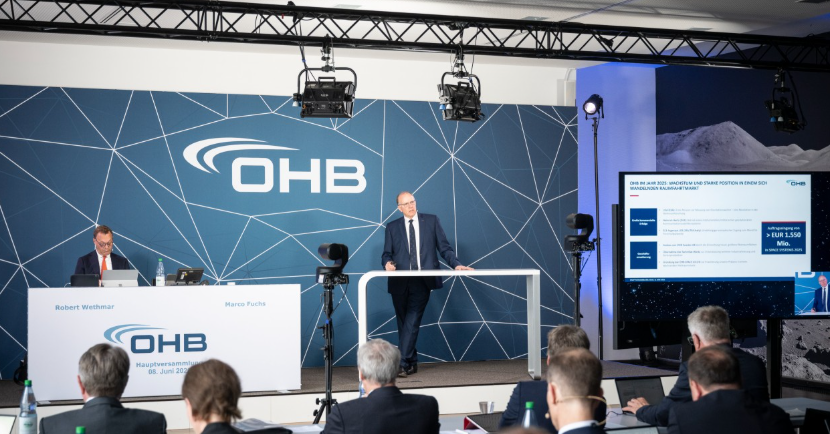
The new reality is closer to a gold rush than a traditional industrial cycle, and companies like Germany’s OHB are suddenly finding themselves at the center of one of the fastest-growing strategic markets on the planet. According to CEO Marco Fuchs, the message is clear: full speed ahead.
OHB is not just riding the wave—it is designing itself for it.
The numbers tell the story. In 2025, the Bremen-based space company recorded a 21 percent increase in total output, reaching €1.25 billion, alongside a record order backlog of €3.2 billion. These are not incremental improvements; they are signals of a structural shift in demand. And if Fuchs is right, this is only the beginning. The company is targeting a total output of €4 billion within just a few years—a scale that would position OHB firmly among Europe’s space heavyweights.
What is fueling this surge is not just commercial satellite demand. It is defense.
Germany’s €35 billion military space program is injecting unprecedented momentum into the sector, reshaping priorities across the industry. Space is no longer a purely civil or dual-use domain—it is increasingly a core element of national security infrastructure. Communication networks, surveillance constellations, and resilient orbit-based systems are becoming as critical as ground-based capabilities.
OHB understands this shift—and is acting accordingly.
The company is aggressively expanding its partnership network to match the complexity of the new space ecosystem. With US-based Axiom Space, it is looking beyond the International Space Station toward its successors, positioning itself in the next generation of orbital infrastructure. With Rheinmetall, OHB is pursuing one of Germany’s most ambitious military communications projects, SATCOM BW 4, structured as a 50:50 joint venture—an indication of both scale and strategic importance.
And then there is Dassault Aviation.
Together, the two companies are working on the Vortex-S project—a concept often described as a “mini space shuttle.” While still in development, such projects signal something deeper than technological ambition. They show that Europe is starting to think in terms of systems, not just components. Reusable spacecraft, integrated launch capabilities, and orbit-based services are no longer futuristic concepts. They are investment priorities.
Yet for all this momentum, OHB’s leadership remains cautious where it matters most: capital.
Despite rapid growth and a share price that has surged by roughly 350–400 percent within a year, CEO Marco Fuchs has emphasized that proposals for convertible or option bonds up to €1.2 billion are precautionary—tools for flexibility rather than immediate action. In a market as volatile as space, optionality is as valuable as capital itself. Fuchs has even suggested that OHB will closely analyze the potential IPO of SpaceX before making major moves—a reminder that Europe’s ambitions are still benchmarked against global players.
And that is the challenge.
The space boom is global, not regional. While European companies are accelerating, they are competing against an ecosystem led by US firms that combine scale, integration, and access to capital in ways Europe is still trying to replicate. To close that gap, companies like OHB are expanding vertically. Satellite manufacturing alone is no longer enough.
OHB’s investment in Rocket Factory Augsburg (RFA) is a case in point.
By participating in a small-launch vehicle developer—whose first rocket launch is planned for late summer—OHB is taking a step toward controlling more of the value chain. Launch capability, particularly if reusable, is becoming a decisive economic factor. Fuchs has made his position clear: reusability is not optional—it is essential.
That statement cuts to the heart of the industry’s evolution.
The next phase of the space economy will not be defined by who can build satellites. It will be defined by who can deploy them faster, cheaper, and more reliably—and who can integrate them into larger, mission-driven networks.
In that race, Europe is no longer sitting on the sidelines.
And OHB is making one thing very clear: it intends to be part of the group setting the pace—not following it.