The Sanctions Boomerang - How Russia Is Rewriting the Rules of Global Trade
When the West imposed sweeping sanctions on Russia, the expectation was economic suffocation. Isolation. Collapse.
Instead, Moscow is building a parallel world.
Not loudly. Not theatrically. But strategically.
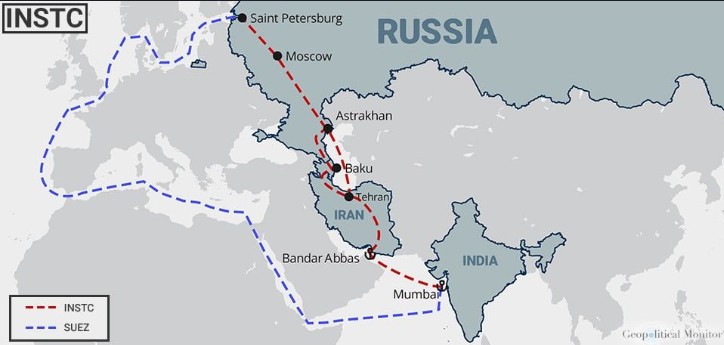
At the center of this quiet transformation is the International North-South Transport Corridor (INSTC) — a 7,200-kilometer trade artery linking Russia to India through Iran. It is more than a railway project. It is a geopolitical bypass.
The corridor cuts shipping times nearly in half. It reduces transport costs by roughly 30 percent. And most importantly, it reduces dependence on the Suez Canal — a maritime chokepoint historically embedded in Western trade dominance.
In plain terms: Russia is rerouting globalization.
Last year alone, 30 million tons of cargo reportedly moved along the corridor. The official target is 45 million by 2030. Ports along the Caspian Sea are being modernized. Rail links are being completed with Russian financial backing. Iran, long isolated itself, becomes a strategic hinge.
But logistics is only half the story.
The real revolution may be happening in digital finance.
Enter the BRICS Bridge — a blockchain-based payment system connecting the central bank digital currencies (CBDCs) of BRICS nations. If successful, it could bypass SWIFT, correspondent banking networks, and much of Western financial oversight.
Transactions between Russia, China, Iran, and the UAE are already being piloted. The system promises peer-to-peer transfers between central banks — potentially reducing transaction costs by up to 40 percent.
The message is unmistakable: If you weaponize the dollar, alternatives will emerge.
For decades, globalization rested on Western-controlled infrastructure: shipping lanes, insurance markets, banking rails, reserve currencies. Sanctions were effective precisely because that architecture was universal.
But universality is eroding.
Russia’s pivot to Asia and the Middle East reflects a deeper structural shift: the fragmentation of the global economic system into competing spheres. Trade routes are being regionalized. Payment systems are being decentralized. Political alliances are increasingly tied to economic infrastructure.
This is not simply about Russia avoiding sanctions. It is about the birth of parallel systems.
Yet the path forward is far from smooth.
The INSTC depends heavily on Iran — a country facing its own sanctions and geopolitical volatility. Infrastructure gaps remain. Technical integration of CBDCs is complex and politically sensitive. Trust in alternative financial rails will take time to build.
And Western governments are unlikely to remain passive.
Still, one reality is undeniable: sanctions have accelerated innovation.
Economic pressure intended to isolate may instead catalyze structural divergence. Instead of forcing reintegration, it may be pushing rival powers to construct self-contained ecosystems.
The world is not de-globalizing. It is bifurcating.
The question is no longer whether alternative systems will exist.
The question is how far they will scale — and who will join them.
History shows that once financial architecture shifts, it rarely returns to its previous state.
The sanctions era may ultimately be remembered not for containing Russia — but for triggering the next phase of geopolitical realignment.
And that phase is already under construction.