The Invisible Battle Over the FIFA 2026 World Cup. Sentrycs and CUAS
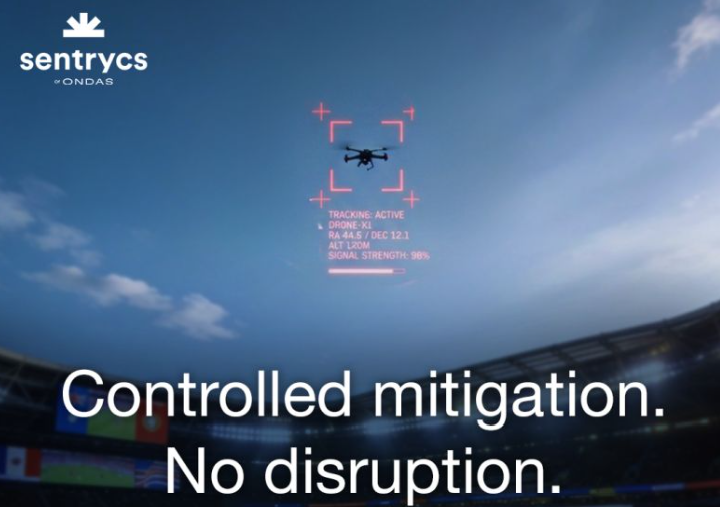
When fans arrive at the FIFA World Cup 2026™, they'll see packed stadiums, national flags, global superstars, and the spectacle of the world's most watched sporting event.
What they won't see is the war unfolding above them.
Not a conventional war.
A technological one.
As drones become cheaper, smarter, and more accessible, they are creating a new challenge for security planners responsible for protecting mass gatherings. The threat is no longer limited to physical attacks on the ground. The modern stadium must now defend an entirely new domain—its airspace.
And the challenge is growing faster than many realize.
The Drone Problem Nobody Can Ignore
Ten years ago, unauthorized drones at major sporting events were considered rare incidents.
Today, they are an operational reality.
A single drone can interrupt a match, compromise VIP security, conduct surveillance, carry contraband, or force costly evacuations. More sophisticated systems can operate autonomously, communicate through encrypted channels, and coordinate with multiple airborne platforms.
The consequence is clear: every major international event now requires a dedicated counter-drone strategy.
But protecting the skies is proving more complicated than simply stopping drones.
The real challenge is stopping them without creating new problems.
The Jamming Dilemma
Historically, many counter-UAS systems relied on jamming.
The concept appears straightforward: overwhelm a drone's communications link and force it to lose contact with its operator.
In theory, effective.
In practice, problematic.
Modern sporting events are dense digital ecosystems. Tens of thousands of spectators simultaneously use mobile networks, Wi-Fi, radio systems, broadcasting equipment, emergency communications, payment terminals, and connected devices.
Disrupting one signal can unintentionally affect many others.
That creates a difficult balance for security teams.
How do you neutralize an unauthorized drone without degrading the fan experience or interfering with critical communication infrastructure?
As global events become increasingly connected, this question is becoming central to modern security planning.
The Rise of Precision Counter-Drone Technologies
This is where companies such as Sentrycs are attempting to change the conversation.
Rather than relying on traditional jamming or kinetic interception methods, the company promotes what it calls Cyber-over-RF technology—an approach focused on detecting, tracking, identifying, and mitigating unauthorized drones through communication-layer interactions.
The appeal is obvious.
Instead of treating every drone encounter as a contest of signal disruption or physical force, security operators gain the ability to respond with greater precision while preserving surrounding communications environments.
For venues hosting hundreds of thousands of visitors, that distinction matters.
Modern security is no longer measured purely by effectiveness.
It is measured by invisibility.
The best security operation is often the one nobody notices.
The World Cup as a Technology Testbed
Mega-events have always accelerated innovation.
The Olympic Games advanced surveillance technologies.
International summits transformed cybersecurity.
The World Cup may become the defining catalyst for the next generation of airspace security.
The challenge extends far beyond stadium roofs.
Fan zones, transportation hubs, public viewing areas, city centers, hotels, and critical infrastructure all become potential areas of exposure.
Protecting such environments requires more than physical barriers.
It requires intelligent, adaptive systems capable of distinguishing legitimate air activity from emerging threats in real time.
This represents a major evolution in security philosophy.
The objective is not simply to block threats.
It is to understand them.
The Future Battlefield Is Civilian
Perhaps the most provocative aspect of the counter-drone industry is how closely it mirrors developments on modern battlefields.
Conflicts around the world have demonstrated how rapidly unmanned aerial systems can reshape operational environments. Technologies originally designed for military use increasingly find relevance in civilian security contexts.
Airports.
Sports venues.
Critical infrastructure.
Government facilities.
Energy networks.
The line between defense technology and civilian protection continues to blur.
As drones proliferate, every major public gathering effectively becomes a complex airspace management challenge.
Security Without Disruption
The most important lesson emerging from the counter-drone revolution may be surprisingly simple.
People do not attend sporting events to witness security operations.
They attend to celebrate, compete, connect, and create memories.
The challenge for security leaders is ensuring those experiences remain uninterrupted while increasingly sophisticated threats are managed behind the scenes.
That is why the future belongs not to the loudest defenses, but to the smartest ones.
As millions of fans gather for the FIFA World Cup 2026™, the success of security operations will not be measured by the threats people notice.
It will be measured by the threats they never know existed.
And in the invisible battle above the world's largest sporting stage, that may be the ultimate victory.