The Infantryman Who No Longer Needs a Controller. How Kova Labs Wants to Democratize Autonomous Warfare
For years, defense technology has been obsessed with building better drones.
Faster drones. Smaller drones. Cheaper drones.
But what if the real revolution isn't the drone itself?
What if the breakthrough is eliminating the need for a pilot altogether?
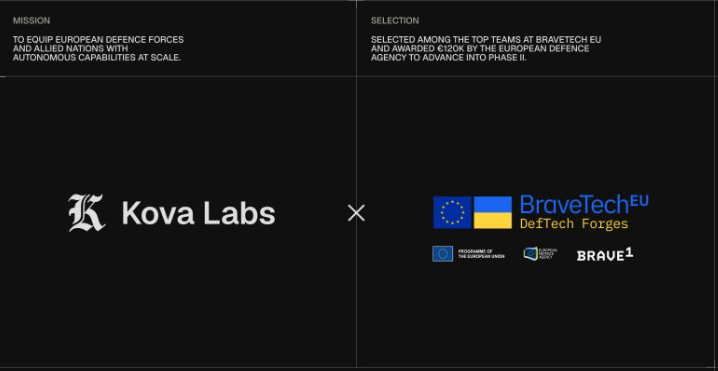
That is the provocative vision emerging from Estonia-based startup Kova Labs, which has just secured a place in Phase II of the European Defence Agency's BraveTech EU DefTech Forges program after impressing military operators and defense officials during field trials in Estonia.
The company was selected among the top-performing teams and awarded €120,000 in funding, a milestone that reflects a growing recognition across Europe that future military advantage may depend less on hardware and more on autonomy.
And Kova Labs is betting that autonomy will be the defining battlefield technology of the next decade.
The Real Battlefield Problem
The defense sector often focuses on drone production numbers.
How many drones can be built?
How many can be delivered?
How many operators can be trained?
But modern conflicts have revealed a different bottleneck: people.
Every drone traditionally requires a trained operator, creating a serious scaling challenge for military organizations. Training takes time. Retention is difficult. High operational tempo creates fatigue.
Kova Labs wants to remove that constraint.
Its vision is straightforward yet disruptive: deploy autonomous platforms capable of navigating and operating independently in the environments where warfare is most difficult.
Forests.
Urban terrain.
Buildings.
Underground passages.
Trench systems.
The places where GPS signals fail, communications are degraded, and traditional autonomous systems often struggle.
According to the company, this is where their technology stands apart.
As Co-Founder and Chief Product Officer Luukas Lohilahti explains, the goal is to build “very low-cost, fully autonomous and intelligent platforms” that can function where others cannot.
If successful, the implications are enormous.
Turning Every Infantryman into a Drone Operator
For years, military forces have viewed drones as specialist equipment.
A separate unit.
A separate skill set.
A separate chain of command.
Kova Labs challenges that model.
The company envisions autonomous systems becoming so simple and intuitive that virtually any soldier can deploy them.
No advanced piloting skills.
No dedicated operators.
No hours spent in front of simulators.
Just mission execution.
This concept mirrors a broader transformation already visible in modern warfare: technology is increasingly shifting the balance from manpower toward machine-enabled decision superiority.
The question is no longer how many soldiers a force possesses.
The question is how many autonomous assets those soldiers can employ simultaneously.
In this future, one infantry squad could potentially control multiple autonomous systems conducting reconnaissance, surveillance, logistics support, and tactical missions with minimal human intervention.
The multiplier effect is immense.
Europe's Search for Defense Innovation
The selection of Kova Labs by the European Defence Agency is also a sign of changing priorities across Europe.
For decades, defense innovation was dominated by large contractors and lengthy procurement cycles.
Today's battlefield realities are forcing a different approach.
Governments increasingly seek startups that can move quickly, iterate rapidly and deliver practical results.
Field testing has become more valuable than PowerPoint presentations.
Demonstrated capability increasingly matters more than theoretical promise.
The Estonian trials highlighted this shift.
Military operators and end users evaluated systems directly under realistic conditions rather than laboratory environments.
For emerging defense companies, these exercises represent a proving ground where technologies either succeed or fail under the scrutiny of those who may eventually rely on them in combat.
According to Kova Labs, feedback from military officers and soldiers generated repeated questions:
"How did you do it?"
That reaction may be as important as the funding itself.
The Next Arms Race Is Not About Drones
Many defense analysts describe the current security environment as a drone race.
That may be true today.
But tomorrow's competition could be something entirely different.
An autonomy race.
Drones are becoming increasingly accessible. Components are widely available. Manufacturing barriers continue to fall.
Autonomy, however, remains exceptionally difficult.
Building systems capable of navigating complex terrain, adapting to dynamic environments and functioning with minimal human oversight is among the most challenging problems in defense technology.
The winners of the next era will not necessarily be those who build the most drones.
They will be those who make drones think.
That is the strategic space Kova Labs is targeting.
The company’s ambition goes beyond producing another unmanned platform.
It seeks to redefine the relationship between humans and machines on the battlefield.
If that vision succeeds, future military historians may look back at today's autonomous systems the same way we now view early aviation.
Not as the end state.
But as the beginning of a revolution.