European Defence Agency to host defence industry workshop on 7 July 2026
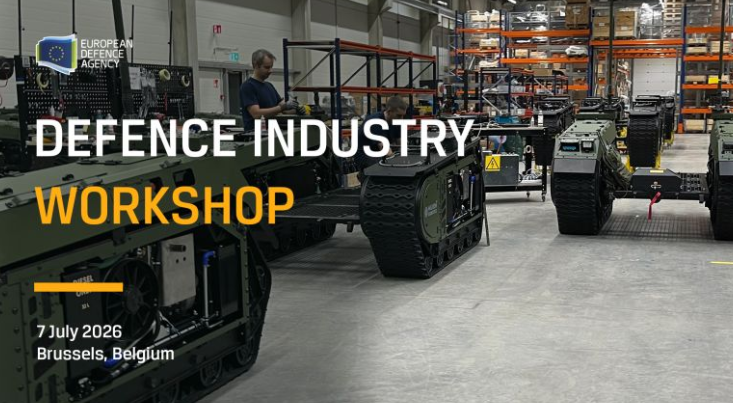
Europe is convening—but this time, it’s not just for discussion. It’s for recalibration.
On 7 July 2026, the European Defence Agency (EDA) will host a Defence Industry Workshop in Brussels, bringing together industry executives, national defence associations, and ASD, the continent’s largest aerospace and defence industry body. On paper, it’s another high-level meeting in the crowded EU calendar. In reality, it feels more like a pressure valve moment—one where rhetoric meets operational reality.
Because Europe is at a crossroads.
The workshop’s hybrid format—blending in-person participation with virtual access—reflects modern accessibility. But don’t mistake the format for softness. The agenda is anything but symbolic. At its heart, this gathering is about tensions that have been building for years: fragmented procurement models, industrial dependency, slow decision-making, and the uncomfortable truth that Europe still struggles to act as a unified defence actor when it matters most.
The official framing speaks of “collaboration” and “open discussion.” But behind those words lies a more urgent question: can Europe finally align its defence industry with its geopolitical ambitions?
The presence of national defence industry associations underscores the stakes. These are not neutral observers—they are power brokers, representing competing interests across member states. Add to that ASD, a strong voice advocating for industrial coherence, and the room quickly becomes a microcosm of Europe’s broader strategic dilemma: cooperation versus competition.
And cooperation has never been more necessary.
The war-driven acceleration of defence spending across Europe has exposed critical weaknesses. Money is flowing—but not always efficiently. Program duplication persists. Cross-border projects face delays. And supply chains remain fragmented, vulnerable, and often externally dependent. The EDA workshop offers a rare forum where these issues can be confronted directly—not in political speeches, but in operational terms.
What makes this moment particularly pivotal is timing. Registration closes on 26 June, and expectations are building that this workshop will move beyond incremental dialogue. The industry is no longer asking for vague alignment; it is demanding clarity, speed, and commitment.
There is also a growing recognition that defence manufacturing is no longer a purely industrial concern—it is a strategic capability. The ability to design, produce, and deploy defence systems within Europe is increasingly seen as a pillar of sovereignty. Without it, political autonomy becomes conditional.
This is where the workshop becomes more than a meeting—it becomes a test.
Can Europe evolve from a collection of national industries into a coordinated defence ecosystem? Can procurement processes be streamlined without undermining national priorities? And, perhaps most importantly, can trust be built in a space historically defined by guarded interests?
The answers will not emerge neatly from a single day in Brussels. But the conversations held there—between executives, policy-makers, and industry bodies—will shape the trajectory of European defence for years to come.
There is also a less visible, but equally critical layer to these discussions: technology transformation. As defence increasingly integrates AI, cyber capabilities, and space-based assets, the lines between traditional manufacturing and digital innovation are blurring. The workshop must grapple not only with how to produce more—but how to produce smarter.
And that introduces another layer of urgency. The global defence landscape is not waiting. The United States is accelerating innovation cycles. China is integrating civil and military technology at scale. Europe, caught between ambition and structure, must decide how quickly it wants to move—and at what level of unity.
The EDA workshop is, in many ways, a mirror. It reflects where Europe stands today: powerful, capable, but still divided in execution. It also offers a glimpse of what could emerge if alignment becomes more than a political aspiration.
So while the official invitation speaks of dialogue, the real story lies beneath.
This is not just a workshop.
It’s Europe testing whether it can finally act like a defence power.
📅 Registration is open to industry representatives and Member State delegates until 26 June.
➡️ Interested parties can sign up via the online form (see comments) or contact industry@eda.europa.eu for further information.