The Harvest of War. When Ukrainian Farmers Reap Drones Instead of Wheat
Ukraine has always been known as one of the world's great agricultural powers.
Its vast golden fields feed millions far beyond its borders. Wheat from the south, corn from the center, sunflower oil from nearly every region. For generations, Ukrainian farmers have harvested one of the most fertile landscapes on Earth.
Today, many of them are harvesting something else.
Russian drones.
Across Ukraine, as air defense units intercept waves of Russian attack drones, the remains do not simply vanish. Fragments fall back to earth. Engines crash into fields. Wings scatter across farmland. Unexploded warheads and explosives become hidden among crops waiting to be harvested.
The battlefield does not end at the front line.
It follows the farmers home.
This is one of the least discussed consequences of Russia's war against Ukraine. Images of burning buildings and missile strikes dominate headlines, while another crisis quietly unfolds across thousands of hectares of farmland.
The fields are becoming contaminated by war.
For a farmer, harvest season should be a race against weather, drought, pests, and market prices.
In wartime Ukraine, it has become a race against unexploded ordnance.
Every combine entering a field faces uncertainty.
Every tractor operator knows that beneath the crops there could be fragments of a drone, pieces of a missile, or explosives that failed to detonate on impact.
A single hidden object can destroy machinery worth hundreds of thousands of dollars.
Or something far worse.
The danger is particularly cruel because it targets one of the most fundamental activities of human civilization: growing food.
War has always destroyed crops.
Armies have burned fields for centuries.
But modern warfare introduces a new reality.
The contamination remains long after the attack.
What falls from the sky in the night may remain buried in the soil for months or years.
A drone intercepted over a city can end its journey hundreds of kilometers away in a field of wheat.
The result is a silent expansion of the battlefield.
The problem extends far beyond immediate safety risks.
Agricultural land is an economic asset, an environmental resource, and a national strategic capability. Every contaminated hectare increases costs for inspection, demining, and recovery. Every delayed harvest reduces productivity. Every damaged machine adds financial pressure to an industry already operating under wartime conditions.
Ukraine is fighting not only to defend its territory but also to preserve its ability to produce food.
And that matters far beyond its borders.
Before the full-scale invasion, Ukraine was one of the world's most important exporters of grain and agricultural products. Disruptions to Ukrainian agriculture have repeatedly affected global food markets, particularly in regions heavily dependent on imports.
When a Ukrainian field becomes unusable, the consequences can travel far beyond Ukraine itself.
Yet amid these challenges, Ukrainian farmers continue to work.
They plant.
They harvest.
They repair equipment.
They adapt.
They return to fields that only months earlier may have been under occupation, shelled, mined, or crossed by military operations.
There is a unique form of courage in this persistence.
It does not wear a uniform.
It does not appear in military briefings.
It rarely makes international headlines.
But it helps sustain a nation at war.
Because food security is national security.
Every harvested field is an act of resistance.
Every successful harvest is proof that life continues despite efforts to destroy it.
The tragedy is that these farmers should never have been placed in such a position.
No agricultural worker should have to wonder whether the next pass of a combine harvester will uncover wheat or explosives.
No family farm should become part of an air-defense story.
No field should become a graveyard of technology designed for destruction.
Yet this is now part of daily reality across Ukraine.
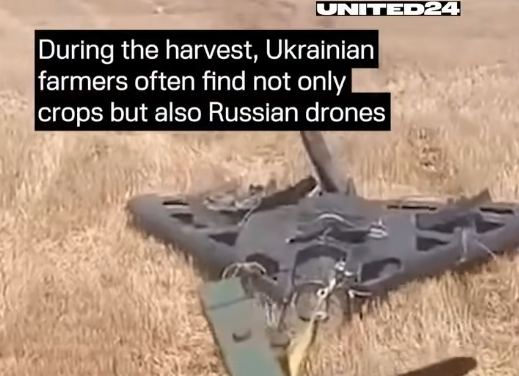
The image is powerful and disturbing.
A golden field under a summer sky.
A farmer preparing to gather the harvest.
And among the crops, the wreckage of another Russian drone.
It is a reminder that modern wars do not only destroy cities.
They poison landscapes.
They transform places of life into places of danger.
And sometimes, the debris left behind becomes another weapon long after the attack itself has ended.
Ukraine's farmers came to reap grain.
Instead, many now find themselves harvesting the remnants of war.