The End of Electronic Warfare? Ukraine's New Drone Trap Turns Fiber-Optic FPVs Against Themselves
For decades, the logic of modern warfare seemed straightforward.
A new weapon appears.
Electronic warfare finds a way to disrupt it.
The cycle repeats.
Drones became vulnerable to jamming.
Radios became vulnerable to interception.
Signals became targets.
Control links became weaknesses.
Then came the fiber-optic FPV drone.
And suddenly, one of the most important assumptions of modern battlefield technology began to break down.
Because you cannot jam a cable.
No radio signal.
No electromagnetic emissions.
No wireless connection.
Nothing to disrupt.
The operator remains connected to the drone through a thin fiber-optic strand stretching for kilometers behind the aircraft.
Electronic warfare, arguably one of the defining technologies of the Ukraine war, suddenly finds itself facing a threat against which some of its traditional strengths are far less effective.
But Ukraine's response may be even more interesting than the threat itself.
Because instead of fighting signal with signal, it is fighting physics with physics.
Meet Chaharnyk.
A machine designed not to jam a drone.
But to cut its leash.
When Electronic Warfare Hits a Wall
The rise of fiber-optic FPV drones has forced military planners to confront a difficult reality.
For years, the battlefield evolved toward increasingly sophisticated electronic warfare.
Jammers became more powerful.
Detection systems became more capable.
Entire operational concepts emerged around electromagnetic dominance.
Then fiber-optic drones changed the equation.
The drone no longer depends on vulnerable radio communication.
The command signal travels through a physical cable.
If the cable survives, the connection survives.
Simple.
Brutally effective.
And deeply frustrating for defenders.
The traditional solution suddenly becomes insufficient.
Which means a new solution must emerge.
The Return of Physical Defense
This is where Chaharnyk becomes fascinating.
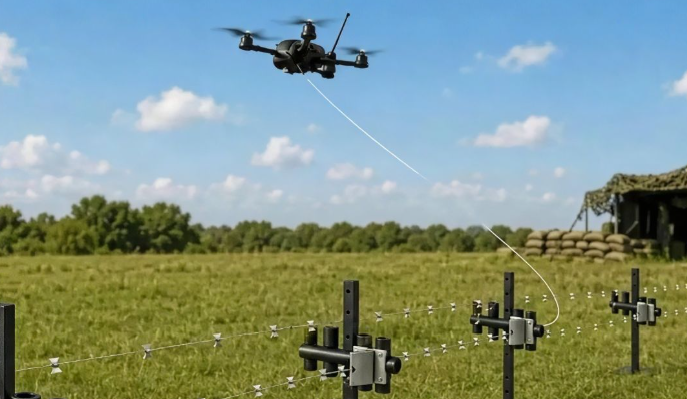
The system reportedly listens for the unique acoustic signatures produced by approaching FPV drones.
Not radar.
Not radio frequency detection.
Sound.
The noise created by engines and propellers becomes the trigger.
Once identified, mechanical arms move into position and physically intercept the fiber line.
The concept sounds surprisingly low-tech.
Which is precisely why it is so interesting.
Military innovation often advances in unexpected directions.
When electronic solutions become less effective, warfare reverts to physical solutions.
Not because technology is moving backward.
Because adaptation is moving forward.
The objective is simple:
Don't stop the drone.
Stop the cable.
And if the cable dies, the drone effectively becomes blind.
Building Digital Walls
Perhaps the most provocative aspect of Chaharnyk is what it represents strategically.
For years, military planners focused on air-defense bubbles.
Networks of sensors.
Missiles.
Electronic warfare systems.
Today, Ukraine appears to be experimenting with something different.
Physical anti-drone infrastructure.
A kilometer-long network of interconnected drone traps begins to resemble a new form of battlefield fortification.
Not trenches.
Not bunkers.
Not walls.
But automated anti-drone barriers.
Infrastructure designed for the age of autonomous warfare.
The implications are significant.
As drones become increasingly common, defense may increasingly depend on permanent robotic protective systems surrounding critical locations.
Command posts.
Artillery batteries.
Logistics hubs.
Power infrastructure.
Headquarters.
Entire sections of the frontline.
The battlefield itself begins evolving into a machine-protected ecosystem.
The Economics of Adaptation
What makes the story particularly important is that it highlights a recurring pattern from Ukraine.
Every advantage produces a response.
Every response generates a counter-response.
Fiber-optic drones emerge.
Traditional jamming becomes less effective.
Physical interception systems appear.
The drone evolves again.
The cycle continues.
This is no longer primarily a competition between specific weapons.
It is a competition between learning systems.
The side that identifies vulnerabilities fastest gains a temporary advantage.
The side that adapts fastest regains it.
The operational window never remains open for long.
The Future Is Not One Technology
Many discussions about the future battlefield focus on finding the revolutionary technology that changes everything.
The Ukraine war suggests something different.
There is no final technology.
Only continuous adaptation.
Drones did not eliminate tanks.
Electronic warfare did not eliminate drones.
Fiber-optic systems did not eliminate electronic warfare.
Each innovation simply forces another innovation.
The battlefield evolves through endless feedback loops.
Threat.
Countermeasure.
Adaptation.
Counter-adaptation.
Repeat.
What makes Chaharnyk remarkable is not merely its engineering.
It is what it reveals.
The future battlefield may not belong to the actor with the most advanced individual system.
It may belong to the actor capable of finding solutions from entirely different technological domains.
When radio fails, use sound.
When software struggles, use mechanics.
When jamming becomes ineffective, cut the wire.
The beauty of warfare has never been complexity.
It has always been adaptation.
And Chaharnyk may be one of the clearest examples yet that the next military breakthrough might not come from a more powerful algorithm.
It might come from somebody asking a much simpler question:
What if we just cut the cable?