The Drone Hunter Gets Eyes. How German Startup Argus Is Building the Future of Counter-Drone Warfare

For years, the global drone race has focused on one question: how to build better drones.
A new generation of defense companies is asking a different one:
How do you stop them?
As drones reshape modern warfare—from the battlefields of Ukraine to the skies above the Middle East and critical infrastructure across Europe—the market for counter-drone technology is becoming one of the fastest-growing sectors in defense. And increasingly, victory is determined not by firepower alone, but by the ability to identify, track, classify, and intercept threats faster than human operators can react.
That is the strategic backdrop behind the newly announced partnership between U.S. sensor specialist Ouster and German counter-drone innovator ARGUS Interception.
At first glance, it may appear to be another defense-industry technology agreement. In reality, it reflects a much larger transformation occurring across military and security systems worldwide.
The interceptor drone is gaining something close to machine vision.
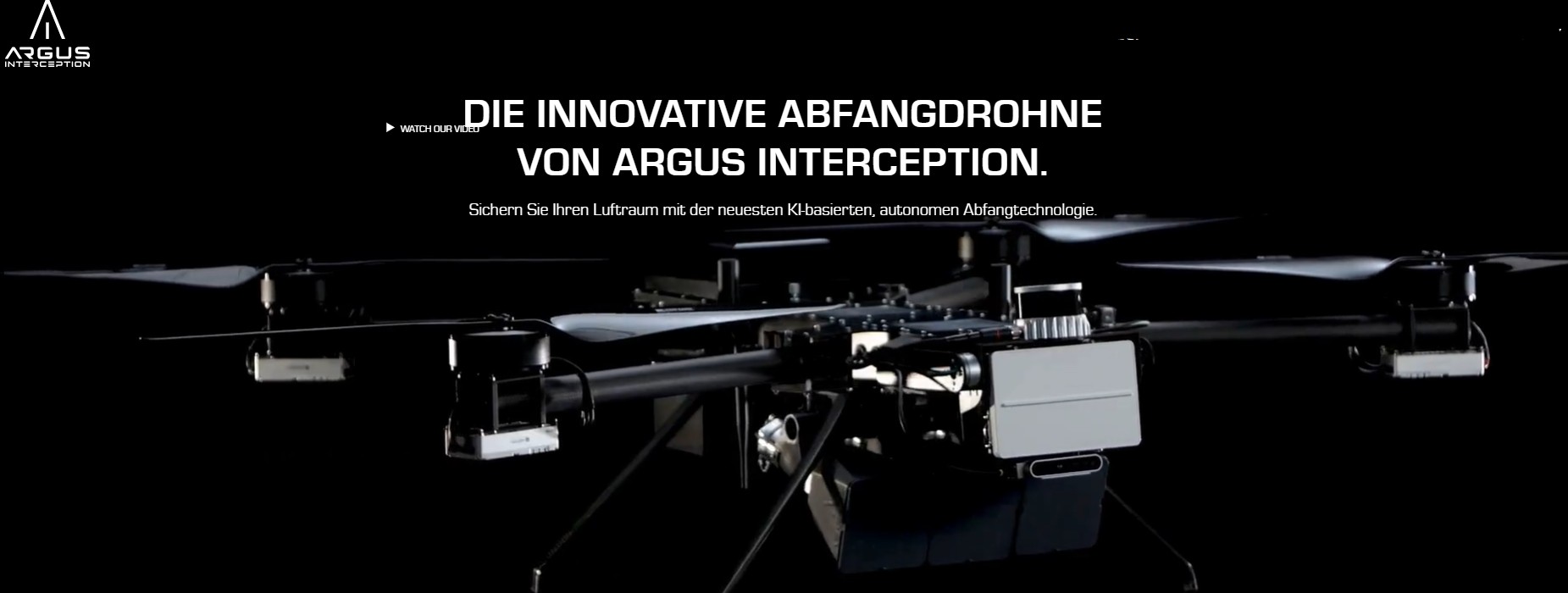
ARGUS, based in Rotenburg an der Wümme, has developed the A1-Falke, a drone designed not to destroy targets but to capture them. Instead of missiles or explosive payloads, the system employs patented net-launching technology capable of intercepting unauthorized drones, securing them, and bringing them safely to the ground.
This seemingly simple concept addresses one of the most difficult problems in modern air defense.
Many environments simply cannot tolerate kinetic solutions.
Around airports, stadiums, government facilities, energy infrastructure, city centers, industrial plants, or crowded public events, shooting down a drone may create dangers equal to—or greater than—the original threat. Falling debris, collateral damage, and legal concerns often make traditional countermeasures impractical.
This is where systems such as the A1-Falke become strategically attractive.
Rather than destroying evidence, they preserve it.
Rather than creating debris, they enable controlled recovery.
Rather than escalating situations, they provide a minimally invasive response.
But such operations demand extraordinary precision.
Catching a moving drone with a net is significantly more difficult than many imagine. Targets can change altitude abruptly, maneuver unpredictably, operate autonomously, and travel at high speed. Success depends on accurately understanding the target's position in three-dimensional space during the final moments of interception.
That is why the partnership with Ouster matters.
Under the agreement, ARGUS will integrate Ouster's digital LiDAR technology into the A1-Falke platform, enhancing detection, tracking, navigation, and interception performance during the most critical phase of engagement.
In practical terms, LiDAR allows machines to perceive the world not as flat images, but as highly detailed three-dimensional environments.
The technology continuously maps objects, distances, movement vectors, and spatial relationships by sending laser pulses and measuring their reflections. The result is a real-time digital representation of the surrounding environment.
For autonomous systems, this capability is transformative.
Military planners increasingly describe future battlefields as contests between sensors rather than shooters. The side that observes, understands, and reacts first often gains a decisive advantage.
In that environment, vision becomes a weapon.
Perhaps the most intriguing aspect of the agreement is ARGUS's planned evaluation of Ouster's next-generation Rev8 digital LiDAR technology.
The company says the system offers native 3D color perception and extended-range detection capabilities—features that move autonomous systems closer to what engineers often describe as human-like situational awareness.
That phrase may sound like marketing language.
But it highlights a profound shift underway in defense technology.
The next generation of autonomous systems will not simply detect objects.
They will classify them.
Interpret them.
Prioritize them.
And increasingly make decisions at machine speed.
Counter-drone systems are becoming less about launching interceptors and more about creating intelligent sensor networks capable of understanding complex environments in real time.
The implications extend far beyond military applications.
Critical infrastructure operators, airport authorities, law-enforcement agencies, and industrial security providers are all confronting the same challenge: low-cost drones are becoming increasingly accessible, capable, and difficult to counter.
The demand for non-kinetic solutions is rising accordingly.
This creates a significant opportunity for European defense technology companies.
While much of the drone industry focuses on offensive capabilities, the counter-drone market is emerging as an equally important strategic domain—one where software, artificial intelligence, sensors, and autonomy matter as much as hardware.
The partnership between Ouster and ARGUS demonstrates precisely where the industry is heading.
The future of air defense will not belong solely to the fastest missile or the largest radar.
It will belong to the systems that can see first, understand first, and act first.
And increasingly, those systems will not be human.

.png)