The Democracy Hack - How AI Is Turning Truth Into a Weapon
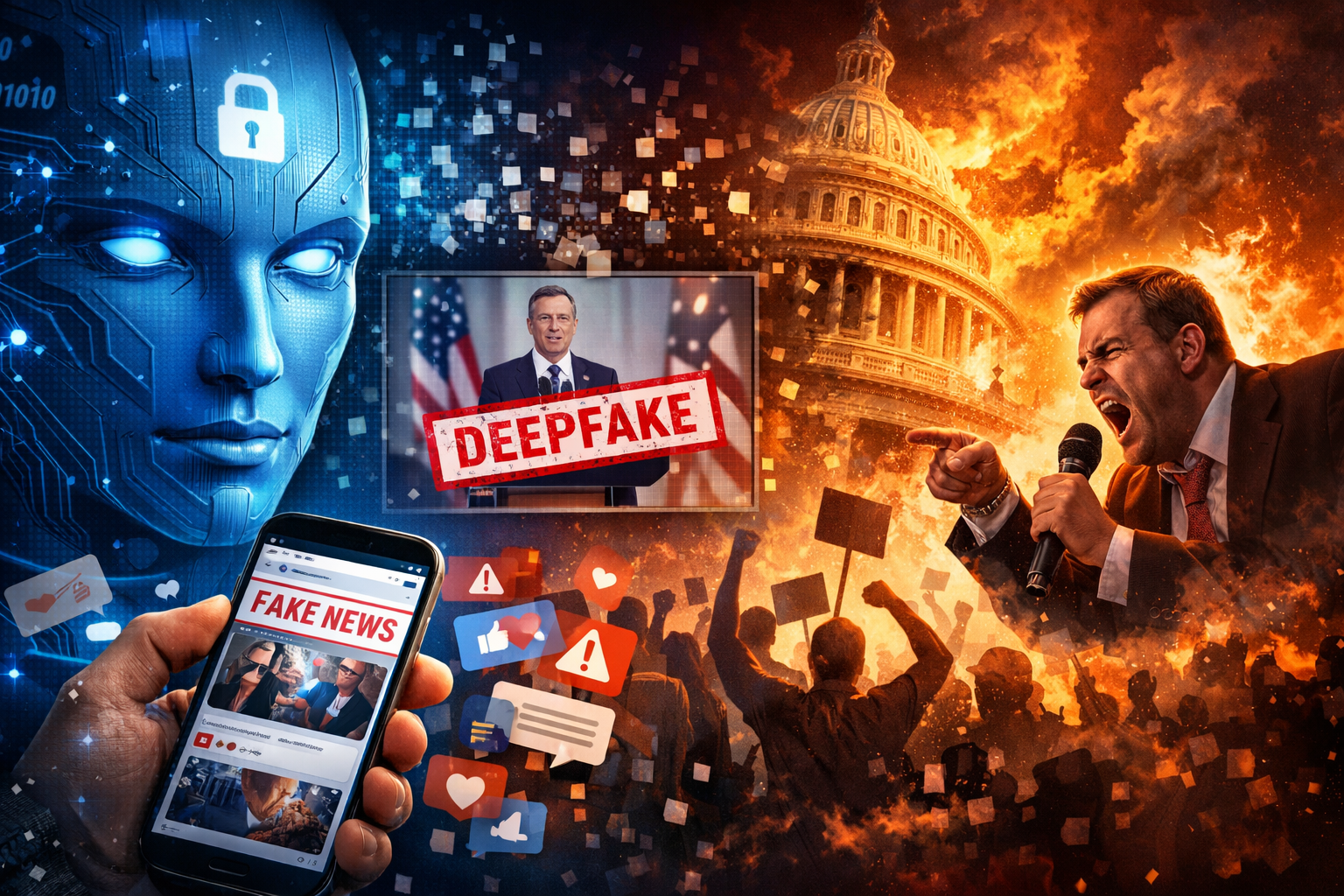
For years, we worried that artificial intelligence would take our jobs. The real danger may be far worse: AI is quietly taking our shared reality.
Deepfakes, AI-generated propaganda, and hyper-targeted disinformation are not fringe experiments anymore. They are becoming mainstream tools in political communication, social media strategy, and influence operations. The result is a world where seeing is no longer believing - and where the line between persuasion and manipulation is disappearing faster than regulators can react.
This is not just a technological shift. It is an ethical crisis.
At the heart of the problem lies scale. Humans have always lied, manipulated, and spread propaganda. What AI changes is speed, precision, and affordability. A convincing fake video that once required a Hollywood studio can now be produced in hours on a laptop. Political actors, activists, foreign influence groups, and even individuals can fabricate reality at industrial scale. The barrier to deception has collapsed.
The consequences for democracy are profound.
Elections rely on one fragile assumption: citizens can access reasonably trustworthy information. AI-generated deepfakes attack that assumption directly. When a fake audio clip of a politician can circulate millions of times before being debunked, the damage is already done. Even when exposed, the doubt remains. The goal of modern disinformation is not necessarily to make people believe one specific lie - it is to make them believe nothing at all.
This erosion of trust is perhaps AI’s most dangerous political effect. Once voters assume every video could be fake and every statement manipulated, democratic debate turns into tribal warfare driven by emotion rather than facts. This “post-truth” environment is fertile ground for demagoguery: leaders who thrive not on evidence but on outrage and spectacle.
AI doesn’t create demagogues, but it gives them superpowers.
Algorithms amplify this problem. Far from neutral, algorithmic systems reflect the biases of their creators and the data they are trained on. Social media platforms optimize for engagement, and outrage generates clicks. The result is a feedback loop where polarizing or sensational AI-generated content travels faster than sober analysis. The machine is not malicious; it is simply rewarding whatever captures attention - and manipulation captures attention extraordinarily well.
Meanwhile, regulators are struggling to keep pace. The European Union’s AI Act represents an important attempt to impose transparency and accountability, including requirements for labeling deepfakes. Yet regulation moves slowly, while AI evolves at breakneck speed. Legal frameworks written today may already be outdated by the time they take effect. Enforcement across borders adds another layer of complexity, especially when disinformation campaigns exploit jurisdictions with weaker oversight.
This creates a dangerous asymmetry: it is easy to generate fake content but extremely difficult to prove authenticity.
The ethical implications extend beyond elections. Deepfake pornography, identity theft, and targeted harassment demonstrate how AI can weaponize personal identity itself. Women and marginalized groups are disproportionately affected, revealing that algorithmic harms often mirror - and amplify - existing societal inequalities. AI is not creating new prejudices; it is scaling old ones.
So what can be done?
First, societies must abandon the illusion that technology alone will solve this problem. Detection tools help, but every improvement in detection is matched by improvements in generation. It is an arms race with no final victory.
Second, media literacy must become a core civic skill. Citizens need to understand how AI-generated content works, how algorithms influence perception, and why emotional reactions are often a warning sign rather than proof of truth. Psychological “inoculation” - exposing people to small examples of misinformation so they can recognize manipulation - shows promise and should become standard in education.
Third, transparency must become non-negotiable. Platforms and AI developers should be required to disclose when content is synthetic, how recommendation systems prioritize information, and who pays for influence campaigns. Without visibility into the system, accountability remains impossible.
But let’s be honest: even these measures may not fully restore trust once it is lost.
The provocative truth is this - AI might not destroy democracy through direct control or authoritarian surveillance. It may destroy it by drowning citizens in so much uncertainty that democratic decision-making becomes impossible. In a world where everything can be faked, power shifts to those who shout loudest, move fastest, and exploit confusion most effectively.
The fight against AI-driven disinformation is therefore not only a technical or legal challenge. It is a fight for epistemic stability - for the very idea that reality exists and can be shared.
The real question is no longer whether AI will shape political reality. It already does.
The question is whether democracies can adapt quickly enough to survive their own reflection in the algorithmic mirror.

.jpg)