The Day Tanks Disappeared from the Parade And UGVs Come
Military parades are designed to send messages.
They are not merely celebrations. They are statements of identity.
For decades, nations have used them to showcase what they believed represented military power: tanks rumbling down broad avenues, missile launchers rolling past grandstands, soldiers marching in perfect formation beneath combat aircraft overhead.
On Ukraine's Independence Day 2026, that script changed.
Dramatically.
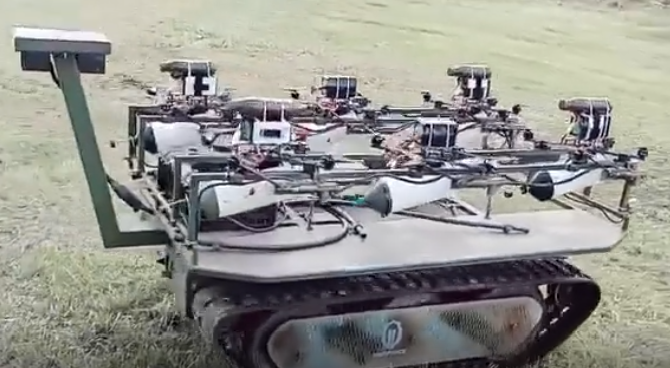
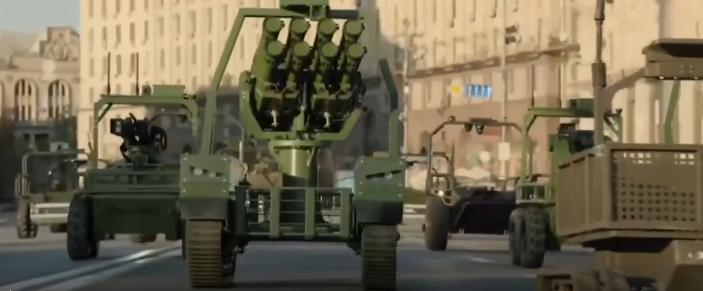
As dawn broke over Kyiv, several dozen ground robotic systems moved down Khreshchatyk, the capital's iconic boulevard. Uncrewed surface vessels crossed the Dnipro River. UAVs filled the skies above the city. Robots designed for combat, logistics, reconnaissance, medical evacuation, interception, and strike missions took center stage.
There were no vast columns of tanks dominating the spectacle.
No armored formations symbolizing industrial-age warfare.
Instead, Ukraine presented something different:
A vision of the future battlefield.
Some observers have described the event as the world's first "all-drone" military parade. Strictly speaking, that is not entirely accurate. F-16s and Mirage 2000 fighter jets also participated, reminding spectators that traditional military power has not disappeared.
But the historical significance lies elsewhere.
The truly important question is not whether the parade was entirely unmanned.
It is why unmanned systems became its defining image.
Just five years ago, Ukraine's Independence Day parade looked much like those of many other nations. Armored vehicles, artillery systems, and conventional military formations dominated the display.
Today, the symbolism has shifted.
And symbolism matters.
Military parades reveal how armed forces see themselves.
They tell the public, allies, rivals, and history itself what military leaders believe is most important.
In 2026, Ukraine made a deliberate choice.
It placed unmanned systems at the center of its national military identity.
That decision reflects a battlefield reality forged through years of war.
The conflict in Ukraine has transformed drones from niche assets into strategic necessities.
Initially used for reconnaissance and artillery spotting, drones evolved into strike platforms, maritime weapons, interceptors, electronic warfare systems, and logistic tools. Ground robots emerged for dangerous missions, reducing risk to human operators. Uncrewed boats altered the balance of power in the Black Sea. First-person-view drones became some of the most discussed weapons of the war.
What began as adaptation became doctrine.
What began as improvisation became industry.
And what began at the margins of military operations has now moved to the center.
That transition was visible on Khreshchatyk.
The parade was less a celebration of individual systems than a public acknowledgment of how warfare itself is changing.
For more than a century, military power was measured in platforms.
The number of tanks.
The number of warships.
The number of combat aircraft.
Increasingly, military effectiveness is being measured differently.
Software.
Autonomy.
Sensors.
Networks.
Data.
Algorithms.
The combat systems displayed in Kyiv reflect an era in which military advantage derives not only from hardware but from the ability to connect machines, operators, intelligence, and decision-making into a single integrated system.
The significance extends beyond Ukraine.
Military planners around the world were likely studying the event closely.
Because Ukraine is not merely fighting a war.
It is conducting the largest real-world experiment in unmanned warfare ever seen.
And unlike defense exhibitions or laboratory demonstrations, these systems have been tested under the harshest conditions imaginable: sustained combat against a major military power.
That gives the symbolism additional weight.
The platforms displayed were not futuristic concepts.
Many are products of battlefield necessity and operational experience.
They represent lessons written not on PowerPoint slides but on actual battlefields.
The broader message was unmistakable.
Ukraine was not showcasing what it hopes warfare will look like in the future.
It was showcasing what warfare already looks like today.
The parade therefore served as a declaration.
Not merely of independence.
But of transformation.
A declaration that military power is no longer defined solely by steel, armor, and mass.
It is increasingly defined by autonomy, adaptability, and machines operating alongside humans across land, sea, and air.
The tanks have not disappeared.
The fighter jets have not become obsolete.
But they no longer occupy the same symbolic place they once did.
On Kyiv's main boulevard, the center of gravity shifted.
And history may remember that moment not as the first drone parade.
But as the day unmanned warfare officially moved from the edge of military power to its very core.