The Arctic Is the New Suez. While America Retreats, Europe and Canada Must Seize the North
Arctic was viewed as a distant frontier. Cold, inaccessible, and strategically secondary. That era is over.
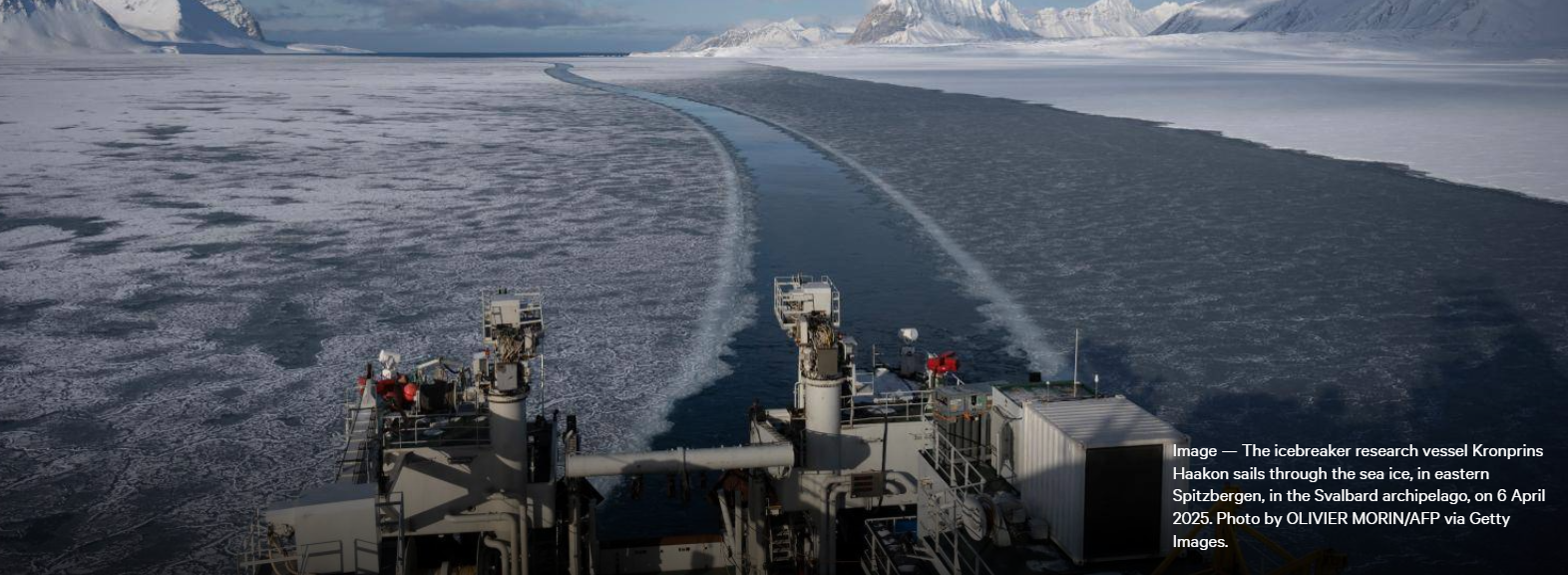
Today, the Arctic is becoming one of the most important geopolitical battlegrounds on Earth. As climate change melts sea ice at unprecedented rates, new shipping lanes, energy reserves, critical minerals, and military corridors are emerging. The future map of global power is being redrawn not in the South China Sea or the Persian Gulf, but across the frozen waters of the High North.
And just as the Arctic enters the center of strategic competition, the United States appears to be stepping back.
Washington's decision to discontinue support for the Arctic Report Card, a flagship scientific assessment that has tracked environmental and climate developments in the region for two decades, represents more than a budgetary adjustment. It is a retreat from one of the most valuable instruments of Arctic influence: knowledge.
In the 21st century, data is power.
The nation that controls information about ice conditions, maritime routes, seabed mapping, weather patterns, and environmental change gains an enormous strategic advantage. Scientific infrastructure is no longer merely about research. It is increasingly about security, economics, logistics, and geopolitical leverage.
China understands this perfectly.
Despite having no Arctic coastline, Beijing has spent years investing heavily in polar science, research stations, icebreakers, satellite networks, and maritime technologies. The payoff is becoming visible. Chinese shipping companies are now moving from experimental Arctic voyages to scheduled commercial operations, supported by predictive ice-navigation systems developed from years of scientific investment.
Russia understands it too.
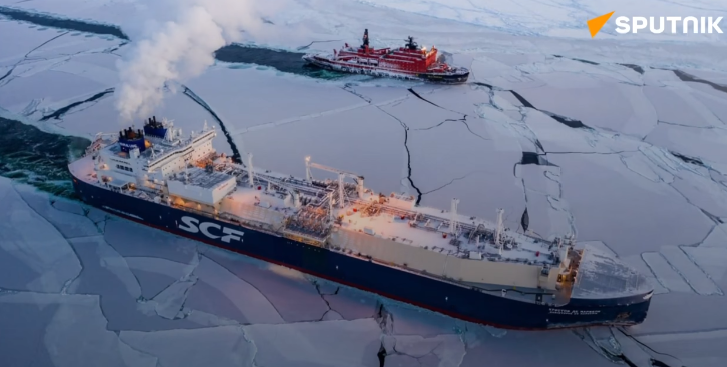
Moscow continues transforming the Northern Sea Route into a strategic artery connecting Asia and Europe. The deployment of massive oil convoys escorted by nuclear-powered icebreakers demonstrates that Russia sees the Arctic not as a future opportunity but as a present reality. Every tanker that successfully crosses Arctic waters reinforces Moscow's claim to influence over one of the world's most important emerging trade corridors.
Europe cannot afford to remain a spectator.
For years, Europeans treated Arctic affairs primarily as environmental policy. Today, that perspective is dangerously outdated. The Arctic is becoming a security issue, an industrial issue, an energy issue, and ultimately a sovereignty issue.
The encouraging news is that Europe is beginning to wake up.
Norway, Denmark, Sweden, Finland, and other Arctic allies are increasing military cooperation. NATO is strengthening its northern posture. New diplomatic missions are opening in Greenland. Advanced surveillance systems, maritime patrol aircraft, and satellite capabilities are receiving greater attention.
Yet these steps remain fragmented.
The Arctic requires something more ambitious: a unified strategic vision linking security, science, infrastructure, technology, and economic development.
Europe and Canada are uniquely positioned to provide it.
Together they possess world-class research institutions, advanced aerospace industries, strong naval capabilities, and a shared commitment to rules-based international governance. Most importantly, they understand that Arctic leadership cannot rely solely on military assets. It must rest on trusted data, scientific cooperation, and long-term presence.
Imagine a Europe-Canada Arctic Data Alliance.
A shared platform integrating satellites, ocean sensors, climate monitoring, navigation systems, and security intelligence. Such an initiative would not simply replace the disappearing American Arctic Report Card; it could surpass it.
The result would be an unmatched situational awareness network spanning one of the world's fastest-changing regions.
The stakes could hardly be higher.
The Arctic's future will determine shipping realities between Asia and Europe, access to critical minerals essential for the energy transition, military balance across the North Atlantic, and the resilience of Western supply chains in an increasingly unstable world.
History rarely provides strategic vacuums for long.
When great powers step back, others step forward.
The melting Arctic ice is exposing more than new sea routes. It is revealing a geopolitical opportunity. The question is whether Europe and Canada recognize it before Beijing and Moscow consolidate an even greater advantage.
The Arctic is no longer the edge of the world.
It is becoming its center.
%20(1)%20(1).jpg)