Sweden’s Leopard 2 Just Got Sharper Teeth
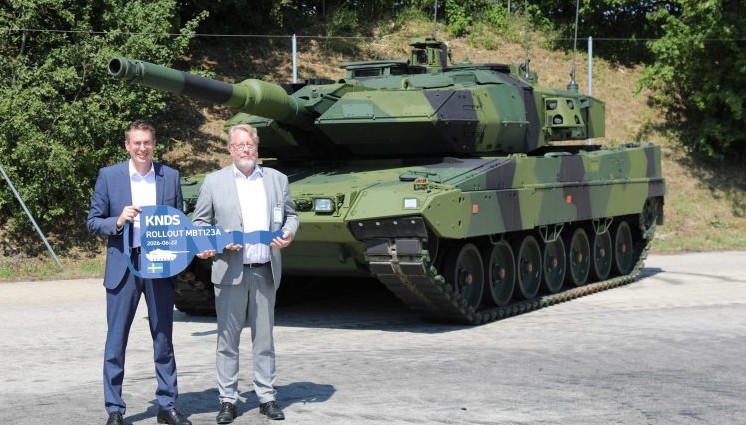
Sweden has taken an important step in strengthening its armoured forces with the handover of the first modernised Leopard 2 main battle tank under the REMO programme. In Munich, the Swedish Defence Materiel Administration, FMV, received the first of 110 upgraded vehicles from KNDS Deutschland. The ceremonial delivery took place on 22 June 2026 and marks the beginning of a major transformation for Sweden’s heavy land forces.
The modernised tank will be known as the Stridsvagn 123A, an upgraded version of Sweden’s existing Stridsvagn 122A and 122B fleet. These vehicles are based on the Leopard 2 platform and are often compared to the Leopard 2A5 and 2A6 standards. But the REMO programme is not just a technical refresh. It is a clear signal that Sweden is preparing its armoured forces for a more demanding European security environment.
At the heart of the upgrade is firepower. The previous L44 gun, used on many earlier Leopard 2 variants up to and including the 2A5, is being replaced by the more powerful L55 A1. This longer and more capable smoothbore gun is also used on newer German Leopard 2A7 variants and gives the tank improved combat performance, especially at longer ranges and against heavily protected targets.
In simple terms, Sweden’s old Leopards are getting sharper teeth.
But the upgrade goes beyond the gun. The Stridsvagn 123A will receive fully digital crew workstations and improved networking capabilities. This matters because the modern battlefield is no longer only about armour thickness and gun calibre. It is about information, coordination and speed. A tank that can share data faster, receive battlefield updates and operate inside a connected force becomes far more dangerous than a vehicle fighting in isolation.
The protection level is also expected to be improved, although detailed specifications remain limited. This is unsurprising. Modern tank survivability is a sensitive topic, especially in a time when drones, top-attack weapons, loitering munitions and precision artillery have changed the threat picture dramatically. For Sweden, increasing the protection of its Leopard fleet is not optional. It is essential.
The contract also includes a logistics package, which may sound less dramatic than a new gun or digital systems, but is just as important. Tanks are only useful if they can be maintained, supplied and kept operational. In a real crisis, spare parts, repair chains and training infrastructure can decide whether a force remains combat-capable or becomes a static museum of expensive machines.
Training on the upgraded vehicles is planned to begin in autumn 2026. This will be a key phase, because technology alone does not create readiness. Crews, maintenance teams and commanders need time to understand what the upgraded platform can do and how it should be integrated into Sweden’s wider force structure.
The Stridsvagn 123A programme also fits into a bigger Swedish armoured build-up. In addition to modernising 110 existing Leopard 2 tanks, Sweden is also procuring 44 new Leopard 2A8 tanks, which will be known as Stridsvagn 123B. Together, these two efforts represent a serious increase in Sweden’s heavy combat power.
This is especially relevant now that Sweden is part of NATO. The country’s armoured forces are no longer only a national defence asset. They are part of a wider alliance posture in Northern Europe and the Baltic region. Modernised Swedish tanks will contribute not only to territorial defence, but also to NATO’s deterrence credibility.
The message behind the Stridsvagn 123A is therefore clear: Sweden is not simply preserving an old tank fleet. It is turning existing platforms into modern, networked and more lethal combat systems.
In European defence, this is exactly the kind of step that matters. New platforms attract attention, but modernisation programmes often deliver capability faster and at greater scale. Sweden’s Leopard upgrade shows that legacy systems can still become highly relevant when combined with better firepower, digitalisation, protection and logistics.
The first Stridsvagn 123A is more than a delivered vehicle. It is the beginning of a stronger Swedish armoured force — and another sign that Europe is slowly, but visibly, rebuilding hard military power.