Stop Shooting the Drones. Kill the System That Launches Them.
Shooting down a drone solves one problem.
Destroying the system that launches hundreds of them solves a very different one.
That distinction may explain an increasingly important feature of Ukraine’s evolving strategy: rather than concentrating only on Russian weapons after they enter the battlefield, Ukrainian forces are increasingly attacking the infrastructure that allows those weapons to operate in the first place.
Don't just kill the weapon. Attack the machine behind it.
Recent Ukrainian operations illustrate the idea.
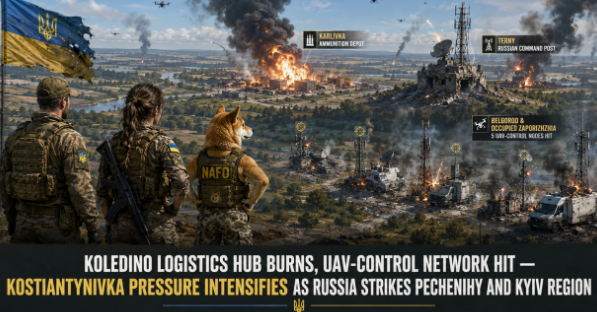
During a reporting window covering 17–19 August, Ukrainian forces reportedly struck an ammunition depot at Karlivka, a Russian command post near Terny and five UAV-control facilities in occupied Zaporizhzhia and Russia’s Belgorod region.
The drone-control sites are particularly interesting.
Every hostile drone represents more than an aircraft.
Behind it may be operators, antennas, communications equipment, power supplies, vehicles, command systems, maintenance infrastructure and logistics.
Intercepting the drone attacks the final product.
Destroying the control architecture attacks the ability to generate future missions.
One target versus an entire network
Consider the economics.
A defender can spend enormous resources detecting and intercepting individual UAVs.
But what happens if instead of attacking ten drones, you disable the command infrastructure coordinating dozens or hundreds of future sorties?
The equation changes.
This is essentially an attack on combat generation capacity.
The source describes strikes on five UAV-control posts—three in occupied Zaporizhzhia and two in Belgorod—as an attempt to attack the command-and-control layer behind Russian drone operations rather than simply intercepting individual aircraft after launch.
That concept scales far beyond drones.
A tank needs fuel.
Artillery needs ammunition.
Aircraft need bases.
Missiles need factories.
Frontline formations need command posts.
And all of them need logistics.
Modern military power is therefore less a collection of individual weapons than a gigantic interconnected machine.
The weapon at the front is simply the visible end of that machine.
The factory is part of the battlefield
Ukraine’s deep-strike campaign pushes this logic hundreds of kilometers farther.
The reporting describes significant disruption around Moscow during a major Ukrainian drone episode, including flight delays, power outages and a large fire at the Koledino logistics center.
But perhaps more strategically interesting was further damage assessment from an earlier strike against the Kamensky industrial complex in Rostov Oblast.
Six facilities were reportedly hit.
Among them were facilities associated with solid-fuel rocket-engine forming, raw-material storage and polymerization—different stages within a production chain supporting rocket motors used by several Russian missile systems.
That is fundamentally different from destroying one missile launcher.
A launcher is a weapon.
A production chain is the mechanism that keeps replacing weapons.
Russia is evolving too
None of this is happening in isolation.
Russia is simultaneously complicating its own long-range attacks.
The reporting describes mixed strike packages involving conventional Shahed-type UAVs, faster jet-powered variants, ballistic missiles, decoys and other unmanned systems.
During one attack, Russia launched 147 UAVs, with Ukrainian reporting claiming 111 were destroyed or suppressed. Another wave reportedly involved 76 jet-powered Shaheds, of which 70 were intercepted.
This creates an enormous defensive problem.
Every incoming target consumes attention.
Sensors must detect it.
Command systems must classify it.
Defenders must decide whether to engage it.
And interceptors are finite.
Which brings us back to the underlying strategy.
Don't fight the swarm one drone at a time
If an adversary can manufacture and launch drones faster than you can economically intercept them, perfect air defense becomes almost impossible.
The alternative is to reach backward through the kill chain.
Find the operator.
Find the antenna.
Find the command node.
Find the ammunition depot.
Find the fuel.
Find the logistics center.
Find the factory.
Ukraine’s strikes described in this reporting increasingly resemble precisely that approach. The conclusion notes a growing focus on ammunition storage, command posts, UAV-control nodes, logistics and military-industrial production.
This may be one of the defining lessons of modern warfare.
The most valuable target is not always the weapon currently attacking you.
Sometimes it is the system that makes the next thousand attacks possible.
Don't just shoot down the drone.
Break the machine that keeps putting drones into the sky.