STARK and Six Robotics integrate loitering munition with SwarmCore autonomy software

Europe’s defence technology ecosystem is moving faster than ever, driven by the urgent need for interoperable, autonomous systems capable of operating in modern high-intensity conflicts. A new partnership between STARK, one of Europe’s fastest-growing defence technology companies, and Six Robotics, a Norwegian specialist in autonomy and swarming software, signals how the continent’s defence industry is adapting.
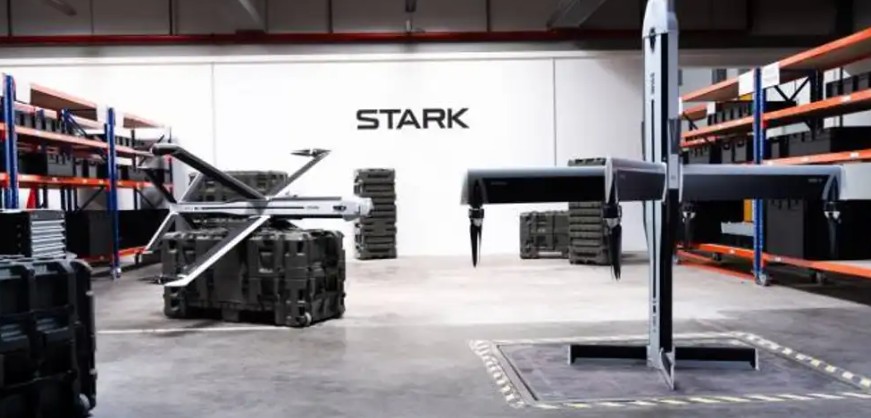
At the center of the collaboration is the integration of STARK’s loitering munition platforms with Six Robotics’ SwarmCore autonomy software, creating a new operational capability built around recce-strike missions.
Recce-strike—short for reconnaissance and strike—has become one of the defining tactical concepts of modern warfare. It combines intelligence gathered by ISR drones with the immediate deployment of precision strike systems such as loitering munitions.
Experience from the war in Ukraine has demonstrated that the speed at which sensor data can be converted into strike action often determines battlefield advantage.
The new STARK–Six Robotics partnership is designed to shorten that cycle dramatically.
Closing the Sensor-to-Shooter Gap
In traditional military operations, intelligence collection, target analysis and strike execution often involve multiple systems and command layers.
That process can take hours.
In modern drone warfare, it needs to happen in minutes.
By integrating STARK’s loitering munition systems with the SwarmCore autonomy platform developed by Six Robotics, operators can conduct fully coordinated missions that include:
- reconnaissance
- target identification
- strike execution
- battle damage assessment
All within a unified software environment.
This dramatically shortens what military planners call the sensor-to-shooter loop.
The systems are designed to operate in electronic warfare (EW) contested environments, where communications may be degraded or jammed.
Autonomous coordination between drones becomes essential in such conditions.
From ISR to Strike in Minutes
The integration enables a battlefield architecture where ISR drones identify targets and automatically feed that information into strike systems.
Loitering munitions can then be deployed rapidly to engage targets with minimal delay.
Once the strike occurs, drones can immediately perform battle damage assessment and relay the results back to command systems.
This loop—reconnaissance, targeting, strike and confirmation—can now be executed in a matter of minutes rather than hours.
The companies report that the first phase of the integration has already been successfully demonstrated in trials.
While details of the systems remain limited for security reasons, the results indicate that the two platforms can operate together seamlessly.
Building a European Defence Ecosystem
The partnership also reflects a broader shift in Europe’s defence industry.
Rather than building closed systems tied to a single manufacturer, modern defence architectures are increasingly open and software-defined.
This approach allows different systems, suppliers and nations to integrate their technologies within shared operational frameworks.
For NATO forces, interoperability is critical.
By integrating STARK’s strike platforms with Six Robotics’ autonomy software, the partnership demonstrates how multi-national unmanned systems can operate as a unified capability.
Christian Fredrik Eggesbø, Founder and CEO of Six Robotics, emphasized that the future battlefield will be defined by software interoperability.
“The decisive advantage lies in autonomous systems from different nations and suppliers operating as one coherent force,” he said.
A Nordic-German Defence Axis
The collaboration also marks STARK’s first Nordic capability partnership, following the company’s recent expansion into Sweden.
For Six Robotics, the agreement expands its ecosystem of partners and brings its autonomy software into a broader European operational context.
The partnership also aligns with the Hansa Arrangement, a bilateral defence cooperation framework between Norway and Germany announced during the Munich Security Conference.
The agreement highlights how European nations are strengthening industrial collaboration to develop next-generation defence technologies.
Johannes Arlt, Managing Director Nordics at STARK, described the partnership as a convergence of innovation across the continent.
“By integrating our systems, we are building a sovereign, interoperable European solution contributing to a credible northern European industrial deterrence,” he said.
The Future of Autonomous Warfare
As unmanned systems continue to reshape modern conflict, speed and coordination will become decisive advantages.
The integration of STARK’s loitering munition platforms with Six Robotics’ SwarmCore autonomy software illustrates how Europe’s defence technology sector is adapting to that reality.
Instead of isolated platforms performing single missions, the future battlefield will likely be dominated by networks of autonomous systems operating as coordinated teams.
And partnerships like the one between STARK and Six Robotics suggest that Europe intends to play a leading role in building that future.
.jpg)
%20(1)%20(1).png)