Rheinmetall’s New Frigate Is More Than a Warship. It’s a Bet Against the Future of Naval Procurement
For decades, naval strategy followed a simple formula:
Build bigger ships.
Add more systems.
Increase capability.
Accept longer timelines.
Accept higher costs.
Accept growing complexity.
Today, that formula is under pressure.
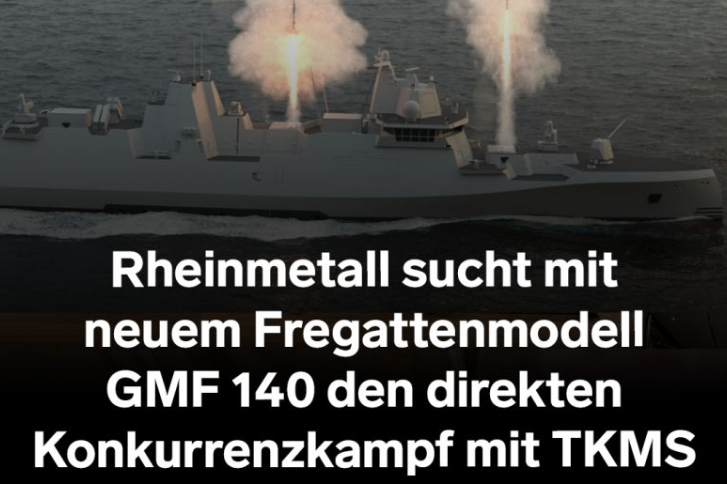
And Rheinmetall's newly unveiled GMF140 frigate may be one of the clearest signals yet that the defense industry is preparing for a different future.
At first glance, the vessel appears conventional. At 140 meters in length and more than 6,000 tons displacement, it sits firmly within the modern frigate category. Rheinmetall says the platform was designed to meet evolving NATO requirements and is intended for international markets, with North America becoming an early target.
But the real story is not the ship itself.
The real story is what the ship represents.
The End of the "Battleship Mentality"?
Western navies have spent years pursuing increasingly sophisticated surface combatants.
The result has often been predictable.
Long procurement cycles.
Rising costs.
Constant delays.
And ships that become political projects before they ever become operational assets.
Germany's planned F127 air-defense frigate perfectly illustrates the challenge.
At approximately 178 meters and around 12,000 tons, the vessel is expected to be among the most capable warships ever commissioned by the German Navy.
It is also expected to be expensive, technologically demanding, and dependent on years of procurement decisions that extend well beyond current political cycles.
The question many defense planners are starting to ask is simple:
What happens if the strategic environment changes faster than the acquisition process?
Ukraine Changed More Than Land Warfare
Ukraine exposed vulnerabilities across military planning.
Not just for tanks.
Not just for aircraft.
For naval procurement as well.
The conflict highlighted how quickly technology evolves and how rapidly inexpensive systems can challenge platforms costing hundreds of millions or even billions.
Drones, autonomous vessels, distributed sensors, and long-range precision weapons are forcing navies to reconsider decades-old assumptions.
Suddenly, flexibility matters.
Production speed matters.
Modularity matters.
Adaptation matters.
Warships may increasingly need to evolve during their service lives rather than remain frozen in requirements written a decade earlier.
That is precisely where the GMF140 appears to position itself.
A Frigate Built for Uncertainty
Rheinmetall is promoting the GMF140 as a platform that can be built faster and configured more flexibly than many larger next-generation combatants.
That may sound like a technical detail.
It is actually a strategic argument.
Modern procurement programs often attempt to predict military requirements 20 or 30 years into the future.
History suggests that prediction rarely works.
The next major crisis may not look like the last one.
The next technological disruption may arrive unexpectedly.
The next budget cycle may eliminate previously accepted assumptions.
A smaller, modular frigate provides decision-makers with options.
And options are increasingly valuable.
The Shadow of the F126 and F127
Rheinmetall's naval ambitions have not always followed a smooth trajectory.
The company faced difficult questions after missing the anticipated prime contractor role in Germany's F126 frigate program.
For some observers, the rationale behind Rheinmetall's deeper move into naval systems appeared uncertain.
That picture has changed.
The ongoing modernization of the German Navy's F123 frigate Bayern demonstrates that the company is establishing a growing role within naval sustainment and modernization programs.
The GMF140 goes a step further.
It signals an ambition to shape future fleets rather than merely support existing ones.
The NATO Question Nobody Wants to Ask
The most provocative question surrounding the GMF140 is not technical.
It is political.
Will NATO members continue buying fewer, increasingly complex ships?
Or will they prioritize larger numbers of adaptable platforms that can be produced, upgraded, and fielded faster?
The answer matters.
A fleet of exquisite warships may offer extraordinary capability.
But capability unavailable in sufficient numbers can become a strategic weakness.
Quantity does not replace quality.
But quantity remains a capability of its own.
More Than a Ship
The GMF140 is not simply another frigate entering an already crowded market.
It is a challenge to conventional procurement thinking.
A challenge to the belief that larger automatically means better.
A challenge to acquisition models that require decades to deliver operational capability.
Most importantly, it reflects a growing reality across modern defense planning:
The future may belong less to the biggest platform and more to the platform that can adapt fastest.
If that proves true, Rheinmetall may not just be launching a new frigate.
It may be launching a new argument about what naval power should look like in the twenty-first century.