Oleshky’s Ceasefire Is Saving Lives — But Moscow May Also Be Winning the Narrative War
The ceasefire in Russian-occupied Oleshky is, first of all, a humanitarian event. Food, medicine, clean water and evacuation routes matter more than political messaging when civilians have been trapped in a devastated city.
But the politics around the ceasefire are impossible to ignore.
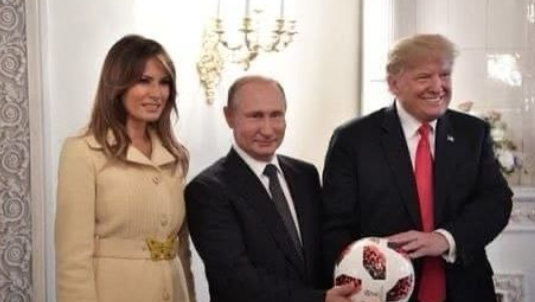
According to Marc Beckman, senior adviser to U.S. First Lady Melania Trump, Russian President Vladimir Putin “wanted very much” for her to participate in brokering the Oleshky ceasefire. Beckman also said Putin sent a formal letter recognizing her as Russia’s “exclusive intermediary.” The letter itself has not been made public, so its exact wording cannot be independently verified.
What is confirmed is that Melania Trump played a mediating role in the localized ceasefire and that both the Ukrainian and Russian sides accepted her involvement. The White House presented the agreement as a humanitarian breakthrough designed to bring aid into Oleshky and prepare the evacuation of civilians.
That alone makes the arrangement unusual.
Oleshky has been under Russian occupation since the early phase of the full-scale invasion. Humanitarian access has been severely restricted, and the city has been described as effectively blockaded, with residents facing serious shortages.
So when Moscow embraces a member of the U.S. president’s family as a preferred intermediary for a crisis unfolding in territory it occupies, questions about political calculation are inevitable.
Former British military attaché John Foreman has argued that Russia understands the political value of the arrangement very well. In his view, allowing Melania Trump to receive credit for the ceasefire strengthens the image of the Trump family as peacemakers before the U.S. midterm elections.
That is an interpretation, not a proven Kremlin strategy. But it points to a broader reality of modern war: humanitarian operations can also become information operations.
The media component adds another layer.
Newsmax has been given a role on the ground to document the humanitarian mission. Beckman described the outlet as a neutral American observer, while Newsmax itself said its cameras would receive exclusive access to the operation. Four American journalists are expected to document evacuations and residents’ decisions about where they wish to go.
Supporters may see that as transparency.
Critics may see it as a carefully controlled media environment.
Ukraine has already warned that Russia could use the evacuation for propaganda, including by presenting itself as rescuing civilians from a humanitarian crisis created under occupation. Ukrainian officials have also expressed concern that Moscow may try to shape where evacuees are sent and how the operation is portrayed.
At the same time, the ceasefire is producing something very real: a temporary reduction in violence and a chance for civilians to leave. Reports from the region indicate that the truce has allowed humanitarian work, evacuations and mine clearance to proceed.
That creates an uncomfortable contradiction.
A humanitarian agreement can be genuinely useful and politically useful at the same time.
Melania Trump may deserve credit for helping open a channel that others failed to open. Russia may also see strategic value in giving her that credit. Both can be true.
The most important question, therefore, is not whether the ceasefire is “real.” It is.
The deeper question is who gets to define its meaning.
For civilians in Oleshky, the meaning is immediate: food, medicine, safe passage and survival.
For Washington, Moscow and Kyiv, the battle over the story may last much longer.