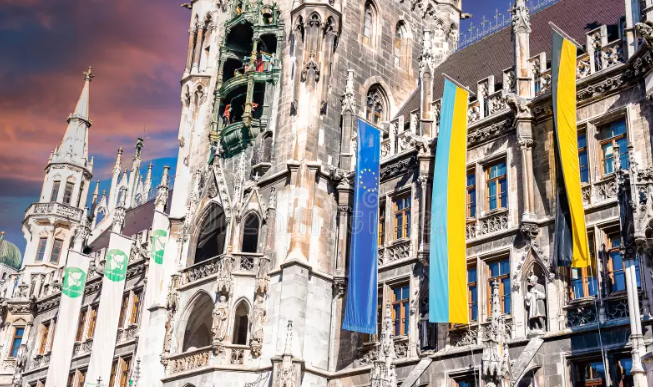
Moscow declares Munich to be "Ukrainian hinterland"
War usually advances with troops, missiles, and maps. This week, Russia chose a different instrument: a spreadsheet.
The Russian Ministry of Defense has published a list of European companies allegedly linked to Ukraine’s drone production—complete with addresses. It framed these facilities as part of Ukraine’s “strategic rear,” language that, in military doctrine, transforms geography into legitimacy for attack. Former Russian president Dmitry Medvedev made the implication explicit: the list should be read as a catalogue of potential targets. [rferl.org]
This is not just another information operation. It is a deliberate act of intimidation—and a test of Europe’s nerve.
The named companies span Germany, the UK, Denmark, Poland, Italy, Spain, the Baltics, Turkey, Israel, and the Netherlands. The message is not subtle: support Ukraine’s defense, and your factories, offices, and industrial parks could be dragged into the war.
By publishing addresses, Moscow crossed a qualitative threshold. Governments threaten each other all the time. Naming civilian-linked facilities inside third countries is different. It collapses the distinction between battlefield and hinterland, between front line and factory floor.
Russia insists it is merely “informing” European publics about security risks created by their own leaders. But intimidation works precisely by outsourcing fear. The Kremlin does not need to strike Munich or Prague tomorrow. The threat alone forces companies to hire guards, governments to reassess risk, insurers to adjust premiums—and employees to wonder whether they have become collateral participants in a war.
The timing matters. Ukraine’s drone campaign has become one of the most cost-effective asymmetries of the war. Moscow knows this. By attacking the supply ecosystem—software, engines, components, joint ventures—it targets Ukraine indirectly while pressing Europe directly.
This is escalation without missiles.
Crucially, the Kremlin’s language mirrors its broader strategic narrative: Europe is no longer a supporter but a participant. By redefining industrial cooperation as military co-belligerence, Moscow attempts to rewrite the rules of neutrality, responsibility, and distance.
The danger is not only theoretical. Russia has repeatedly used deniable methods—cyber attacks, sabotage, arson plots, and proxy actors—when direct military action would be too costly. Publishing addresses lowers the barrier for such activity while maintaining plausible deniability.
For Europe, the dilemma is sharp. Backing down would reward nuclear blackmail and threats. Doubling down requires acknowledging that industrial policy is now security policy. If drone engines for Ukraine are strategic assets, then civilian infrastructure protection, counter‑intelligence, and resilience must expand accordingly.
What Moscow likely hopes for is fragmentation: companies quietly withdrawing, governments hesitating, public debate shifting from “how to help Ukraine win” to “how to avoid becoming a target.” Fear, not firepower, is the weapon of choice.
Yet the gambit may also expose Russia’s weakness. States confident of victory do not threaten model‑engine factories and software startups. They do not warn European publics that war is coming unless they already sense that time, innovation, and industrial depth are working against them.
By publishing a list, Russia has admitted something fundamental: Ukraine’s defense today is not produced only in trenches, but in workshops, code repositories, and supply chains stretching deep into Europe.
The war, in other words, has already arrived at Europe’s industrial doorstep. The only open question is whether Europe chooses to acknowledge that—and act accordingly.

.png)