Industrial Learning Velocity: The New Arms Race Is Not About Who Has the Best Weapons / by Diego Bavio

For most of the modern era, military power was relatively easy to understand.
Count the tanks. Count the aircraft. Measure the factories. Examine the technology. Look at the defence budget.
The country possessing more advanced weapons, deeper industrial capacity and greater resources usually started with an obvious advantage.
But what if the most important variable is becoming speed?
Not missile speed.
Not aircraft speed.
Learning speed.
That is the provocative argument at the heart of defence analyst Diego Bavio's concept of Industrial Learning Velocity, or ILV.
His thesis is deceptively simple: in an era of drones, artificial intelligence, electronic warfare and rapidly changing battlefields, possessing superior technology is no longer enough.
What increasingly matters is how quickly a country can absorb knowledge, modify technology, reorganize production and manufacture the improved capability at scale.
In other words, military competition is becoming a race between learning systems.
And Ukraine may be the laboratory showing us what that future looks like.
From globalization to strategic competition
There is historical irony here.
After the Cold War, much of the West reorganized industry around efficiency.
Production moved across borders. Inventories shrank. Supply chains became global. Just-in-time manufacturing reduced costs. European armed forces became smaller and increasingly professional.
Meanwhile, globalization gave emerging economies access to technology, investment, production knowledge and international markets.
China used those opportunities to build enormous manufacturing ecosystems while steadily climbing into increasingly sophisticated technological sectors.
India followed another route, exploiting engineering talent, information technology, science and international cooperation while expanding domestic industrial ambitions.
The remarkable result is that the economic system associated with the West's Cold War victory simultaneously helped diffuse the knowledge necessary for new competitors to emerge.
Access, however, was only the beginning.
As Bavio argues, the crucial question became who could absorb what they accessed.
Ukraine changed the equation
Then came Ukraine.
The war brutally exposed a weakness beneath decades of Western technological superiority.
Military systems can be exceptionally sophisticated and still become strategically constrained if there are too few missiles, shells, spare parts or production lines to replace what combat consumes.
Europe rediscovered an old truth:
You cannot fire industrial capacity that does not exist.
But Ukraine revealed something newer as well.
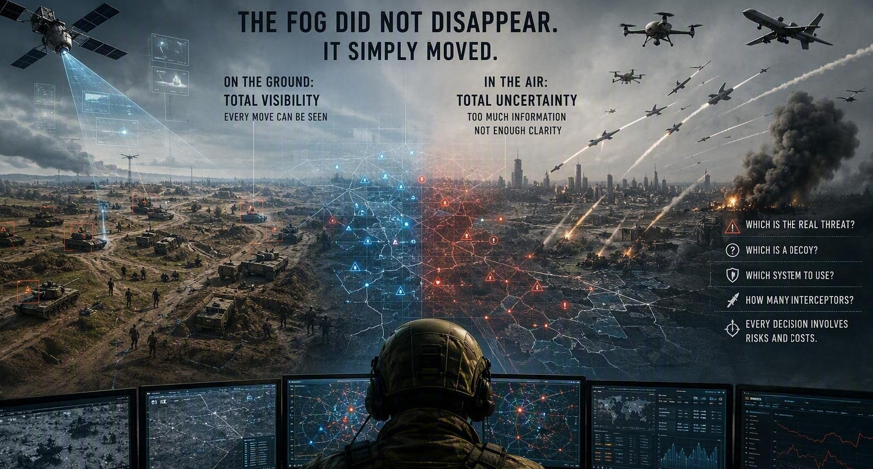
The battlefield itself has become an accelerated development environment.
A drone works.
Electronic warfare defeats it.
Its navigation changes.
The defender adapts again.
Software is modified. Frequencies change. Antennas move. New sensors appear. Production incorporates the modification.
Then the cycle begins again.
This is where Bavio separates Military Learning Velocity from Industrial Learning Velocity.
Military Learning Velocity describes how quickly a force observes what is happening, understands it and changes how it fights.
Industrial Learning Velocity asks what happens next.
Can industry turn that lesson into hardware and software quickly enough to matter?
Russia's Geran experiment
Russia's Geran drone family provides a revealing example.
What began with the acquisition of Iranian Shahed technology evolved into increasingly localized Russian production and continued modification.
The key lesson isn't whether every modification was technologically revolutionary.
Many were not.
It is that the platform did not remain frozen.
Combat generated information. Ukrainian defences created problems. Navigation, communications, components, payloads and production methods could then be modified in response.
That creates a feedback loop:
Deploy. Observe. Adapt. Manufacture. Deploy again.
A relatively inexpensive system backed by a fast learning cycle can therefore become strategically more important than its technical specifications initially suggest.
The weapon is no longer just the drone.
The learning system behind the drone becomes part of the weapon.
Europe's million-shell problem
Rheinmetall illustrates the other side of Bavio's argument.
Europe suddenly needed artillery ammunition at a scale its post-Cold War industrial base was not designed to deliver.
Rheinmetall's expansion plans demonstrate that industrial capacity can be rebuilt. But factories do not materialize because demand suddenly exists.
New facilities require machinery, explosives, suppliers, qualified workers, contracts, capital and time.
And here lies the paradox.
By the time an industrial system has massively expanded production of what today's war demands, tomorrow's war may demand something different.
Ukraine's battlefield has already shifted toward extraordinary quantities of UAVs, electronic warfare, precision effects and rapidly evolving countermeasures.
Industrial strategy therefore cannot simply mean producing more.
It must mean becoming capable of changing what is produced without losing scale.
Six ingredients of industrial speed
Bavio divides Industrial Learning Velocity into six connected capabilities:
Knowledge absorption: Can an industry understand external technology and operational experience?
Technological adaptation: Can it modify systems when requirements change?
Organizational learning: Does knowledge survive beyond individual engineers and temporary projects?
Production flexibility: Can factories and supply chains change without starting from zero?
Scalability: Can a successful prototype become thousands of reliable products?
Knowledge continuity: Can accumulated expertise survive personnel changes, supplier losses and periods of low demand?
Together, these produce something traditional measurements of industrial power often miss.
Two countries might own similar technologies and possess comparable financial resources while having radically different abilities to turn a battlefield lesson into mass-produced capability.
The difference is time.
Industrial geography is changing
This also has implications for who can compete.
The twentieth-century defence industry rewarded enormous industrial incumbents capable of developing fighters, submarines, missiles and armoured vehicles through programmes lasting decades.
Software, AI and unmanned systems lower some of those barriers.
A small company's technology can become operationally important surprisingly quickly.
Ukraine itself has demonstrated that relevance can emerge from engineers, startups and relatively small production networks, not simply national industrial champions.
That does not mean traditional defence primes become obsolete.
Building a combat aircraft, missile-defence system or nuclear submarine still requires extraordinary capital, integration experience and industrial depth.
But another layer of competition has emerged alongside them.
And it operates much faster.
The real arms race
This leads to Bavio's most consequential argument.
Military advantage has always been temporary.
What is changing is the speed at which temporary advantage expires.
A new drone may dominate until electronic warfare catches it.
A new communications system matters until it is jammed.
A production advantage lasts until an opponent scales an alternative.
The strategic winner may therefore not be the actor producing the world's most sophisticated first version.
It may be the actor capable of reaching versions two, three, four and five before its opponent completes version two.
That changes how we should think about industrial power.
Factories still matter.
Capital matters.
Engineers matter.
Supply chains matter.
Technology matters.
But increasingly, their strategic value depends on how rapidly they can be reorganized around new information.
The twentieth-century arms race asked:
Who can build the most powerful weapons?
The twenty-first century adds another question:
Who can learn faster than the enemy?
Because knowledge creates an opportunity.
Production converts it into material power.
Scale turns it into strategic effect.
And speed determines whether the opportunity still exists when the weapon finally reaches the battlefield.
The next great military advantage may therefore be neither a drone, missile nor artificial-intelligence model.
It may be the industrial system capable of changing all three before its adversary can catch up.