How to identify spies and saboteurs with AI at Ostsee/Baltic Sea

The Baltic Sea has quietly turned into one of Europe’s most exposed security zones. Data cables lie on the seabed. Energy infrastructure stretches across open water. Commercial shipping, naval forces, and research vessels share increasingly crowded routes. And in this dense environment, the line between accident and sabotage is becoming harder to draw.
Now, artificial intelligence is being tested as a new line of defence.
In the Kiel Fjord, researchers from the Fraunhofer Center for Maritime Logistics and Services (CML) are trialling a mobile AI‑based system designed to detect suspicious ship movements and aerial activity in real time. The system, called KIRMES, aims to strengthen the protection of critical maritime infrastructure by identifying anomalies before damage occurs.
The backdrop is a changing threat landscape. Manipulated GPS signals, deactivated tracking systems, damaged seabed cables and drone surveillance over ports and shipyards have all been documented in the Baltic region. In several cases, authorities were able to intercept vessels—but proving intent has often remained elusive.
KIRMES is designed to close that gap.
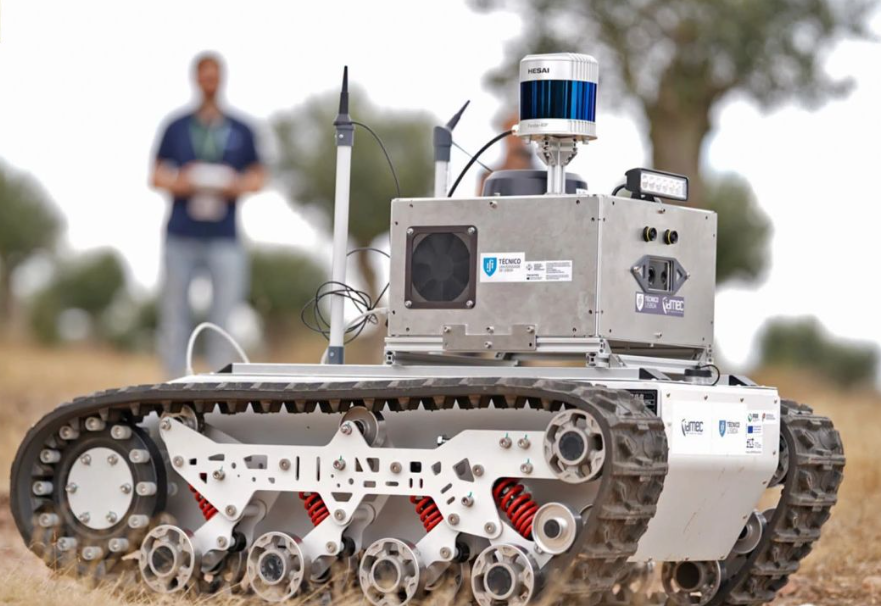
The system integrates multiple mobile sensor platforms—so‑called “Cells on Wheels”—equipped with antennas and sensors that collect a wide range of data. These include GPS signals, radio communications, the Automatic Identification System (AIS) used by ships, and ADS‑B data transmitted by aircraft and drones. A research vessel, equipped with the same sensor suite, extends surveillance into offshore areas beyond the coast.
What sets KIRMES apart is not the sensors themselves, but how their data is processed. Instead of analysing individual signals in isolation, the system fuses multiple data streams into a single, real‑time situational picture. Artificial intelligence algorithms continuously scan this picture for anomalies—patterns of behaviour that may indicate spoofing, manipulation, or coordinated hybrid activity.
According to Fraunhofer CML, this approach allows suspicious events to be identified earlier and correlated more precisely than with conventional monitoring systems. Unusual ship routes, disabled tracking signals, irregular radio traffic, or drone activity near sensitive sites can be flagged automatically and passed on to relevant authorities. [cml.fraunhofer.de]
The Kiel Fjord was chosen as a test environment for practical reasons. The range of the sensors—between 15 and 30 nautical miles depending on conditions—matches the geography well, and the area’s heavy vessel traffic provides abundant data to train and validate the AI models. Test deployments are currently underway in Strande and Kiel‑Friedrichsort, with the trial phase expected to run through the end of the year. [cml.fraunhofer.de]
Mobility is a central feature of the system. Because the sensor units are mounted on trailers and vessels rather than fixed installations, they can be deployed quickly without lengthy approval procedures. This makes the system suitable for temporary operations, emerging threat situations, or the protection of infrastructure such as ports, offshore wind farms, or undersea cables.
The developers see this flexibility as a decisive advantage. Traditional maritime surveillance systems are often stationary, expensive, and slow to adapt. KIRMES is designed to move where the risk moves.
The project reflects a broader strategic shift. Maritime security is no longer limited to patrol vessels and radar stations. It now includes data fusion, cyber‑physical analysis, and the ability to interpret complex behaviour patterns across domains—sea, air, and digital networks.
Importantly, KIRMES is not a weapons system. It does not intercept or disable. Its purpose is situational awareness: providing authorities such as police, coast guards, or the armed forces with a clearer, faster picture of what is happening in contested maritime spaces.
As hybrid threats blur the boundaries between civilian shipping, espionage, and military operations, that clarity may prove critical.
The Baltic Sea, once a peripheral theatre, has become a frontline for infrastructure security. With KIRMES, Germany is testing whether artificial intelligence can help defend it—not by replacing human judgment, but by giving it better eyes.
.jpg)