Drone Dreams Hit a Data Wall due Part 108 FAA - Why the U.S. BVLOS Revolution Risks Stalling Before Takeoff
For years, the commercial drone industry in the United States has been flying a quiet workaround.
Beyond Visual Line of Sight (BVLOS) operations—long seen as the holy grail of drone scalability—have technically been possible. Companies inspected pipelines, monitored crops, and surveyed infrastructure miles away from operators. The catch? Every single mission required a waiver.
It worked. Until it didn’t.
Now, with the Federal Aviation Administration preparing to roll out its long-anticipated Part 108 framework, that entire operating model is about to collapse. And not because the technology failed.
Because the data did.
Part 108 represents something fundamentally different from the waiver era. Instead of granting one-off approvals, the FAA is building a system that expects operators to prove something far more difficult: that they can manage risk consistently, at scale, across time.
Not just fly safely once—but operate safely always.
And that’s where the industry’s biggest blind spot is being exposed.
The waiver system, by design, never forced companies to build a unified operational backbone. Each application was its own self-contained universe: risk assessment here, crew records there, flight logs somewhere else. Documentation was reactive, assembled under pressure, and filed away after approval.
There was no need to connect the dots.
Part 108 will demand exactly that.
Under the proposed framework, operators will need to present an auditable, coherent operational picture—one where risk methodologies are standardized, crew competencies are continuously tracked, maintenance histories are transparent, and every flight contributes to a growing body of evidence.
In other words: data is no longer paperwork. It is the product.
For operators accustomed to navigating bureaucracy through expertise and experience, this is a seismic shift. Institutional knowledge—the unwritten know-how of “how we get waivers approved”—suddenly matters less than structured, systematized records.
And many are not ready.
This isn’t just a compliance issue. It’s a competitive one.
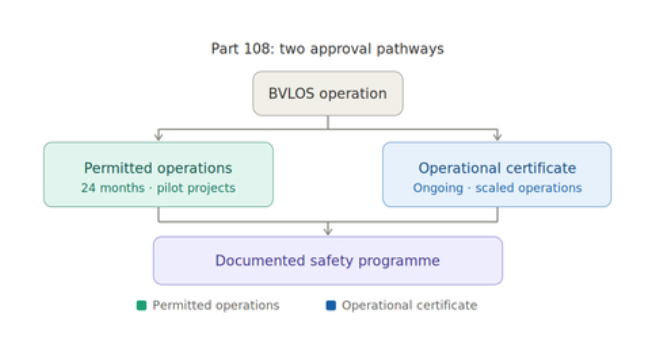
Part 108 introduces a two-tier model: entry-level permissions for controlled operations, and higher-level operational certificates for those who want to scale. The latter is where the real commercial opportunity lies—persistent BVLOS operations across industries like logistics, energy, agriculture and emergency response.
But access to that opportunity will hinge on operational maturity.
Can you prove, consistently, how you assess risk?
Can you demonstrate that your crew is trained and current?
Can you show complete, structured flight logs and maintenance records?
For a large part of the industry, the honest answer today is: not yet.
The danger is not that companies won’t eventually meet these requirements. It’s that they will try to build this infrastructure too late—when the rule is finalized, applications open, and competition accelerates.
Because building operational discipline is not instant.
Standardizing processes, aligning data, cleaning historical records, integrating workflows—this is months of work, not weeks. For organizations that grew organically under the waiver system, it may require rethinking operations from the ground up.
What complicates matters further is the uncertainty. The FAA has reopened discussions on key issues like right-of-way rules and electronic visibility, pushing the final timeline further out.
For some operators, that sounds like breathing room.
In reality, it’s a trap.
The direction of travel is not in question. Waivers are going away. Systematic oversight is coming. The only thing uncertain is how unforgiving the transition will be for those unprepared.
And here’s the deeper shift the industry is struggling to absorb:
This is no longer an aviation problem. It’s a data problem.
Operators who succeed under Part 108 won’t just be good pilots. They’ll be disciplined operators of complex systems—where every decision, every flight, every outcome feeds into a structured framework that regulators can trust.
The tools to enable this already exist, particularly in software platforms that embed compliance directly into operations. But adoption remains uneven, often seen as overhead rather than strategic infrastructure.
That mindset is about to be tested.
Because when BVLOS finally scales—and it will—the winners won’t be the ones who flew the most missions under waivers.
They will be the ones who built the most credible systems.
And those systems start with something deceptively simple:
Getting the data right.


.png)