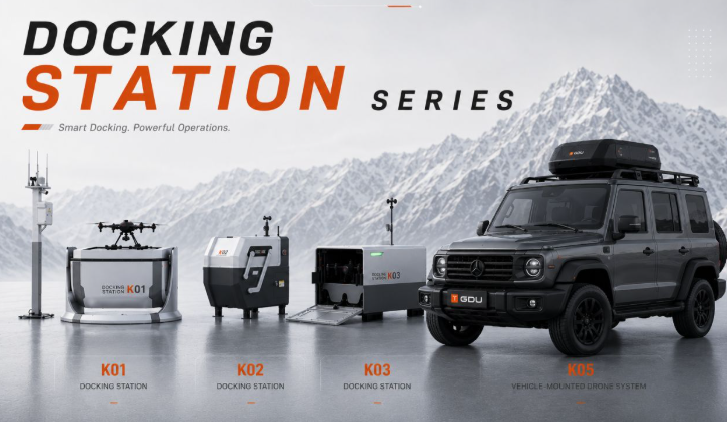
GDU Tech. Why the Future of Industry Doesn't Wear Hard Hats. It Flies.
For decades, industrial productivity followed a familiar formula.
Hire more people.
Buy bigger machines.
Build larger facilities.
Today, a new workforce is emerging.
It doesn't need roads, ladders, scaffolding, or helicopters.
It flies.
What was once considered futuristic technology has rapidly become an operational necessity across industries ranging from energy and utilities to public safety and emergency management. The latest generation of enterprise drones is no longer about capturing impressive aerial footage. It is about delivering critical data, reducing costs, improving safety, and helping organizations make decisions faster than ever before.
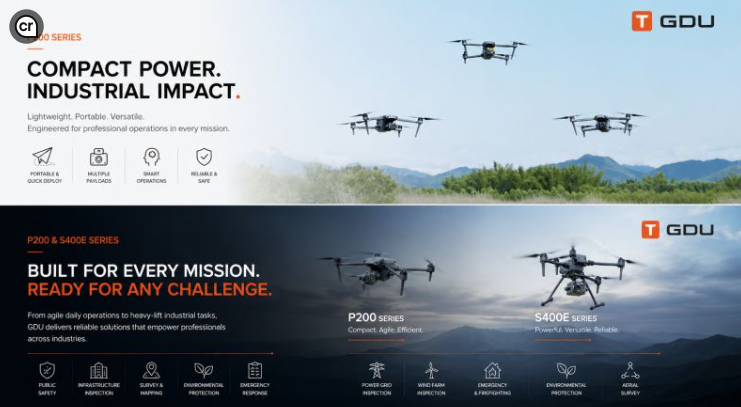
The newest examples of this evolution can be seen in GDU's P200 Series and S400E Series, two platforms designed for very different operational realities but united by the same goal: making aerial intelligence a core business capability rather than a specialized service.
The real story, however, is bigger than the drones themselves.
It is about how work is changing.
The Death of Slow Inspections
Consider a traditional infrastructure inspection.
A power transmission line stretches across rugged terrain.
A wind turbine rises hundreds of feet into the air.
A bridge requires visual examination of difficult-to-access structures.
Historically, these tasks demanded teams of specialists, expensive equipment, extensive planning, and significant safety risks.
Today, many of those inspections can be conducted from the air within minutes.
The economic impact is substantial.
The operational impact is even greater.
Industries no longer want annual snapshots of their assets.
They want continuous visibility.
Drones have become the fastest path to achieving that goal.
Small, Fast, Everywhere
The GDU P200 Series represents the growing demand for agile aerial platforms that can deploy quickly and perform multiple functions without requiring large operational footprints.
Public safety teams use compact drones for situational awareness.
Surveyors employ them for mapping and data collection.
Emergency responders leverage aerial perspectives to assess incidents before personnel enter hazardous zones.
In these environments, speed matters more than size.
Success depends on getting airborne quickly and providing actionable information immediately.
The drone is no longer the product.
The information is.
And organizations increasingly judge aerial systems by how fast they can deliver decisions rather than how long they can stay in the air.
When Bigger Missions Demand Bigger Tools
Yet agility alone is not enough.
Industrial operators face challenges that require greater endurance, payload flexibility, and operational reliability.
This is where platforms such as the GDU S400E Series enter the picture.
Large-scale infrastructure monitoring, power-grid inspections, wind farm maintenance, firefighting operations, and industrial surveying create demands that exceed the capabilities of smaller systems.
These missions require more sensors.
More power.
More resilience.
More connectivity.
The transformation occurring across industrial drone technology mirrors what happened decades ago in computing.
A single device cannot solve every problem.
Organizations increasingly deploy fleets optimized for different operational requirements.
The result is a layered aerial ecosystem rather than a one-size-fits-all solution.
The Rise of the Autonomous Workforce
The most provocative aspect of the drone revolution is not the aircraft.
It is the workforce transformation they are accelerating.
When drones inspect substations, monitor pipelines, map construction sites, survey disaster zones, or assess fire conditions, they are performing tasks traditionally carried out by humans.
That does not eliminate people.
It changes their role.
Workers become analysts instead of inspectors.
Decision-makers instead of observers.
Operators of intelligence rather than collectors of information.
This shift is particularly important at a time when many industries face labor shortages, aging workforces, and increasing operational complexity.
The ability to multiply human capability through autonomous systems may become one of the defining competitive advantages of the next decade.
The Sky Becomes Infrastructure
The most successful companies no longer view drones as experimental technologies.
They view them as infrastructure.
Just as organizations once adopted computers, mobile devices, cloud platforms, and artificial intelligence, drones are becoming another layer of operational capability.
Utilities use them to maintain essential services.
Emergency responders use them to save lives.
Engineers use them to optimize maintenance.
Surveyors use them to build digital twins of the physical world.
The question is no longer whether drones will become standard equipment.
The question is how quickly organizations can integrate them into everyday operations.
Because the future of industry is not waiting on the ground.
It is already airborne.
And the companies that learn to leverage that perspective will see farther, move faster, and operate smarter than those that don't.
.png)