From Sensor to Strike: How HENSOLDT’s Ceretron Could Turn 270 Scout Vehicles into Germany’s First AI-Powered Reconnaissance Network
For decades, military reconnaissance followed a familiar formula: find the enemy, report the enemy, wait for a decision. In the age of artificial intelligence, that sequence may already be obsolete.
Germany's future reconnaissance vehicle, the LUCHS 2, is not merely designed to observe the battlefield. It is designed to understand it.
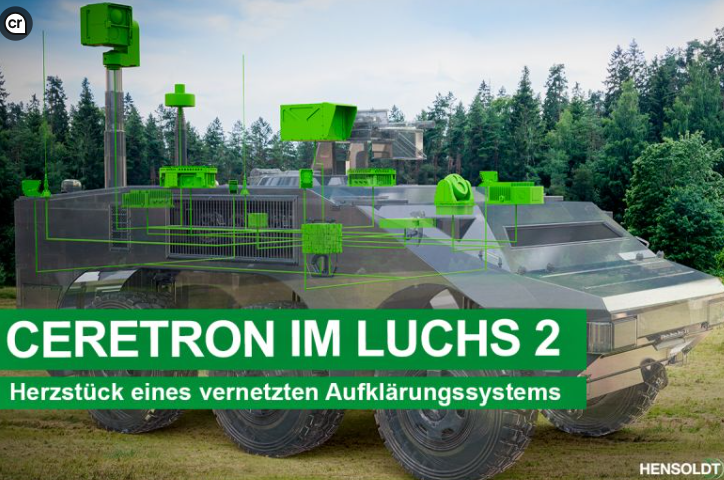
With the Bundeswehr set to receive more than 270 LUCHS 2 reconnaissance vehicles beginning in 2029, the spotlight is increasingly shifting away from armored steel and toward something far more decisive: software, sensors, and data fusion. At the center of that transformation stands HENSOLDT's Ceretron mission system.
The announcement marks another chapter in a profound change sweeping through military organizations worldwide. Modern warfare is generating more information than any human crew can process. Drones, cameras, radar systems, electronic intelligence sensors, satellite feeds, and battlefield networks constantly produce mountains of data.
The challenge is no longer collecting information.
The challenge is turning information into decisions before the enemy does.
That is precisely where Ceretron enters the picture.
HENSOLDT describes the AI-supported system as a platform capable of fusing sensor data from multiple sources in real time, delivering a coherent operational picture to vehicle crews. While that description sounds technical, its battlefield implications are potentially revolutionary.
In traditional reconnaissance operations, crews often receive fragmented information from separate systems. Visual observations, radar contacts, electronic emissions, and external intelligence sources may arrive independently, forcing operators to build the tactical picture manually.
Ceretron seeks to eliminate that fragmentation.
Instead of presenting disconnected signals, the system combines them into a unified view of the battlefield, helping crews detect, identify, prioritize, and understand threats faster. The objective is not simply to provide more information. The objective is to provide the right information at exactly the right moment.
The result is a significant shift in military thinking.
Historically, reconnaissance vehicles were platforms that gathered intelligence. Tomorrow's reconnaissance platforms may become decision-generation systems.
That distinction matters.
Modern combat increasingly moves at machine speed. Drone swarms can appear without warning. Electronic attacks can disrupt communications in seconds. Precision weapons can exploit delays measured in minutes. In such an environment, the side capable of accelerating its decision cycle gains a decisive advantage.
Military strategists often refer to this as winning the "decision race."
The importance of the LUCHS 2 program extends beyond the vehicle itself. More than 270 platforms equipped with the same mission architecture create something larger than a fleet. They create a network.
Each platform becomes a node within a broader reconnaissance ecosystem capable of sharing information, distributing awareness, and building a collective battlefield picture.
That evolution reflects HENSOLDT's broader ambition to position itself as a "Neo-Systemhaus," a new-generation defense systems integrator focused not only on sensors but on connecting sensors, software, artificial intelligence, and operational workflows into a single capability.
The timing is significant.
European armed forces are rapidly adapting to lessons from Ukraine, where information superiority has often proven as valuable as firepower. The ability to identify targets quickly, distribute intelligence efficiently, and respond faster than adversaries has become a defining feature of modern military effectiveness.
In that context, the future battlefield may reward not the vehicle with the biggest gun or the thickest armor, but the one with the fastest understanding of reality.
That is why Ceretron may ultimately represent more than a mission system.
It may represent a glimpse into the future of land warfare itself.
The LUCHS 2 program demonstrates how armed forces are increasingly investing not only in platforms but in cognitive advantage. Sensors collect. AI analyzes. Networks connect. Humans decide.
At least for now.
As autonomy, artificial intelligence, and battlefield networking continue to evolve, the line between sensing and decision-making will become increasingly blurred. The militaries that master that transition first may define the next generation of operational superiority.
For Germany, the LUCHS 2 is officially a reconnaissance vehicle.
In practice, it may become something far more important: a mobile intelligence network designed to compress minutes into seconds and information into action.
And in modern warfare, that difference can decide everything.