From Draken Convoys to Drone Swarms. The 1966 Photo That Predicted the Future of Air Warfare
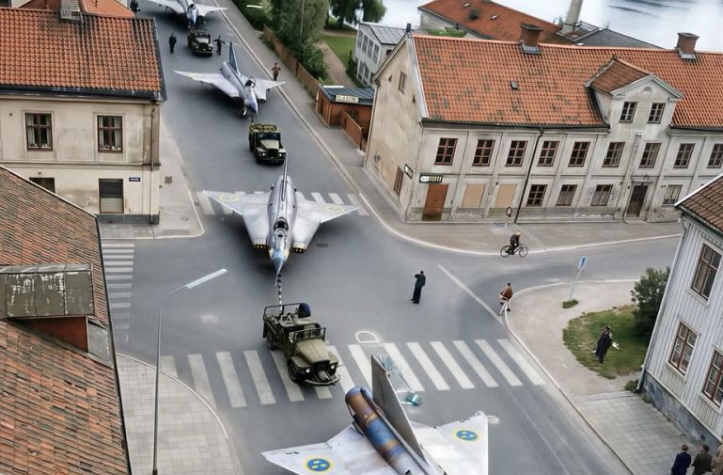
In 1966, residents of Linköping, Sweden, witnessed an extraordinary sight: a convoy of Saab 35 Draken fighter jets slowly moving through ordinary streets on their way from the SAAB factory in Malmslätt to Malmen Air Base.
It looked bizarre. Even absurd.
Supersonic fighters, symbols of cutting-edge military technology, crawling through civilian roads like oversized agricultural equipment.
Yet six decades later, that image feels less like a historical curiosity and more like a glimpse into the future.
Because what those Drakens represented was not speed. It was mobility.
And mobility is exactly what is redefining air power in the drone era.
The Original Swedish Lesson
During the Cold War, Sweden knew it could never match the military mass of larger powers. Instead, it developed a strategy based on resilience.
Aircraft would not depend exclusively on giant airbases.
They would disperse.
Roadways could become runways. Small operating sites could become launch points. Logistics would be decentralized. Enemy targeting would become more difficult.
The image of Drakens being transported through city streets was a physical manifestation of that philosophy: survival through dispersion.
Today, drone warfare is taking the same concept to an entirely different level.
Air Power Leaves the Airbase
Traditional fighter jets are magnificent machines.
They are also expensive, complex and increasingly vulnerable.
Modern precision missiles can cripple major airbases within minutes. Satellites can track fixed infrastructure. Long-range strike systems can reach targets once considered safe.
Drones are changing the equation.
Many systems no longer require long runways, massive support crews or billion-dollar facilities. They can launch from improvised sites, trucks, fields, ships and even urban environments.
In other words, air power is becoming mobile again.
The Draken convoy was moving aircraft to the runway.
Modern drones bring the runway to the aircraft.
The Logistics Revolution Nobody Talks About
Military discussions often focus on speed, range and payload.
But wars are frequently decided by logistics.
The famous photograph from Linköping highlights a reality that remains true today: how you move military assets may matter as much as what those assets can do.
A fighter jet needs extensive maintenance, fuel infrastructure and specialized personnel.
A drone swarm may require nothing more than transport vehicles, batteries and network connectivity.
This dramatically changes the economics of warfare.
When systems become cheaper and more portable, military planners gain flexibility. They can spread risk, complicate enemy targeting and rapidly regenerate combat power after losses.
The battlefield becomes less concentrated and more unpredictable.
Swarms Are the New Squadrons
The Draken represented the peak of Cold War fighter design.
One aircraft. One pilot. One mission.
Today's drone revolution flips that model.
Military organizations increasingly think in terms of dozens, hundreds or thousands of autonomous and semi-autonomous systems working together.
A drone swarm does not behave like a squadron of fighters.
It behaves like a network.
Lose one drone and the mission continues.
Lose ten and the system adapts.
The emphasis shifts from protecting individual platforms to maximizing collective effectiveness.
What Sweden once achieved through dispersed aircraft operations, future forces may accomplish through digitally coordinated drone ecosystems.
A Photograph From the Past, A Warning From the Future
The convoy rolling through Linköping in 1966 captures an uncomfortable truth.
Technology changes.
Principles endure.
The same strategic logic that encouraged Sweden to move fighter jets through public roads is driving modern investment in drones, autonomous systems and distributed operations.
The future of air warfare may not belong to the fastest aircraft or the most expensive platforms.
It may belong to the force that can move, adapt and reappear faster than its opponent can track.
That is why the old photograph matters.
Not because it shows where aviation has been.
But because it reveals where it is going.
The Drakens were being towed through Swedish streets.
The drones of tomorrow may emerge from almost anywhere.
And that changes everything.